July 2nd – In Darlaston, a gentle precipitation; sweet-smelling, light, and coating all it touches. It’s pukh.

Pukh is a downy fluff produced by female poplar trees, not unlike the blossom fluff produced by sallows; I noticed today the Owen Street in Darlaston was coated with fuff. I’ve seen it before – Pitsford Street in the Jewellery Quarter used to be swept with clouds of the stuff in a good year, but rarely as uniform and snow-like as this.

It’ll be interesting to see if the rains washed it away.

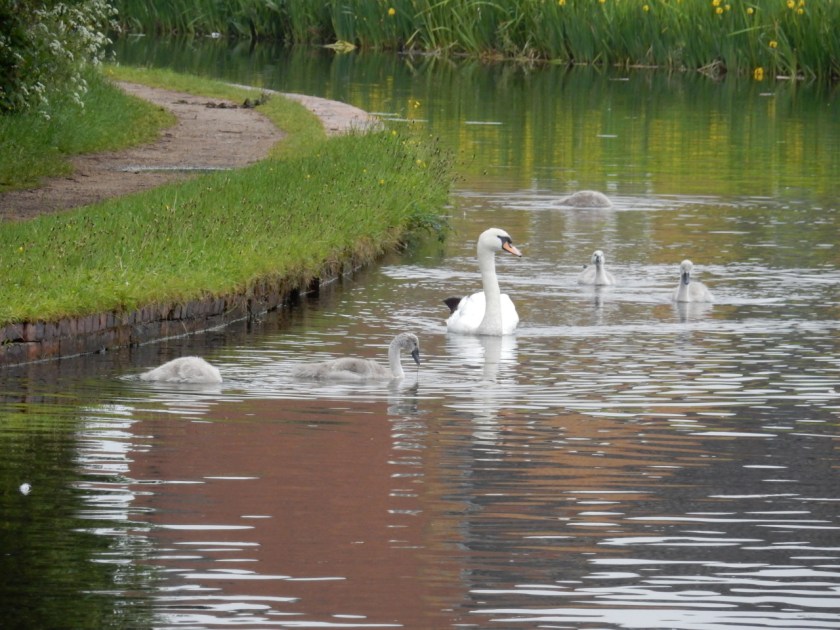
June 13th – So, the Watermead cygnets are down to five – this is definitely the family, spotted today near their nest. They started with seven and have lost two, which isn’t too bad – most likely to predators of some sort. The youngsters are growing well and seemed happy and healthy (as far as I could tell, anyway).

It’s so good to watch the local wildlife mature like this. You almost develop an attachment to the birds as they get older.

May 28th – At Clayhanger, the Mallard family that numbered four on Sunday is down to three; probably picked off by a heron or raptor (or perhaps even a fox), it’s sad to see but natural, I guess. Mum may go on to have another clutch this year, and this is the way of things I guess. But I do hope the missing one didn’t suffer too much.

Meanwhile, just near Clayhanger Bridge, a single Canada goose mum and one gosling. I think there must be a story there too; she looked like she was protecting her fluffy charge with grim determination.

Nature can be so brutal sometimes.

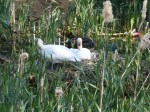
May 13th – The Walsall Canal swans at Pleck had hatchlings when I passed them midday; I was very pleased to count four, and I suspected she was hatching more. The cob patrolled on the open water, and the scene was tranquil.

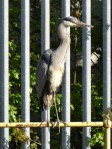
I returned the same way that evening on my way home, to find a drama unfolding. An elderly heron was perched on the rear rail, his beady eye making unfailing eye contact with the cob, who was perched on the nest with his mate. There was clearly deadlock – the heron obviously had spotted an opportunity, but the swans were having none of it.

In a couple of days when grown, they’ll be safe from the herons and other predators, but it’ll be a tense few days for mum and dad as they guard their precious charges.

Nature, red in tooth and claw.

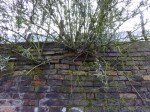
January 6th – I’d not noticed this before. On the canal near Darlaston, a high factory wall, and by some twist of nature, soot and the wind, a pair of buddleia plants, slowly and tenaciously taking the brickwork part by the action of gentle and sustained hydraulic pressure alone.

Although it’s destructive, I love to see this; nature reclaiming the constructed. It’s nice to see nature winning occasionally.

September 17th – Recently on Facebook there was some concern over a swan that was found dead in Pelsall. The bird had been decapitated, and many were accusing vandals. The truth is less controversial, but sadly a little more gory.

The swan was, in all probability, killed by a fox. Anyone who’s seen the aftermath of a fox in a henhouse will know that Reynard goes for the neck.

At this time of year, this year’s cubs are driven out of the den by their parents to seek their own territories – that’s why we often see foxes sleeping on roofs and in quiet but open spots in late summer. Quite frankly, these canines are homeless.

The young, inexperienced adolescents are forced to fend for themselves – that includes finding food – and many will attempt kills that are well above them. So it probably was with the Pelsall swan.

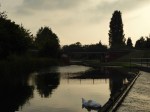
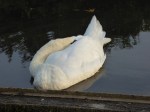
Swans are not bright birds. As I came home along the canal, I spotted this usually aggressive lone bird fast asleep, drifting on the water. It had floated into the bank around the overflow, at Clayhanger Bridge, and the thicket nearby is usually host to a den of Brer Fox.

It would be fairly trivial for the fox to sneak up to the bird unseen, and go straight for the neck, which is about the only bit the fox can attack without the risk of being ferociously pecked. The kill, to an experienced fox, would be fast and efficient and lead to food for a week or more.

The fox that attacked the Pelsall bird was probably scared off, or attacked by other swans roused by the commotion, leaving their kill behind.

I couldn’t knowingly leave this swan to a similar fate, so after taking a few pictures, I gently woke it by speaking. I was greeted by wing-flapping, honking and hissing, and the white bird swam away from me.

Job done.

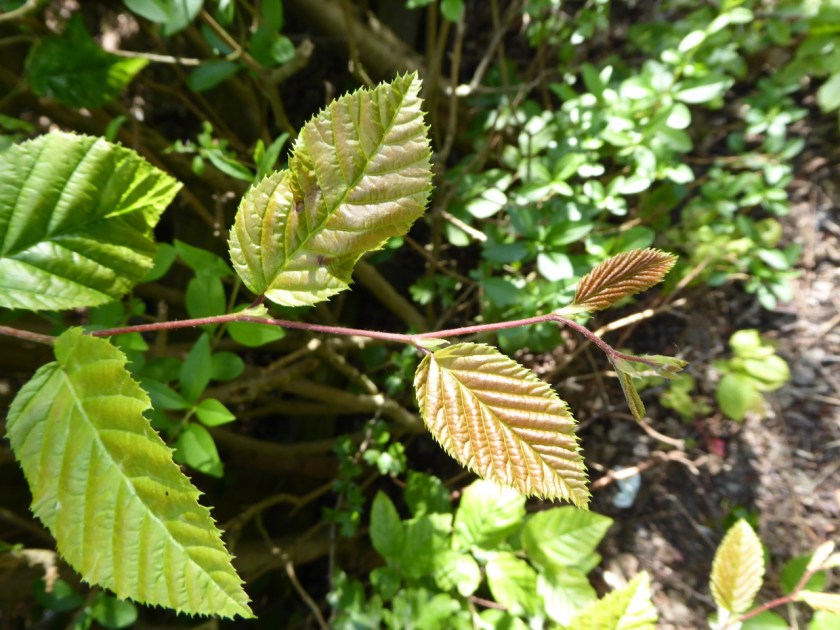
June 25th – One the way to work today in Telford, I passed, as I usually do, a tall beech hedge. My attention was snagged by the bright, crisp red-green new growth, and the intensely geometric nature of these gorgeous leaves.

Each leaf different, but similar. Macro, and fascinating. Never really studied them before, but these were remarkable.

Funny the things you sometimes see afresh by chance.

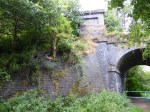
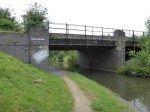
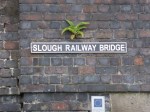
August 4th – 3 former rail bridges in Brownhills, from 3 separate railway lines, all three suffering with age and the destructive tenacity of nature. The lone arch at the top corner of Clayhanger Common is slowly being pushed apart by shrubs and weeds, and is in what must be the final stages of natural reclamation. The Slough bridge, over the canal near Coppice Side, now serves as a pedestrian and cycleway over the Wyrley and Essington for National Cycle Route 54, but the familiar blue Freakley bricks are being pried apart here too by gentle, instant hydraulic pressure.

The third bridge is arguably the most interesting. One of only two listed buildings in the town, it is considered of rare enough design to be worth preserving, although it too is suffering the ravages of lack of care. As if to compound the misery, It has recently had a new nameplate installed, which reads ‘Pelsall Old Railway Bridge’.

This isn’t Pelsall, you muppets.

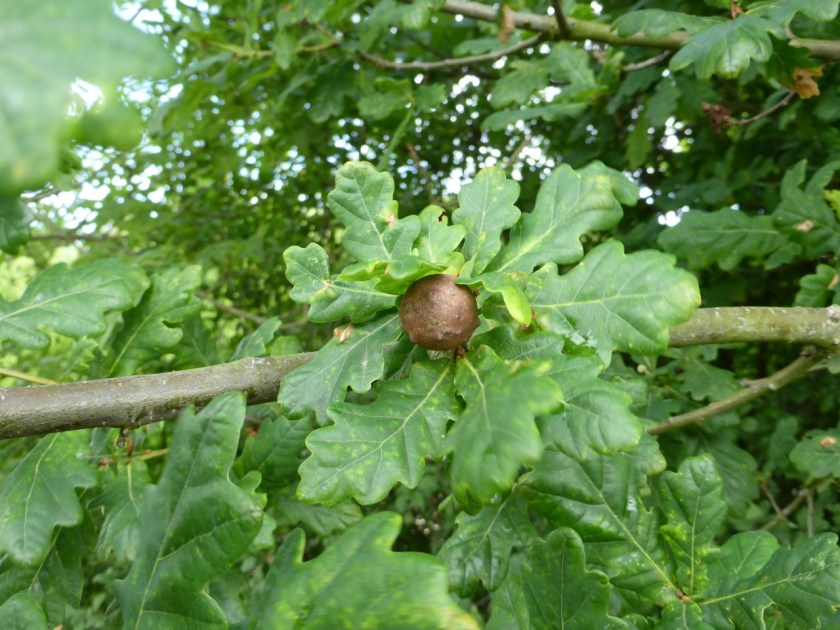
July 29th – Oak Apples, or galls, are an interesting thing. Very visible right now, they are the gall of a type of wasp that lays it’s egg inside new oak leaf buds. A chemical reaction caused by a secreted fluid causes the gall to grow, and inside, the wasp larva feeds on it, eventually burrowing it’s way to the surface and flying away.

Isn’t nature amazing?

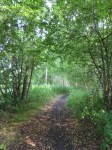
July 22nd – I had to do a favour on my way home from work, so I returned from Walsall through Pelsall and hopped on to the old railway line across the common at Brownhills. Although half of it’s length is a cycle way and part of National Route 5, the northern section to Brownhills West is not. Whilst the southern section is surfaced and a little overgrown, it’s unofficial section is open and a green, a verdant arcade. On this balmy summer evening, this greenway was shady and cool, and full of bird and animal life. A real gem, and relatively unknown to all but Brownhillians.