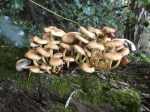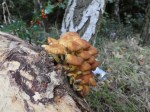
October 31st – The mornings have been damp over the weekend, and we’ve had a little rain in what has generally been a very dry autumn indeed. This has led to the fungus taking a surge, and I noted in the canal cutting through Pleck this morning there was lots of fly agaric growing, some of which were astoundingly large. Contrary to my earlier fears, it actually seems to have been their year after all.

Meanwhile, the toadstools I found on the log at the back of Queen Street Cemetery have turned a gorgeous orange brown colour as they mature and die off.

Lets hope with a little damper weather, more fungus will appear. I love to see it.

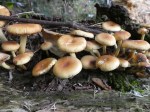
October 20th – Spotted from the canal towpath as I zipped past, a forest of toadstools growing on a fallen log in the scrub at the back of Queen Street Cemetery in Walsall. 

I think they might be honey fungus, but I’m not sure. There were hundreds of caps, all growing in clumps, feeding on the decaying wood. Ranging in colour from a dull weigh to a dark burnt umber, they were beautiful and fascinating.

Best crop of toadstools I’ve seen for a while.

March 14th – Monkeying through the back streets of Walsall Wood on an errand today, I traversed Hollanders Bridge, the pedestrian-only canal crossing next to Binary Wharf. Closing the bridge to through traffic years ago cut off Queen Street from the Lichfield Road side of the canal, and created an orphaned stub of road that was of no consequence until a new housing development was constructed adjacent to it, on the site of an old computer business. Somewhat cringingly, the road-stub was christened “Steep Bridge Way’.

Way back in August, 2011, local blogger The Stymaster noted the original sign was badly spelled; then, in May 2012, I spotted that sign had been removed. It seems to have been finally replaced.

One wonders at the cost, and how slowly the gears of bureaucracy can grind in such matters…

January 17th – Some of Walsall’s municipal cemeteries are in a woeful state. Ryecroft can be a bit grim in the less visited corners, Queen Street is disgustingly neglected, doubly so since it’s the resting place of local nursing heroine Sister Dora. James Bridge is no exception – a large burial ground wedged inbetween former factories, waste ground and the canal, it was never a picturesque location. It’s sad to see recently that an adjacent building waste processing plant has expanded operations, leaving relatives of the interred to complain of masonry dust coating the graves. Today, it wasn’t hard to see why it was happening. Why on earth was that noisy, pollutant yard given permission to operate in such a sensitive location?
On a side note, the older sections of James Bridge are amongst the most densely packed I’ve ever seen. There are a huge number of graves here. 

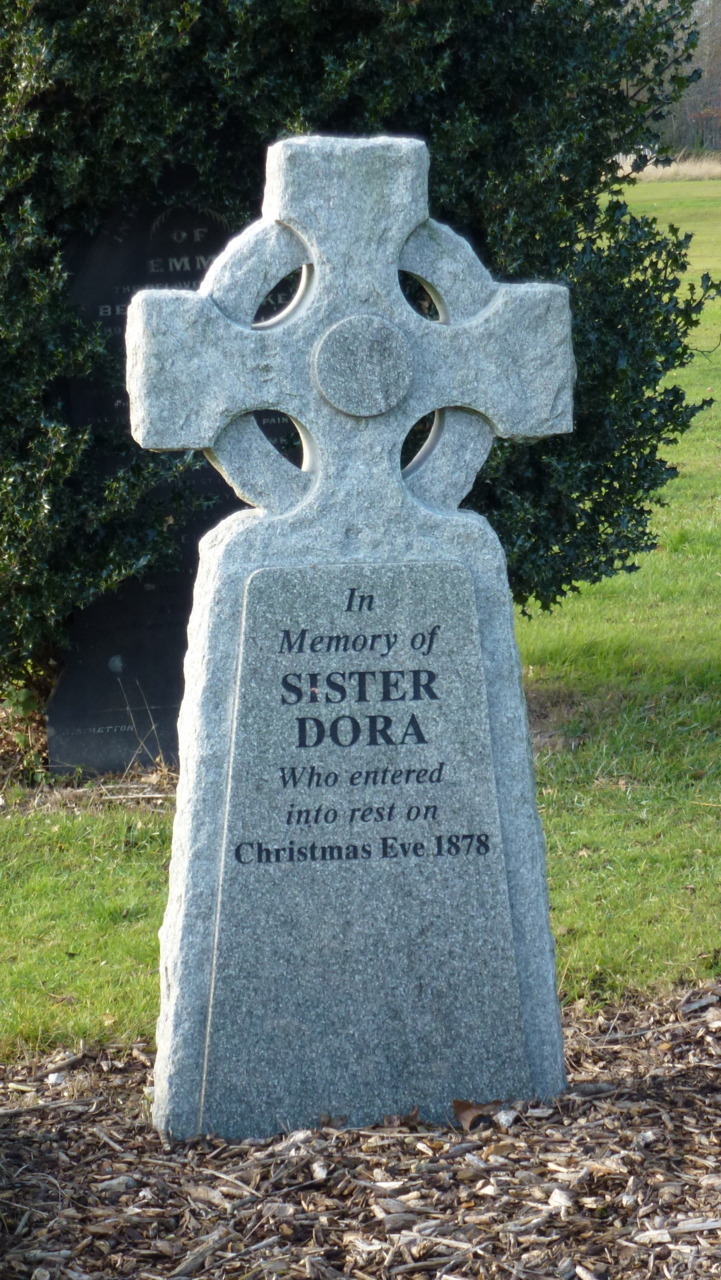
December 15th – Of all Walsall’s notable folk, I think perhaps the most loved is Sister Dora. Dorothy Pattison was one of the first nurses in the town, and she worked tirelessly to heal the sick and injured from industrial accidents and smallpox. She was well respected in her lifetime, and her reputation remains to this day. She’s buried at the sadly dilapidated Queen Street Cemetery in Walsall, in a very low key grave. Her statue stands proudly on The Bridge in Walsall, and as well as giving her name to streets and buildings locally, Dora also gave her name to the town’s mental hospital. 

Wikipedia has this to say about the great nurse:

She was the second-youngest child of the Rev. Mark James Pattison, and sister of the scholar Mark Pattison Jnr. From 1861–1864, she ran the village school at Little Woolstone,Buckinghamshire.

In the autumn of 1864, she joined the Sisterhood of the Good Samaritans at CoathamMiddlesbrough and devoted her life to nursing. She was sent to work at Walsall’s hospital in Bridge Street and arrived in Walsall on 8 January 1865. The rest of her life was spent in Walsall and it was there that in local eyes she became to be compared with Florence Nightingale.

Later she worked at the Cottage Hospital at The Mount.

In 1875, when Walsall was hit by smallpox, Sister Dora worked for six months at an epidemic hospital being set up in Deadman’s Lane (now Hospital Street). During 1876, Sister Dora attended more than 12,000 patients.

The last two years of her life, Sister Dora worked at the hospital in Bridgeman Street, overlooking the South Staffordshire Railway (later the London and North Western Railway). It was there that she developed a special bond of friendship with railway workers who often sufferen in industrial accidents. The railwaymen gave her a pony and a carriage and even raised the sum of £50 from their own wages to enable Sister Dora to visit housebound patients more easily.

In 1877 Sister Dora contracted breast cancer, and died on Christmas Eve in 1878. At her funeral on 28 December the town of Walsall turned out to see her off to Queen Street Cemetery, borne by eighteen railwaymen, engine drivers, porters and guards, all in working uniform. On her death Florence Nightingale paid the following tribute, ‘May every nurse, though not gifted with Sister Dora’s genius, grow in training and care of her patients, that none but may be better for her care, whether for life or death’. Her epitaph read, ‘Quietly I came among you and quietly let me go’.
August 11th – Thanks to The Stymaster of Pigblog fame who spotted this and tweeted it for the attention of Walsall Council. Until he posted, I was unaware that the bottom end of Queen Street by Binary Wharf had been renamed. Dictionary for town planning, I feel. Wonder how much that’ll cost to correct?

If the Express & Star are reading this, hope you get lost trying to find it…