October 16th – An very strange weather day. We were expecting severe storms in the afternoon, and in the morning, to a gradually increasing wing, the sky and light turned pink. Not just a light, gentle pink, but a deep, strong pink that suffused everything and made one think the end was coming.

It actually turned out to be pollution and sand dust in the upper atmosphere caused by the oncoming, dying hurricane, but the effect was bfar better than any eclipse I’ve ever seen. 

For an hour or so on an otherwise unremarkable October morning, the world went a little bit strange for us all.

October 7th -The Saturday was just as grey, and seeking fresh air I went out in steady rain, dried off for a short while, then returned home again in penetrating drizzle.

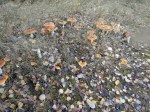
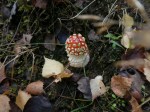
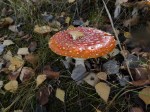
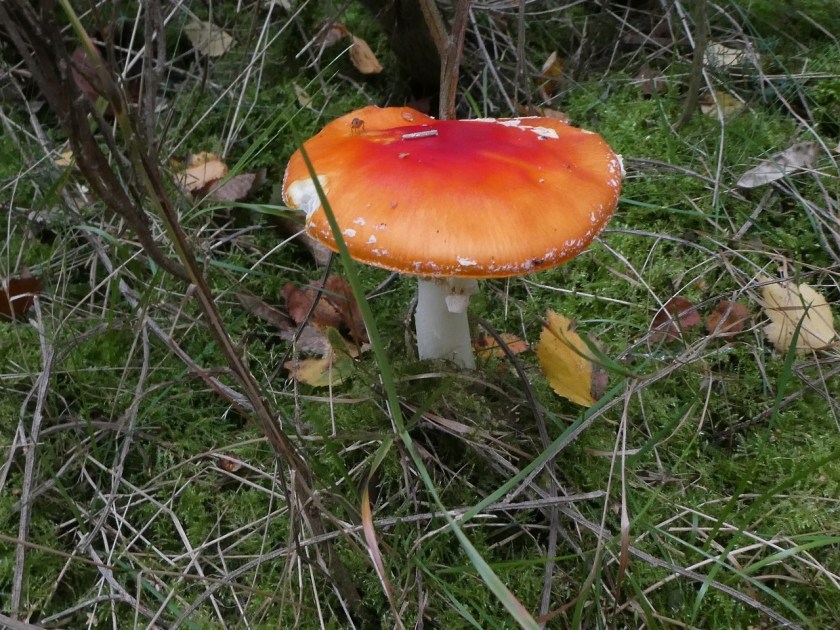
My seasonal barometer, the horse chestnut at Home Farm, Sandhills is currently wearing autumn colours, and will soon be naked once more, it’s green majesty having pleased me throughout the summer. Now it’s the turn of the fungus, and on the bank near Wharf Lane on the canal, where I thought there were to be none this year, the fly agaric are having a riot amongst the ferns under the silver birches.

It looks like contrary to my previous assertions, the fairytale red fungus with white spots is having another excellent year.

September 28th – My quest for fly agaric – the red and white spotted toadstool of folklore and fairytale – was satisfied today when I visited a familiar patch that unexpectedly exists between the Darlaston Road and canal in Walsall. 

This edge land, under self-seeded silver birches at the top of the cutting, is host to the largest colony of these toadstools I’ve ever seen; there must be at least a hundred of them in various stages of life.

This is a remarkable find and confirms my suspicion that I’ve largely missed the season this year – they seem to have peaked earlier this year, but this spot which is quite hard to climb to contains some of the best, most perfect examples of the fungi I’ve ever seen.

All in one of the most built-up, urban patches of Walsall.

September 24th – I can’t make up my mind at the moment if fly agaric – the red and white spotted toadstools of folklore – are having a bad year or if I’m just a bit early.

I’ve found a few examples – notably a good specimen on August bank holiday on the Chase – but all the favourite spots like the bank before Anglesey Wharf on the canal at Brownhills are empty save for a few dog-eared or faded specimens.

This one at the top of the above bank seems quite elderly, as the spots drop off and the colour fades as they mature – but where are it’s usual companions?

They had an extraordinarily good year last year so perhaps it’s natural balance.

September 7th – Spotted as I cruised towards Brownhills just off the Lindon Road, a fine crop of bright red, hard crab apples, so ripe they were falling untouched from the tree.

Like previous apples of this type, scraping them with a fingernail revealed the  smelled bitter and acidic, explaining the lack of takers.

I suppose it’s a thing to grow trees and shrubs for the beauty of the fruit and flowers, with no regard to utility of the crop. Which is a bit sad; whenever I see fruit rot like this I feel it’s a pity it can’t be readily used or consumed.

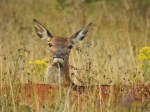
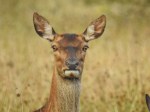
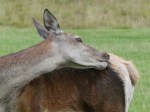
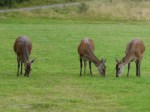
July 30th – The deer are busy around Chasewater at the moment. I thought I’d spotted yesterday’s group of reds on the north heath, where I got pretty close without spooking them at all; but when I passed the rugby club the deer from the day before were still there.

That I can take a short journey around the park and see two listing groups of deer shows how populous they are becoming lately, and I do wonder if this might become a difficulty as they move around. 

Deer are not known for their traffic sense and I worry that environmental pressures making them move around are forcing them into contact with traffic more.

They are so lovely to see, but with no predators I fear that soon the herds may need some management…

July 29th – Returning from a ride out on a grey evening threatening rain I came through Chasewater and was heartened to note a group of deer browsing the grass on the Rugby Club by the Chasetown bypass. The herd was disjointed, with six adults spread around the pitch and a fawn getting some rest on the far side.

The animals were calm, inquisitive and not particularly troubled by my attentions. I noticed what good condition they were in and how shiny their coats were.

I’m also amused by the idea of some visiting rugby player going face down in the Chasetown turf during a tackle and getting a face full of fresh deer raisins.

Can’t be many pitches where that’s a hazard…

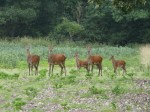
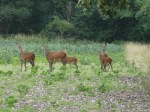
June 19th – Spotted in appallingly bad light way off near the back of the bean field at Jockey Meadows, I noted this small herd of red dear, three females and two of this year’s fawns. I was pleased to see them as I haven’t seen deer up here recently.

They were skittish, and probably displaced by the recent arrival of the cows. But they looked healthy and content and it’s good to see the little ones thriving.

Still can’t get over the fact that I see these magnificent beasts on my way to and from work. How lucky we are to have this on our doorsteps.

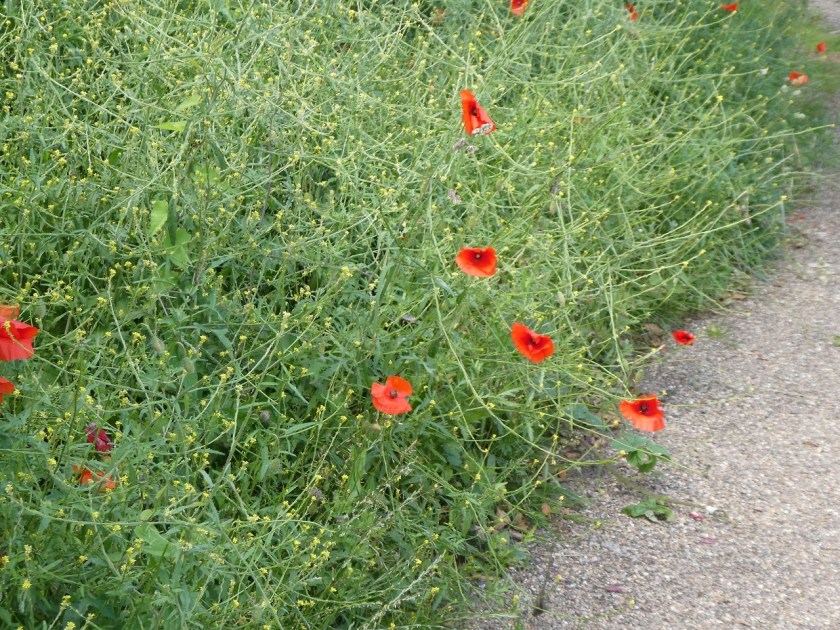
July 3rd – Also on the towpath near Darlaston, the poppies are beautiful at the moment, too. Another kind of urban pioneer, these too will grow just about anywhere, be it in a wayside patch or a fissure in some brickwork.

Riding urban backwaters at the moment – be they canals, tracks or inner city streets – is a real riot of natural colour.

June 25th – I wasn’t expecting much when I headed to Chasewater; battling a strong wind and drizzle, the place was all but deserted and my circuit of the lake looked set to be dismal.

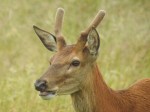
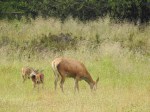
However, I was to be proven wrong; first of all I spotted a group of three red deer browsing the north heath contentedly, and they were happy for me to take pictures, even seeming to pose. But the real treat was waiting on the brow of the hill.

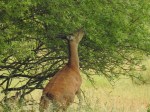
There was an adult female plucking greens from the trees, and after stopping to photograph her too, I noted she had another adult and two fawns with her. They progressed down to the marsh and loosely joined with the earlier three.

The antics of the fawns – never still for a moment – were lovely and the deer weren’t a bit shy or skittish. I watched them for a long time, even thought the rain was pretty steady.

However used to these gentle, beautiful beasts I become, I still can’t remove myself from the shock that we have them here, living on our green spaces. A wonderful, beautiful spectacle.