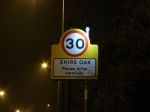
February 14th – A day spent sleeping, relaxing, and catching up. I had business in Stonnall in the evening, so nipped down there. Progress was slow. I was still tired.

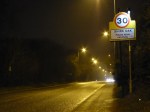
On the Chester Road just past the houses – at the spot once colloquially referred to as ‘death mile’ or ‘mad mile’ after so many accidents – new speed restriction signs have appeared. ‘Please drive carefully’. I’ve never understood this rubbish, personally. 

(Death Mile became much, much safer after the road was modified in the 1990s.)

For starters, much of the traffic passing will be too fast to read anything other than the restriction; and secondly, who the hell decides to drive with wicked abandon only to later correct their behaviour because some quango or councillor decided to ask them to drive nicely in 180-point Helvetica Black?

There is something interesting here, though. That sign didn’t originally say Shire Oak; that legend has been added on a foil applied over other text, which could possibly say ‘Brownhills’, but I can’t decide. 

Are the folk on the Hill too posh and are now pushing for independence? In these straitened days, does anyone really care that much? And before the whinging starts, Shire Oak is indeed in the parish of Brownhills. 

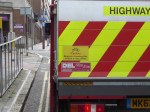
March 14th – In Birmingham, Newhall Street junction by the old Remploy headquarters. A great safety warning on the back of a truck. I only have two issues with it:

  • It should be twice as big
  • It should say ‘Do not pass this vehicle’

Regardless of how cycle lanes are marked, don’t come up the lefthand side of traffic folks. It’s not big, not clever, and is what kills most of the adult cyclists involved in road accidents in the UK.

January 31st – Someone asserted yesterday that I should be glad of increased cycling facilities in the UK. I am, and I’m not. Here’s why.

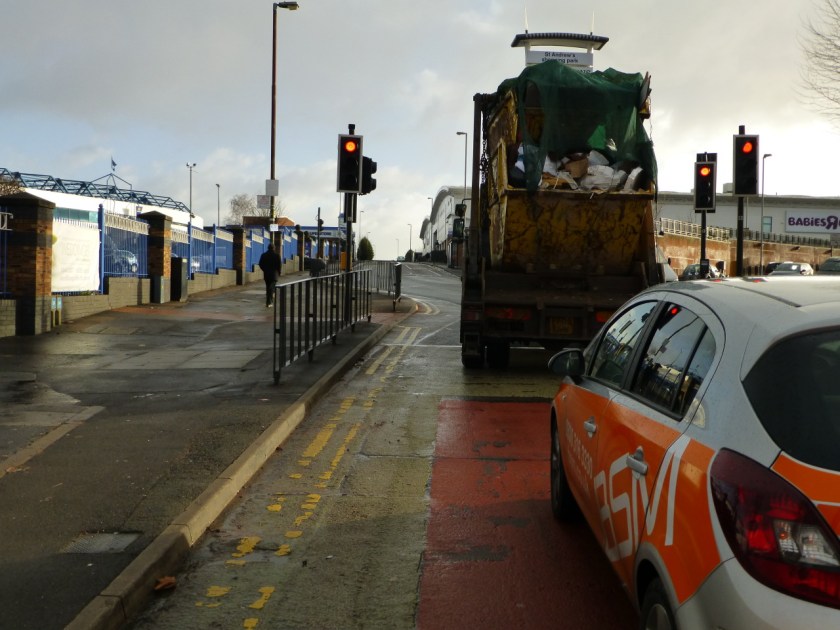
On the Coventry Road, Birmingham, near the St. Andrews ground, there are lights to control a ‘y’ junction. Prior to the junction, there is a green tarmac filter lane leading to an advance stop line (ASL). The idea is that cyclists use the green lane up the inside of the traffic to access the green ASL box to place themselves safely at the head of the queue. This rarely works in practice, and to me, is actively encouraging dangerous cycling behaviour.

If I were to take the lane up the side of the traffic, as the skip lorry is occupying the ASL, I’d likely stop next to him. Right in his blind spot. Cyclists tend to be quicker off the mark at lights than lorries and chances are we’d interact at the pinch point a few yards ahead. If the lorry goes down left fork here (which he did, without indicating the intention), he would not see the cyclist and possibly lead to the cyclist being crushed at the pinch point between the railings and the lorry.

This road position kills the vast majority of adult cyclists mortally injured on the roads in the UK. It’s bloody stupid to get up the inside left of a line of traffic, as drivers don’t expect it and often, physically can’t see you. Between the ‘safety’ railings and the lorry wheels, you’re toast. Or rather, puree.

This cycling ‘facility’ encourages dangerous road positioning, and in my view, makes this junction more dangerous to the inexperienced cyclist.

I’ll celebrate cycling facilities when they’re safe, and designed properly. Not ill-thought out lip service like this.

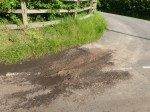
June 28th – Time for a bit of cycling knowledge. After heavy rains – like we had today – the roads are way more hazardous than usual. If it’s the first rain after a dry spell, the surface water becomes greasy and slippery, due to tyre rubber detritus and diesel being washed into the sludge. This makes white lines, ironworks and junctions really nasty. After heavy rain, silt washes of fields and gardens, bring with it loose gravel. This gathers in bands, hollows and dips, often just where cyclists cross junctions. The silt when wet is slippery, but when dry, will steal your wheels from beneath you. The gravel – known as ‘marbles’ to motorcyclists – gets progressively polished by vehicle wheels, and is like cycling on ball bearings. Take care – the hazard continues in the dry, too, and can last for weeks after a storm.

Councils don’t really understand the menace of this stuff to folk on two wheels. I wish they did.