

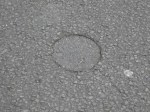
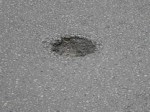
July 21st – It’s true that I am one of those characters that amasses a huge amount of trivia and mental flotsam as I go about daily life, and this is one of those things, but in my defence, I was actually asked about this a month or so ago so here you go…
People who study the road surface (and there are a few of us, mainly on 2 wheels) may notice perfectly circular cutouts, punch-throughs or holes in the endless asphalt. Sometimes they’re filled with tar, or white lining paint. Often, they have the material that came out of them put back in like a tarmac divot. Sometimes, they open into potholes, particularly if badly sealed. But what are they?
These odd features are the signature of the road surveyor, and a road near the end of it’s life. When a road is resurfaced, the tarmac is literally planed off by a large cutting machine. The planings are then taken away, recycled back into asphalt, and relaid. How deep that planing operation goes is critical, as is knowing the depth of the road surface, and what it’s like beneath the blacktop ‘crust’.
When a road is considered for resurfacing, a surveyor will take cores with a drill and round cutter at about 100-125mm diameter, and extract them like a cheese taster sampling a cheddar. They are photographed, measured and replaced (or filled). From this a plan of work can be formulated.
Sometimes cores are taken in pairs, close together; others they are equally spaced along the length or a road, on either side. These, spotted around Walsal today, are in various states of becoming potholes themselves and adding to the problem they were created in the process of alleviating.
I’m convinced that every time I learn rubbish like this, it pushes something useful out of the back of my brain.










 BrownhillsBob's #365daysofbiking