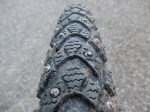
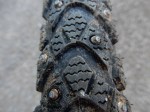
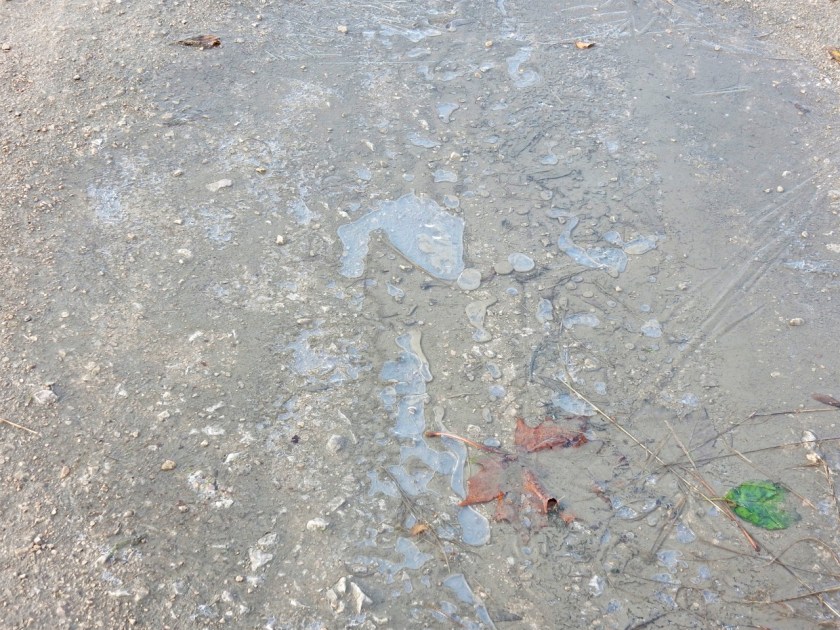
November 29th – It’s time. The winter tyres, with tungsten carbide studs in the tread are back on the bike to hopefully prevent further spills this winter. Pumped up hard in normal conditions, Schwalbe Winter roll easily and quietly; let a little air out when icy and they grip beautifully, and run with a satisfying buzz.

Like many cyclists, studded tyres keep me rolling through the winter.

November 1st – It’s coming on winter. That was cold, and a shock to the system, for sure.

Now commuting in both directions mostly in darkness, the cold and the nights are drawing in. Already seeing evidence of the communal madness that commences with the darkness every year, this run up to Christmas is my least favourite time to be on the road on a bike.

Stay safe everyone, and wrap up warm – it’s getting chilly out there.

July 25th – A horrid, horrid ride home. I had to take a trip into Birmingham on my return from work, and I caught the train out. On my return from the station, it rained the sort of fine, penetrating rain that searches out every not-quite closed zip and aperture on your jacket, and just soaks you. But far, far worse than being wet were the road conditions.

The first rains after a dry spell are always bad – but if they aren’t heavy, the surface water they precipitate mixes with road grime, tyre detritus, spilled fuel and oils and makes a soapy, foamy, slimy emulsion that steals wheels from under you. I slid a couple of times. I head cars skid at junctions. It was awful.

I was glad to get home, just as the rain stopped. There hasn’t been enough rain to wash this away yet, so watch out the next time we have wet weather.

Be careful out there folks.

June 15th – I passed through Corporation Street in Birmingham, which is odd and otherworldly now the tram lines are finished and operational. I rode down to New Street, mindful of my narrow wheels and the hazards of parallel tracks. I’ve cycled around tramlines loads – always cross at as close to 90 degrees as you can – but they still unnerved me.

The new trams are quiet, too. so I can see some danger as we all get used to each other, but it is an impressive thing, and it’s nice to see Corporation Street not choked by traffic.

A surprising sight I thought I’d never see.

December 18th – the weather got progressively worse, and on my return I crossed the Alan Woollatt memorial bridge over the A38 at Thickbroom. I had to be back for an appointment, and it was raining steadily but I couldn’t resist long exposure photos of the rush hour.

Before this bridge was built – again, a side effect of the M6 Toll – I used to negotiate that road between here and the turning for Little Hay. It was murder.

Alan Woollatt was a great cyclist and a fine man who fought for this crossing. I think of him every time I use it, and gaze from safety at the traffic speeding beneath me.

My name is Aiden and I am a Cyclist.

aideym:

There are very few situations in normal society where you are expected to look out for the incompetence of others and if someone else gets it wrong you are responsible for the result.

The victim is usually a very normal person going about his lawful business, cruelly interrupted by the inconvenience of killing, maiming or injuring a cyclist. After all cycling is an outdated mode of transport,…

View On WordPress

This is important – the victim blaming must stop. I was outraged at the coverage on Midlands Today last night. I got out with big lights, body actions and am an assertive, confident cyclist. But against people who can’t, won’t or are too distracted to see me, I stand no chance, whatever measures I take to protect myself from the stupidity of others.

How about the cops  nick some of these buggers on mobiles for a change?

Cheers, Aiden – very well said.

August 11th – This is something I knew about, but had never seen in use. It’s a bit geeky, but I find it a fascinating demonstration of simple solutions being best.

As New Street Station is gradually turd-polished and sprinkled with cheap glitter, platforms are periodically closed to the public. At the moment it’s the turn of platform 3.

When the platform is closed, so is the adjacent track so that work can be undertaken in safety. The track is blocked, the overhead wires are grounded and these detonators are placed on the line.

Should a train get down here, the yellow disc, which contains a small but effective explosive charge, will be crushed by the wheels, activating the explosive. This makes a sound like a gunshot, alerting nearby workers and the driver.

This technology has been in use for decades, but I didn’t know it was still employed today.

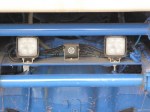
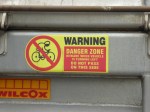
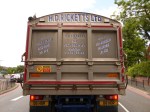
June 10th – Waiting in the queue at the Arboretum Junction in Walsall this morning, I was pleased to note that this Ricketts Ltd. tipper wagon was kitted out with safety features – a reversing safety camera, cyclist warning notice. He seemed to have extensive mirrors too, but I couldn’t get them in shot.

The wagon was driven professionally and courteously, and I couldn’t fault it – it was nice to see. More and more tipper trucks seem to have these safety features – shame they aren’t on some bigger HGVs.

Well done, H. D. Ricketts – very considerate.

April 17th – The minutiae of drainage engineering are wonderful. I’ve been passing this array of manholes for a couple of weeks now, and noticed that new bars had been installed across the covers. It’s taken me ages to work out what they’re for. It’s not what one may imagine.

Opposite a small, automatic sewer pumping station on Green Lane at Bullings Heath, Walsall Wood, there is the concrete cap to what must be a storm buffer. A storm buffer is a large underground tank that, in time of heavy rainfall, collects drainage water and fills up, storing it and allowing slower discharge into the main network to prevent overload. There are lots around and they work well; you can tell this is one due to the large circular ‘cap’ evident with the access covers.

Recently, bars were mounted over the covers. Initially, I assumed they were to prevent access by drainers – a type of Urban Explorer that goes into sewers and storm drains to explore – but they aren’t actually secure. They’re secured with normal nuts and bolts, not locks. A couple of covers in front (not shown), which I think house pumps of valves – are not so protected.

They have actually been fitted to prevent internal pressure from blowing the access covers out. If the buffer filled to capacity due to a storm event, water pressure would increase against the hatches, and lift them out. That would then expose anyone walking through the subsequent flood liable to fall into a very deep, open manhole.

The bars are therefore a safety feature.

I wonder what has occurred, and where, to make this risk suddenly appreciated?