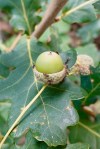
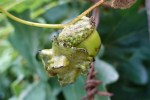
August 13th – At Hortonwood in Telford, I found a small wayside oak sapling, which was growing round, large acorns. they were generally healthy and surprisingly large, with only a handful affected by knapper galls – and where they were, the actual effect of the acorn remained small.

The ants were clearly interested in the acorns, but I have no idea why, and I’m wondering if the low gall-count and manner of development is maybe signifying and evolved defence to these parasites.

Certainly is fascinating. Going to be a good crop of acorns this year I think, and a bumper hedgerow harvest generally from what I can see so far.

August 13th – More oak wasp galls, which I’ve gone all out to find this year for no other reason than they fascinate me.

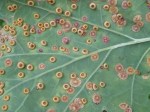
On a small sapling by the canalside track at Hopwas, hundreds of thousands of almost annular, ring-like growths on the leaves, looking maybe like fungus or some odd egg. These are the delightfully named common spangle gall for the flat ones, and silk button galls for the rounder, more sharply defined ones.

These are all created by the same mechanism – a small wasp injects an egg into the leaf, and a chemical coating the egg disrupts the plant DNA to grow the gall, which leaves a light patch on the upper surface of the leaf where nutrients have been leeched away by the larva growing underneath.

I’m not sure why galls like this captivate me so much but they are absolutely fascinating.

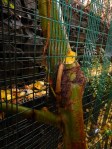
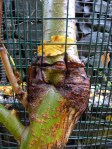
October 28th – One thing that does fascinate me on the cycle path in Telford is the way the trees and scrub have grown awkwardly through the fences. There are lots of instances like this – where the sapling crossed through the mesh, and the tree is so large now it’s consuming the fece by growing around and through it. 

I’d have thought the constriction would have killed the tree, but it seem,s to have done OK considering, proving just how adaptable nature really is.