#365daysofbiking Don’t stop me now


March 4th – The front brake was feeling funny again, it had some initial resistance – like a click – when applied. I’d had it before but couldn’t recall the cause.

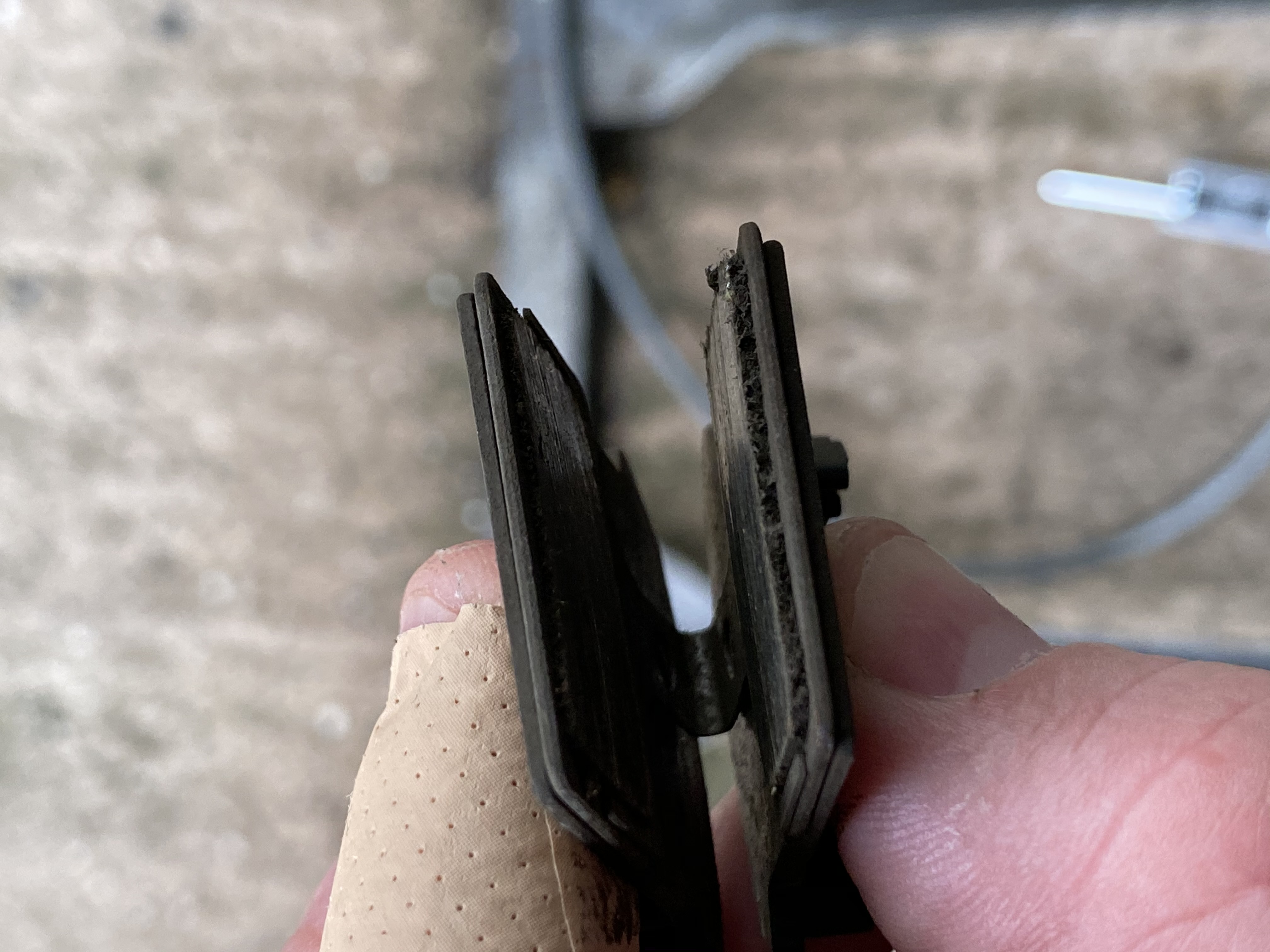
Turned out I discovered it riding to work when I lost braking power on the same brake. The pads were so worn, the return leaf spring was being pushed out of place by the disc surface.causing the click.

The pistons were opened back out with a wedge tool for the purpose and new pads dropped in. Braking harmony restored!

This journal is moving home. Find out more by clicking here

from Tumblr https://ift.tt/2xLeHld
via IFTTT

#365daysofbiking Gearing up

January 3rd – One of my bikes uses a Shimano Di2 hub gear – an Alfine 705. This is the original Di2 11 speed hub and has its own pros and cons, but on the whole it’s reliable and workmanlike, and apart from a somewhat fiddly oil change when the shifting gets lumpy, requires little in the way of mechanical attention during it’s lifetime.

Generally, the life I’ve found is about 15-25,000 miles. This hub has been through a lot, and more than 3 wheel builds, but I’m happy with the wheel it’s in now, which was why it was so annoying when it suffered a serious failure on Christmas Day. I lost about half the gears which just spun out when selected – 3,4,5, 9 and 11 I think. An oil change and filling with cleaning oil hadn’t helped at all. The hub was knackered.

There’s not much I don’t know about this system; I’ve been using it in different iterations for over a decade and I’ve got to know the tricks and fiddles and advanced maintenance procedures – both by reading manufacturer documentation and by trial and error. The internal mechanism of the hub is easy to remove and change for another – you remove the wheel, take off the changer mechanism, sprocket and disk brake. You then remove the non drive side cone and locknut, then unscrew the plastic retainer and oil seal on the drive side – I have the right tool for this but a strap wrench will do it fine too, but the key bit is it’s a left hand thread. Once it’s off, the whole gubbins will come out, the oil can be cleaned out and a new mechanism can be put back, or the old one repaired and refitted.

There was a snag. The 705 is no longer available, but there is a new version, the 7051. I didn’t want to rebuild the wheel. I scoured fleabay and the web for a 705. No dice. I found a brand new 7051 in Germany for about £250, which is a great price. I poured over Shimano drawings of the two hubs. I decided to risk ordering the 7051 and trying to swap the innards. If they didn’t fit I could always reassemble it and build a new wheel.

In time the hub arrived, and the good news is it fitted exactly the same. On the rare chance that anyone ever reads this wondering if it’s possible to swap the two, yes it is. I swapped the guts, but also the non drive side bearing and oil seal too – be careful popping that out as they’re easy to damage and if no longer flat, oil will leak from the cone.

The 7051 hub has an upgraded clutch, smother shifting and performs better changing under loading. I have to say, fitting it back was a dream, and it runs well. Once the factory stiffness had gone, changes are much smoother and there’s far less clatter when doing so.

The old hub mechanism I plan to dismantle to see what’s gone. Looks like I’ll be spending some time in the garage with the tools…

This post has been created on the off change anyone ever wonders the same thing: I would say this also applies to the non-Di2 cable variants too.

This journal is moving home. Please find out more by clicking here.

from Tumblr http://bit.ly/2LQizV0
via IFTTT

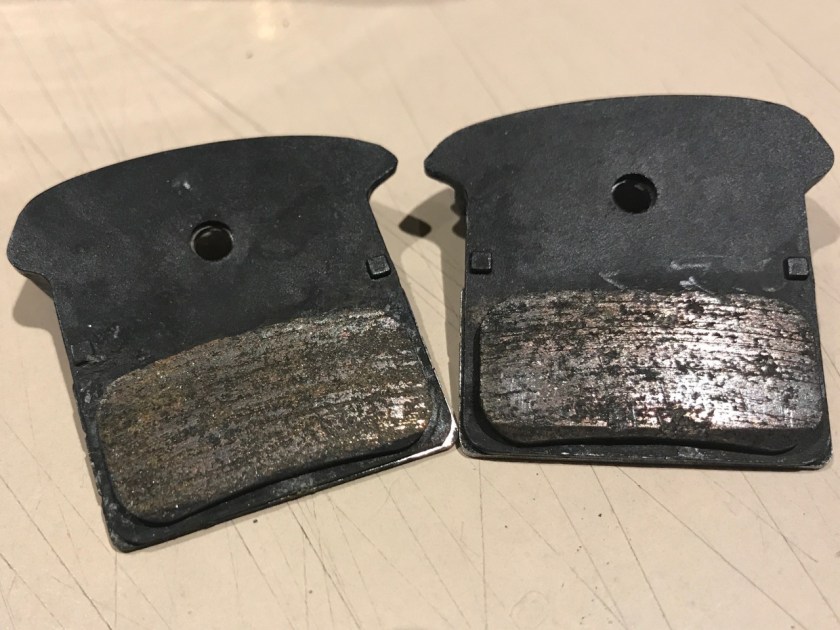
February 13th – I wore out a set of front brake pads, and still have a fair few part worn ones glazed out from the problems with the rear brake, which I wouldn’t throw away in case I found a way to reclaim them.

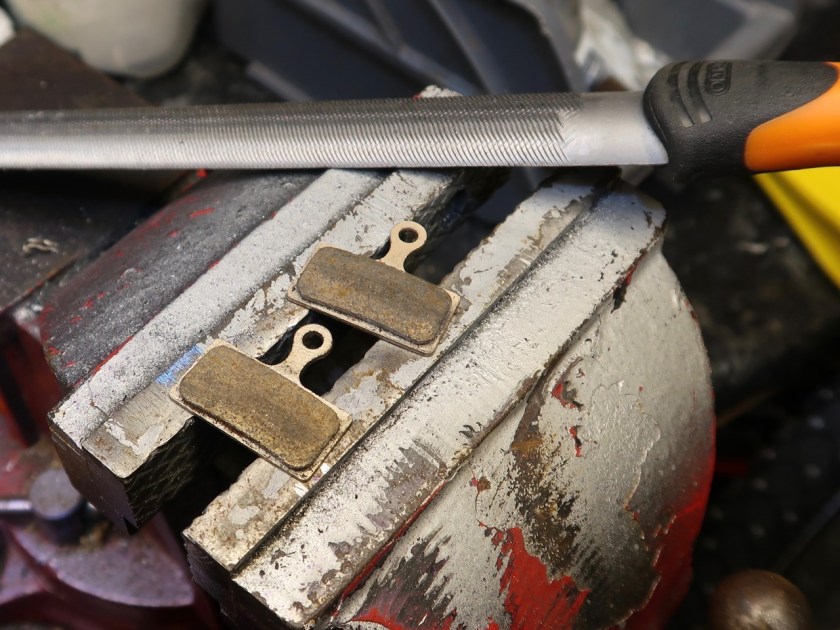
I’ve been thinking about it idly, and I’ve managed to recover a set. I filed off the surface a little with a clean flat file surface. Filing alone doesn’t work, so working on the basis whatever has destroyed them must be oil based, I took the pads, placed them on an aluminium sheet, and gently heated them with a very hot plumber’s blowtorch for ten minutes, until they stopped smoking when I removed the flame.

I then cleaned off the oxidisation with a scotchbrite pad and finally degreased them with a zero residue spray cleaner.

They are as good as new. Without the heat, none of these steps have worked before. 

I guess you could stove the pads in a normal kitchen oven if you don’t have a blowtorch.

It’s saved a few bob, I guess. Be interesting to see if they wear any quicker or glaze again.

September 3rd – It’s been a while since I bored you with disc brake pads, so it’s your lucky day – or maybe not.

I favour a hydraulic disc brake on all my bikes, road or off-road. On road bikes, I think the Shimano 785 based callipers are the bees knees; combined with a decent disc and pads, they control my resplendent girth down the steepest of inclines and without snatching.

The only issue I have – and I’ve covered this before – is the mystery of what exactly happens to rear pads in particular when they overheat. Sometimes, despite the best care, pads will develop a sheen, lose the nice grip and squeal horridly. I’ve been trialling aftermarket alternatives all summer to see if other manufacturer’s inserts are better.

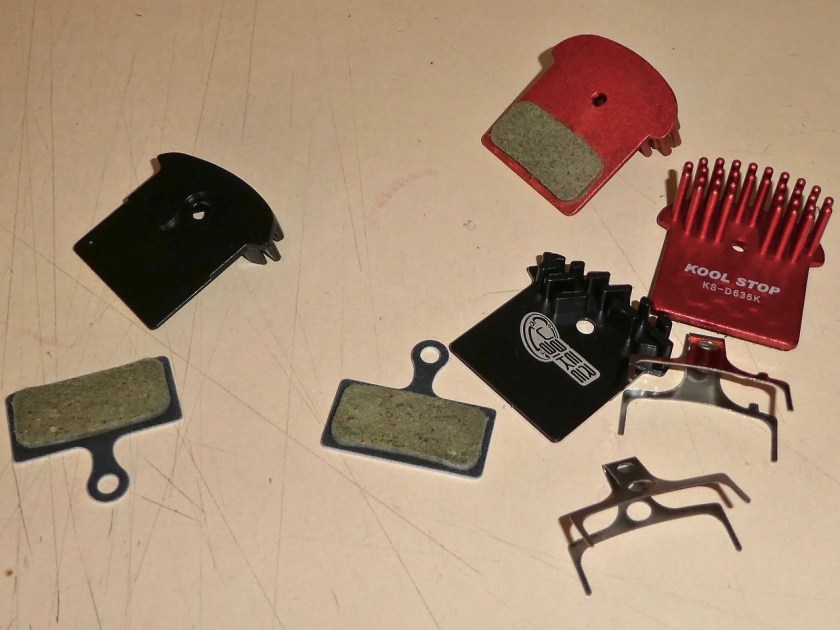
I tried Kool Stop, an expensive brand. They were nothing special, and glazed out. Clarks performance was tepid, but lasted well. My best results have been with Uberbike sintered and semi-metallic. These are an interesting design – 785 road pads normally have a backplate with cooling heatsink fins. Uberbike have separated the two, so you can re-use the cooling fins on a slightly thinner pad, which are only £6 a set instead of the £20 for a set from Shimano. And they work a dream.I had one set glaze out near the end of life, but other than that, great.

I thought the front set had taken the same dive while winding down from the Roaches the day before, becoming squeaky and losing friction, so swapped them in the workshop the next day, to find the pads had worn to the spring, and that was the wail.

I really do recommend Uberbike pads.

February 23rd – Back to brakes. This has really caught my attention, sorry.

Following the brake trouble I’ve talked about where pads suddenly lose effectiveness in my hydraulic disc brakes, I’ve decided to try alternatives to the stock Shimano pads. 

I wasn’t expecting them to be any good – I was wrong.

I’ve tried the Kool-Stop first. This company makes a very highly regarded road brake block, and I was interested to see how that translated. After initial disappointment, I’m actually quite impressed.

These resin pads are described as having a ‘rotor saving compound’, which usually means they’re soft and not too effective. My fears seemed to be confirmed on the first two or three days of use, when stopping power was poor and the brakes noisy. 

I then rode in the rain. This appeared to bed the pads in and they’re now every bit as good as manufacturer originals in use. They aren’t quite as snatchy, which is good, to be honest, but they do bite when demanded.

The question is, how long will they last? We shall see. But my initial feeling is that although they took an age to bed in, they’re great pads.

February 18th – Brakes. Can’t keep stopping like this…

Thanks for all the suggestions for answers to the sudden loss of braking power issue. The disc is not greasy, the pads are dry and the disc is only 0.06mm down from new thickness – although that one really did make me think, so cheers for the suggestion.

I put in a set of Shimano pads. They worked fine once bedded in, without cleaning the disc. The old ones look glazed, and seems to be a grumble in online bike forums. 

I’ve decided to trial some aftermarket alternative pads to see how they fare in comparison – the red ones are Kool Stop, who are famed for old-style brake blocks, and the other set, with separate heatsinks are from Uberbike. The Kool Stops are at the pricey end of the market, the others, cheap. The interesting thing about the Uberbike ones is they come in synthetic, metal and semi-metal flavours, and you can buy the pad separate to the sink, so they’re cheaper.

Got the Kool Stops in for now. I’ll report back. Again, thanks for all the advice.

February 9th – A puzzle, for sure. Shimano metal sintered disc brake pads for hydraulic brakes: what happens to them that renders them useless beyond recovery?

Usually the rear set, all of a sudden they loose stopping power,  and often become screechy. They are not contaminated with oil, although it feels like it. Deep cleaning in the dishwasher doesn’t work. Ultrasonic cleaner with solvent doesn’t, either. Neither does surface grinding as much as .75mm off the surface.

It’s like they just glaze, and some structural or metallurgical change takes place, and that’s it. Only thing to recover stopping power is new pads. Or using them in the rain; when wet, and only then, do they stop better.

At £20 a set, this is not fun. Anyone any ideas please?

September 20th – Spotted in a customer’s cycle shed, two bikes side by side that illustrate something that annoys me.

Shimano, the Japanese industrial giant that revolutionised cycling are not what many people imagine them to be. They are essentially production engineering experts, probably more than they are bicycle technology or fishing equipment manufacturers.

Shimano make loads and loads of great, well thought out products that I love. their work to refine the derailleur gear system in the 80s and 90s, their clipless pedal systems and electronic gear technology have changed cycling for the better immensely. But something more than these innovations has had a massive influence.

Shimano sell innovative kit to bike manufacturers. That means they also sell and produce the tooling to manufacture bikes en masse. Shimano often market products to manufacturers because they’re cheaper or easier to assemble on a production line, but sometimes of little discernible end-user benefit.

Shimano pioneered the external bottom bracket, a frankly piss-poor idea that is hated by lots of cyclists for it’s increased wear and susceptibility to corrosion. Shimano invented it to make assembly of bikes from one side far easier. It shifted to producers in large numbers and is now, sadly, ubiquitous.

Similarly, for years, bicycle disk brakes – which I love as a technology – had their rotors attached to the wheel hubs by six M5 screws, like the bike in the top picture. This ‘6 bolt’ design has been a standard for more than a decade, and works well. You can feel if there’s a securing issue without the loose disc being dangerous, and the rotors are light and easy to replace with standard workshop tools – usually an Allen or Torx driver.

Shimano recognised that a big cost in disc brake adoption to mainstream bikes was assembly of the disc onto the wheel – six screws require either a complex, mutispindle head or an operator repeating the same action 12 times per product. So they invented Centerlock(sic).

The lower picture shows a bike with a Centerlock rotor.

Centerlock uses a splined male dog on the hub, and a special brake disc with a mating female recess. The rotor slides onto the splines, and is held in place by the same type, thread and tooled ring that holds the gear cassette on a rear wheel, thus requiring one tool to fit the cassette and two brake rotors, a huge cost saving in production.

Centerlock rotors are heavier, and you need a special tool to fit or remove them. If the ring comes loose, there’s nothing else to hold it.They limit consumer choice of aftermarket replacements.

There’s a whole industry sprung up around centre lock to 6 bolt adaptors.

This change in technology was introduced purely for the benefit of bike manufactures, arguably to the detriment of consumers and to me, is inferior.

Rant over.
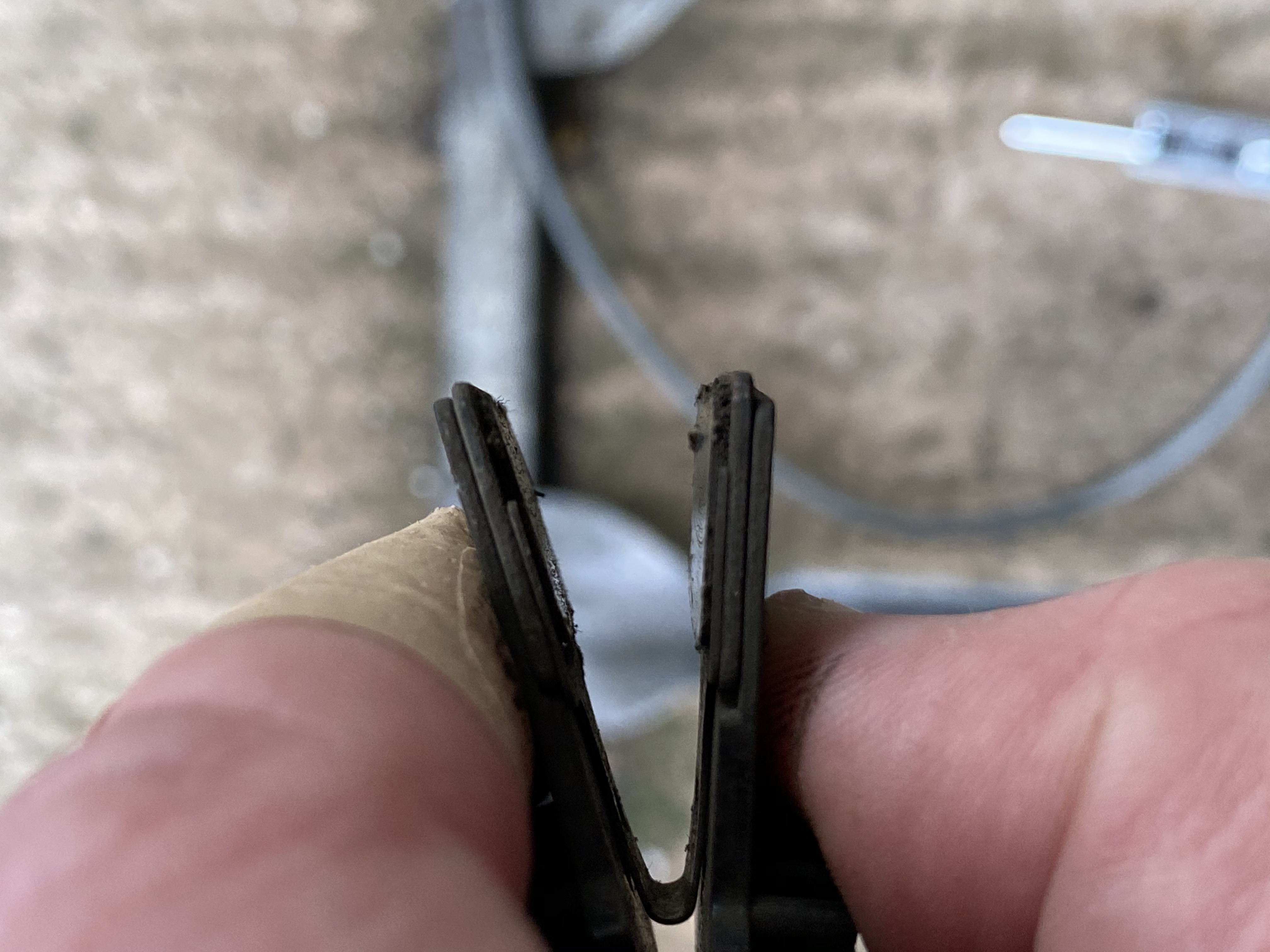
August 1st – A mechanical mystery. Three month old Shimano hydraulic brake pads, which suddenly lost grip and appeared to be glazed or contaminated. The pads are the sintered metal type and are genuine manufacturer parts.

Sometimes, long periods of braking can ‘glaze’ pads. causing them to become highly polished and shiny, meaning they don’t work well. The common treatment for this is to file the surface of the pad and pop them back in. 

These I have degreased, cleaned, filed and even surface ground, but whatever I do they quickly glaze again. New pads of the same type were just fine.

Anyone got any idea what’s going on here? I’m wondering if overheating has caused the pad material to harden…

March 11th – A nasty graunching from the rear brake on the way home was severe enough to have me check it out as soon as I got home. Much to my shock, I found the stock, soft resin-organic brake pads in my rear calliper were just a bit worn.

Ahem.

The new sintered metal ones are at the rear, the ones I took out in front. That’s bad. Should have spotted it sooner – luckily I don’t seem to have damaged the disc.

Never take your eyes of those essential maintenance tasks, people!