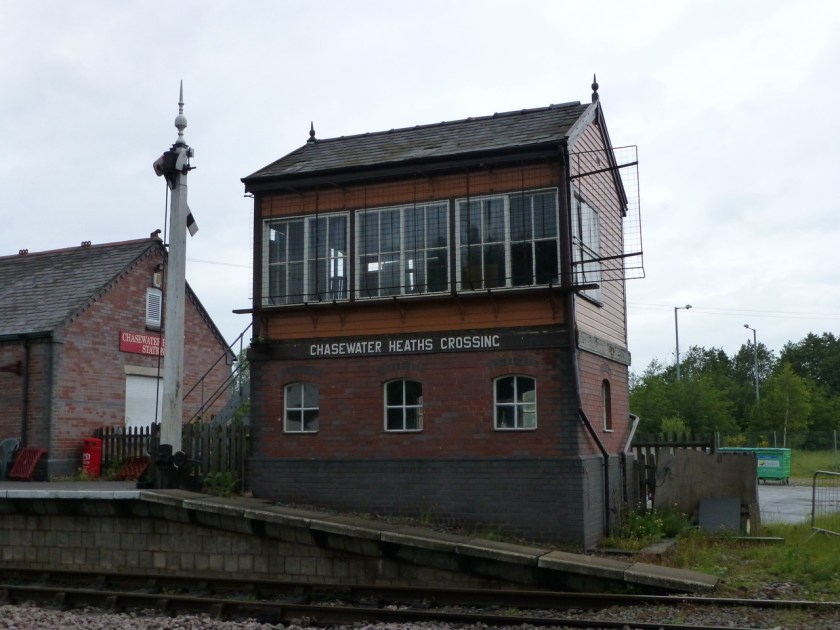
June 15th – The signal box at Chasewater Heaths, on the preserved coal line around Chasewater, has an interesting provenance. It originally stood at Hademore, near Fisherwick, east of Whittington, Staffordshire, where it controlled the level crossing. Upon expansion of the Trent Valley section of the West Coast Mainline, two more tracks were laid though the site of this box, and the crossing removed. The signal box was shipped, almost intact, to Chasewater Heaths to control the sidings proposed there. I have to say, I preferred it in white, rather than mustard brown… many is the time when I shouted conversation with the signalman as I waited at that crossing. Sadly, it it’s new home, it seems unmanned.

June 7th – Birmingham New Street. This is Birmingham New Street. All regular travellers through Birmingham’s derided main station will recognise that tannoy jingle. I have a love-hate relationship with the place; dark, grubby, overcrowded, a nightmare on a bike or for the elderly or disabled. Yet, unlike so many stations, the layout is logical, compact and easy to grasp. It just carries way too much traffic and we need a new station – possibly on Eastside – to relieve it, then maybe the platforms could be reduced in number and widened, some natural light could be let in. 

There’s history, here, too, but not many realise. The arches at the end of platform 2 and 3 are a remnant of the original Victorian Station, as are many of the retaining cutting walls. The signal box – a remarkable Brutalist style structure designed by Bicknell & Hamilton to resemble an electrical component, is listed and a wonderful thing. As developers tear away at the upper levels, the ‘regeneration’ (how I hate that word) of this much misunderstood transport hub will not solve any of it’s functional problems, but I’m still rather fond of the old dump, if I’m honest.