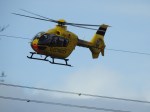
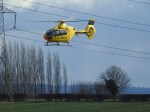
February 11th – Near Middleton and Drayton Basset, a Western Power Distribution survey helicopter was inspecting electricity lines. I’ve never seen this before, and feeling the draft from the rotors, watching the careful manoeuvres and skill of the pilot were fascinating.

How they never clipped the cables I’ll never know – but these crews must be top notch.

A real wonder on an otherwise quiet Sunday in rural Warwickshre…

March 8th – There’s clearly a traffic survey going on along the feeder routes on Walsall Ring Road. A huge amount of monitoring equipment has been temporarily installed at junctions and crossings, some of it quite high tech.

In a journey between Lichfield Road and Ida Road I must have seen 20 different items of equipment – cameras, motion sensors etc.

This must be costing a lot of money. Wonder what’s going on?

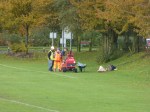
November 12th – Meanwhile, at the other Oak Park, something is happening. The 70s recreation centre and sports ground is up for a rebuild, and I’m hoping that should it happen, the council might be able to renovate the old park adjacent. All around the grounds of the leisure centre there are surveyor’s marks on the tarmac, highlighting measurements, cables and pipes. Meanwhile, on the football pitches, a small drilling machine was boring test holes to measure ground conditions. This plan is clearly serious.

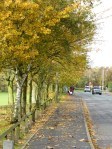
Meanwhile, the row of ornamental cherry trees on the east side of the site rain golden beauty on the Brownhills road. Hope they can be preserved in any new development; they’re lovely.

June 17th – At Spring Road station in Birmingham, I overheard to travellers discussing the white plates visible on the the edge of the opposite platform, down beside the track. They often baffle station users, and their usage is a bit obscure, really.

These are merely a datum survey marker for when the rails are replaced and the track relayed, which happens more often than one would imagine. Before the old track is moved, a surveyor uses a laser level or theodolite to measure the exact position of the rails, and their tilt angle if they have one. The rail height – plus any required offset – is set on the sliding knob, and is used as a datum for relaying new lines.

The legend proclaims this plate no 3; it’s 1105mm to the nearest rail, on the Up Main (UM) line. The cant (or tilt between the two rails to enable safer dynamic cornering of rolling stock) is 2mm.

The (just visible) +474 above the slider indicates that the level set is 474mm above the desired rail height (vertical offset) and a green knob says this is the level the rail should be at as it was designed, and may not currently be at that level. A red knob indicates the actual track position when the plate was installed.

Geometry like this is essential to rail engineers, who obsess over it. Maintaining correct geometry is of prime concern, prevents accidents and ensures trains fit under bridges, alongside platforms and don’t foul each other on bends.

You can often see these marker plates fixed to line side structures or electricity and signal masts.

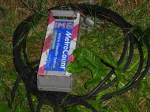
July 12th – there seem to be a lot of traffic surveys going on in South Staffordshire at the moment. Lots of back lanes seem to have the familiar rubber pickups nailed to the asphalt, just like this one in Gravelley Lane, between Shenstone and Stonnall. These devices count vehicles, and many modern ones take a punt at guessing what yore driving. The black cables are actually flexible, soft pipes, sealed at one end (usually by tying it in a simple knot). Any vehicle tyre running over the pipe causes the air pressure to rise within, and activates a pressure switch in the counter. By analysing the number of pulses and distance apart in time, many units can now tell the difference between HGV’s passing and normal cars. This device is probably installed for a routine traffic survey, and will soon be moved to a different spot. Surveys like this are regularly taken by councils.