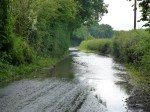
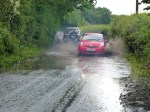
July 6th – Green Lane, Walsall Wood, after a day of heavy rain. It always floods here, and I doubt it can ever be stopped. Nothing to do but wait for a gap in the traffic, close your mouth and go for it.

Note the exemplary driving by the four-wheel drive. It takes real skill to be that much of an inconsiderate cock.

Sorry about the video quality, bad weather and an unwiped lens.

July 7th – One standing water issue I know it’s unreasonable to expect anyone to ever solve is Green Lane, at Jockey Meadows between Walsall Wood and Shelfied. It has always flooded here; it’s the lowest point on the road between the two places, and sits in the marshy wetlands that drain Shelfield, High Heath, Pelsall and Brownhills. I think there’s little that can be done in civil engineering terms to solve this, that wouldn’t involve pumps and huge expense. There’s nothing to do but pick your moment, and plough through it. It’s not like a rural flood, though, so take care. The sewage works is nearby, and when overwhelmed, it will discharge to the Ford Brook. There’s a very real chance of contamination in that water. Close your mouth and go slowly…

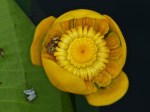
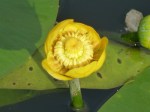
June 29th – It must be high summer , as the water lilies are in bloom on the local canals.These were near the Black Cock Bridge, in Walsall Wood. I don’t know if this is an invasive species or just a resurgent resident one, but they’re very lovely. We never used to see them when I was a kid, as the canals were too filthy to support much apart from sticklebacks and algae. The yellow variety – there’s a white lily too, which is also extraordinary – is fascinating to study. The flower heads are very complex. I’m quite fascinated by them.

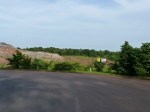
June 27th – A few people have remarked to me lately about the landfill site at Highfields South, behind Baron’s Court in Walsall Wood. The operators – Cory Environmental – are actually working to a defined plan here. At the moment, only half the void is full of waste, piled to some height, as you can see. this mound will be monitored, tapped for gas for use in a generator set, and with the weight on top, gradually settle to an agreed level. While this is taking place, waste is dumped in the to he half of the void, and the same process occurs. When the hole is full, the whole lot will be sealed with a layer of marl and topsoil, and parkland planted. The same kind of plan is in operation at the Vigo Landfill, on the other side of the canal. That one is now full, constantly generating electricity from landfill gas, and settling. In a couple of years that too, will be landscaped in public open space.

This is big business. There’s nothing so valuable as  a hole in the ground.
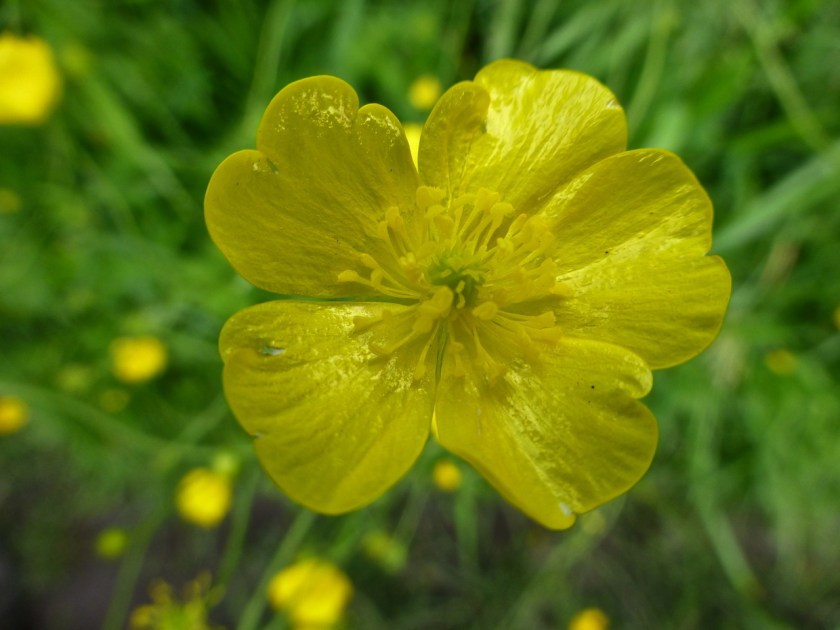
June 18th – The farmer who planted such a fine crop of beans seems very sensitive to wildlife, leaving wide fieldmargins and nic patches of scrub. This benefits the who biodiversity – bugs, birds, animals and flora. Still beautiful, though, however common, is the humble buttercup, here in abundance with cow parsley, dandelions, cornflower and poppy. Gorgeous.

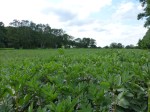
June 18th – I noticed cycling back home that the field between the sewage works and Goblin Wood in Walsall Wood seems to be host to a crop of broad beans, or at least, beans of some variety. Last year this field grew quinoa, and I guess growing a legume will re-nitrate the soil for good crop rotation. The crop looks healthy, despite being a little ravaged at the southern edge due to the weather. An interesting and unusual sight.

June 16th – I ad to go to Walsall to pick something up from the central sorting office. The weather was atrocious – windy and rather wet. I bit the bullet at lunchtime and pulled on shorts – wet legs dry quicker than wet trousers – and actually found it to be warm and oddly pleasant. I cycled along the canal, and noticed the flowers were in fine form, if a little battered. Orchids and waterlillies graced the Wyrley and Essington, whilst in the Goscote Valley upon my return, dog roses and sweet peas grew in scented abundance. Not a bad ride, all in all.

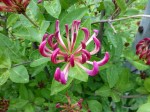
June 11th – Summer’s cauldron continues to simmer. I noticed whist climbing the Black Cock Bridge in Walsall Wood that the wild honeysuckle – or woodbine – I talked about choking the lupins was growing over the guard rails on the souther flank of the bridge. A riot of colour, these gorgeous blooms, when fully open, will smell wonderful. I never thought I’d see such a thing growing wild in this post-industrial landscape.

June 11th – It was spotting with rain as I came back through Walsall Wood. I stopped off to take in Jockey Meadows, between Shelfield and Walsall Wood. These fields, now a notified Site of Special Scientific Interest, are classic, marshy, undisturbed wildflower meadows. It was peaceful, and bullfinches and jays went about their business. I must come back to explore these on a sunnier day. 

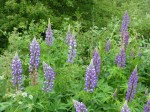
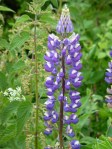
June 8th – Returning from Walsall via the canal (it seemed to be drive like a moron day, and yet again, nobody had informed me), I noticed that with all the rain, the lupins were out. I love these flowers, and they used to grow with greater profusion here than they do now. On this bank of the new pond at Clayhanger, they seem to be being choked by a somewhat voracious growth of honeysuckle. The dilemma contemplating this is somewhat delicious considering the scarred industrial heritage of this land.

This, of course, was once the foot of a spoil heap.