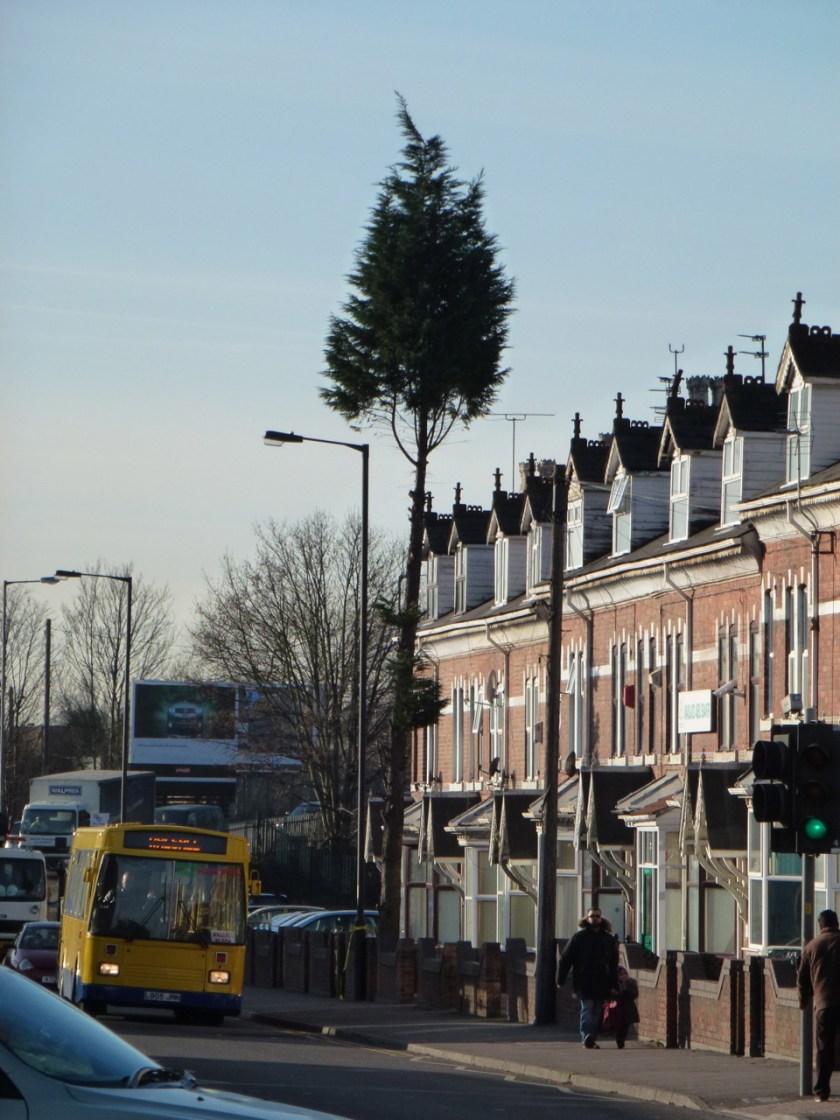
January 13th – Whilst pottering down the Wednesbury Road, I noticed a curio I’d not been aware of before – a pine tree, or conifer, growing in the front garden of one of the terraces that now form the Girls School there. It’s very, very tall, and has progressively had the lower branches trimmed away. I don’t think I’ve ever seen this in an urban environment before – and why, in all the years it must have existed, have I never noticed it? A real oddity.

January 13th – it was a hectic, draining day. I had a meeting in Brownhills, then had to got to the doctor, then on to work. My infection has returned and my stomach was bad again, ever since finishing the antibiotics. It was about 11:30am as I cycled to work in Darlaston. Heading through Walsall town centre for a change, I passed this pair of Victorian semis that used to be neighbours of the now demolished Mellish Road Church. They’re actually very interesting, as they were just saved from demolition – the subsidence that caused the closing of the church affected them, too; but better construction and less weight helped them survive. They’re a very good illustration of the effects of subsidence – in this case caused by limestone caverns – as outwardly, they look straight, but when studied, there isn’t a single true line anywhere on them. A testament to the tolerance of Victorian building techniques.

January 10th – A little further on, and a vista opened up I hadn’t noticed before. This is why I love Walsall. The light caught the dome on the Sikh Gurdwara at Wellington Street, framed perfectly by it’s surroundings. Every generation and every group brings their own architecture to the Black Country, and the Sikhs are no exception. This is why I love this place. A new face for every angle, every angle a new view. Catching the light like a jewel.

January 10th – Back in Darlaston, I enjoyed the morning commute. It was temperate and bright, and although there was a headwind, it felt good to be outdoors. I hopped on the canal in Walsall and cycled to Bentley Bridge. On the way through Pleck, I noticed that the peculiar algal bloom that Roger ‘Ziksby’ Jones had noticed on the Rushall canal, was now growing here, too. I suppose it must be the mild winter. I wonder what it is exactly, and why it suddenly proliferates like this?

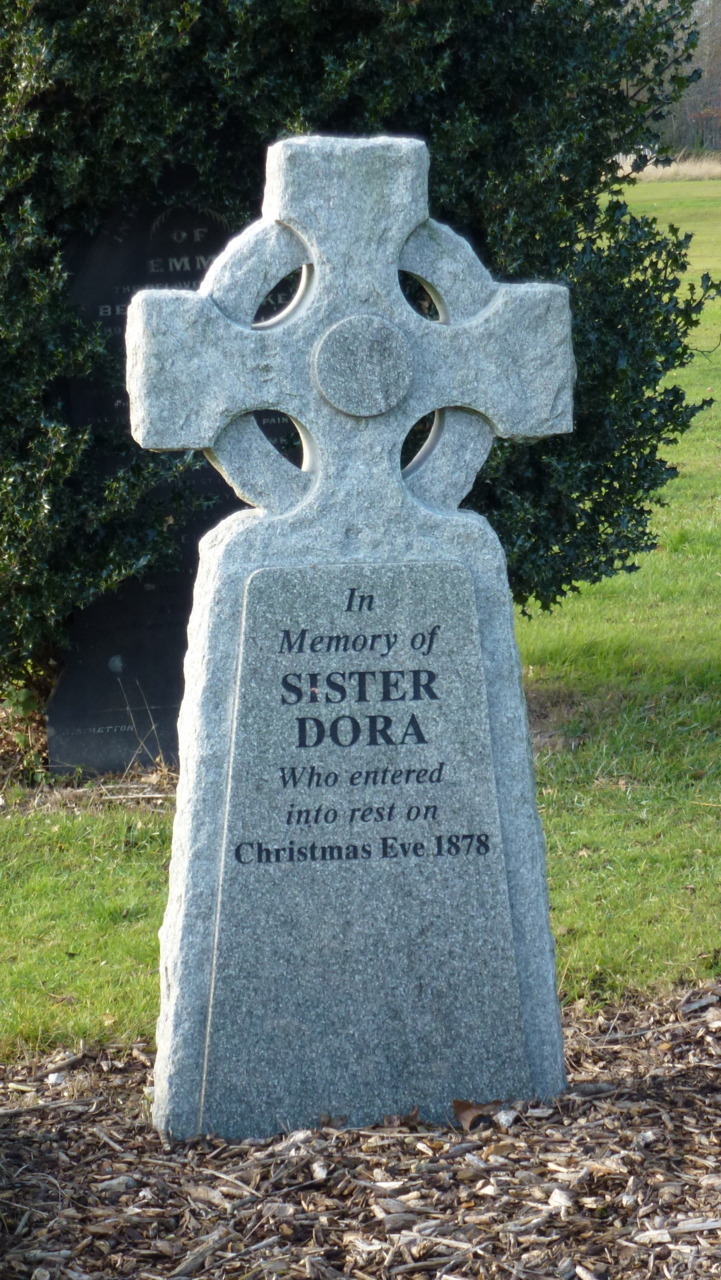
December 15th – Of all Walsall’s notable folk, I think perhaps the most loved is Sister Dora. Dorothy Pattison was one of the first nurses in the town, and she worked tirelessly to heal the sick and injured from industrial accidents and smallpox. She was well respected in her lifetime, and her reputation remains to this day. She’s buried at the sadly dilapidated Queen Street Cemetery in Walsall, in a very low key grave. Her statue stands proudly on The Bridge in Walsall, and as well as giving her name to streets and buildings locally, Dora also gave her name to the town’s mental hospital. 

Wikipedia has this to say about the great nurse:

She was the second-youngest child of the Rev. Mark James Pattison, and sister of the scholar Mark Pattison Jnr. From 1861–1864, she ran the village school at Little Woolstone,Buckinghamshire.

In the autumn of 1864, she joined the Sisterhood of the Good Samaritans at CoathamMiddlesbrough and devoted her life to nursing. She was sent to work at Walsall’s hospital in Bridge Street and arrived in Walsall on 8 January 1865. The rest of her life was spent in Walsall and it was there that in local eyes she became to be compared with Florence Nightingale.

Later she worked at the Cottage Hospital at The Mount.

In 1875, when Walsall was hit by smallpox, Sister Dora worked for six months at an epidemic hospital being set up in Deadman’s Lane (now Hospital Street). During 1876, Sister Dora attended more than 12,000 patients.

The last two years of her life, Sister Dora worked at the hospital in Bridgeman Street, overlooking the South Staffordshire Railway (later the London and North Western Railway). It was there that she developed a special bond of friendship with railway workers who often sufferen in industrial accidents. The railwaymen gave her a pony and a carriage and even raised the sum of £50 from their own wages to enable Sister Dora to visit housebound patients more easily.

In 1877 Sister Dora contracted breast cancer, and died on Christmas Eve in 1878. At her funeral on 28 December the town of Walsall turned out to see her off to Queen Street Cemetery, borne by eighteen railwaymen, engine drivers, porters and guards, all in working uniform. On her death Florence Nightingale paid the following tribute, ‘May every nurse, though not gifted with Sister Dora’s genius, grow in training and care of her patients, that none but may be better for her care, whether for life or death’. Her epitaph read, ‘Quietly I came among you and quietly let me go’.
December 15th – Hopping on the canal at Bridgman Street in Walsall today on the way to work, I noticed new graffiti – or at least, some I hadn’t noticed before – on the walkway wall. Someone has clearly been taking inspiration from Banksy, and having a go with stencils. As things go, I don’t mind these, as they’re attractive and interesting. I thought the cat and magpie were particularly well executed. I’m intrigued, though; a caped, make man, Marylin Monroe, a magpie and a cat. What do they have in common, if anything? I looked out for more, but didn’t spot any.

December 14th – I spotted this interesting old bike captive in the old mill by the canal in Walsall today. It looks about 70’s vintage – it’s a large frame, drop-handlebar tourer. It was clearly a high quality machine, as the front wheel is secured with the old style butterfly quick release – these were only fitted on the highest end bikes. I’d really like to rescue this forlorn steed, yet have no idea who the mill, or the yard around it, belongs to.

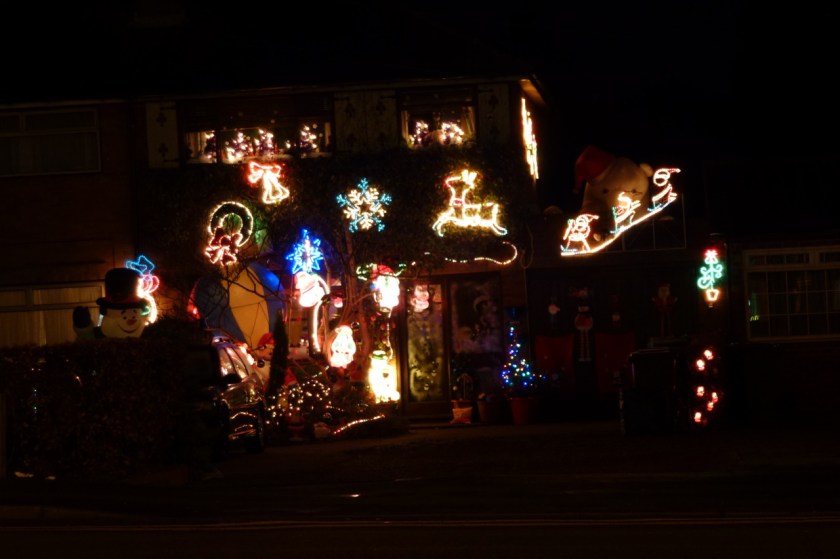
December 9th – I like Christmas as much as the next man – that is, I generally keep my head down and enjoy the break. However, I don’t think I’ll ever match the enthusiasm of some of those who have adopted the odd suburban American tradition of decorating the outside of one’s house with lights. This example is in Rushall, and I quite like it. There are plenty of examples locally. I find the whole phenomena utterly baffling.

December 9th – Newcomers to Walsall often wonder where Karma is. Lots of folk talk about it, but it’s not marked on any map. There’s a reason for this – it’s actually spelt Caldmore. This local linguistic quirk helped nail child killer Raymore Morris, and continues to baffle delivery drivers and visitors alike. The area itself is busy and possesses the air of the inner city. A huge immigrant population – initially afro Caribbean, then asian, now eastern European have settled in areas like this around south Walsall. This has led to a huge variety of shops, busy into the night, selling everything from furniture to felafel to fenugreek. The focus, of course, is on the asian; samosa, shashlik and shami mingle with brightly coloured burfi, gulab jamun and jalebi. On a Friday Night at 6:30pm I stop for indian snacks, smell the aromas of cooking for tomorrows wedding parties and mooch through the Polish delicatessen. I love this place.

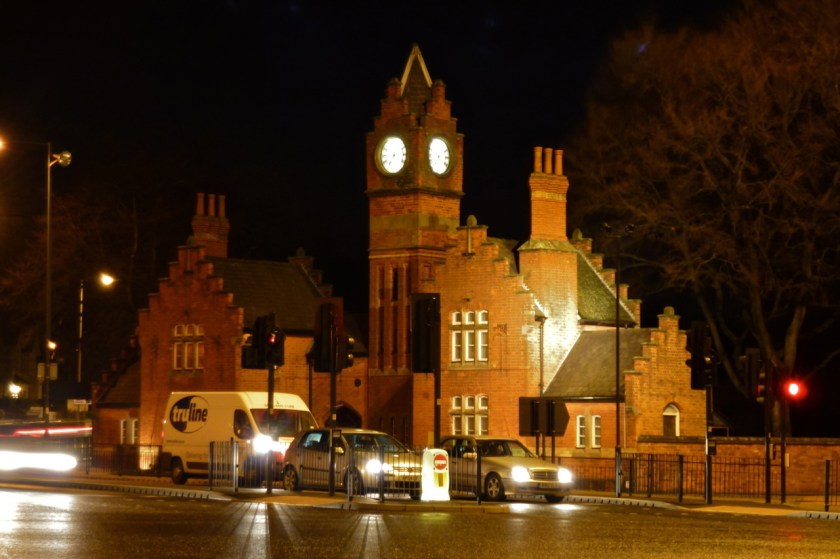
December 8th – Walsall Arboretum is the jewel in Walsall’s Victorian crown. The extensive park was created out of former limestone mining land over a century ago, and remains, to this day, a classic example of a municipal park. Neglected somewhat for two decades, it is currently undergoing a lottery-funded restoration which has proven controversial. The gatehouse – classically Victorian in design and execution – is sadly diminished now by being overseer to the hideous traffic junction bearing the park’s name. Still, the handsome tower and clock give the weary cyclist something to admire whilst waiting for the lights to change…