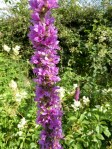
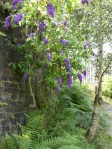
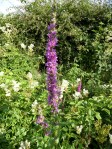
July 22nd – Lots of this gorgeous purple flower about at the moment, chiefly in ditches and damp areas. At first I thought it was an orchid of some sort, but thanks to help from twitter, it turns out to be purple loosestrife.

It’s gorgeous, and there’s lots of it this year, complimenting the foxgloves, buddleia and willow herb beautifully.

Purple really is the colour of high summer…

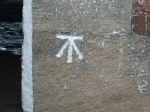
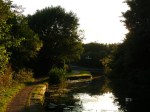
July 22nd – A fast, enjoyable 50 mile ride on an afternoon bunked off work saw me calling at Barton and then Rosliston for excellent carrot cake on a hot, sunny day. On the way, I took in a little of the canal near Barton Marina, and spotted the benchmark in the bridge just by Barton Turn. I think that’s the first I’ve ever seen highlighted with paint and it also seems rather high.

It must be genuine, but I sense a story here. Any ideas?

July 21st – It’s true that I am one of those characters that amasses a huge amount of trivia and mental flotsam as I go about daily life, and this is one of those things, but in my defence, I was actually asked about this a month or so ago so here you go…

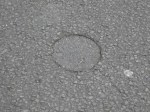
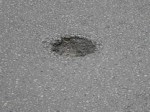
People who study the road surface (and there are a few of us, mainly on 2 wheels) may notice perfectly circular cutouts, punch-throughs or holes in the endless asphalt. Sometimes they’re filled with tar, or white lining paint. Often, they have the material that came out of them put back in like a tarmac divot. Sometimes, they open into potholes, particularly if badly sealed. But what are they?

These odd features are the signature of the road surveyor, and a road near the end of it’s life. When a road is resurfaced, the tarmac is literally planed off by a large cutting machine. The planings are then taken away, recycled back into asphalt, and relaid. How deep that planing operation goes is critical, as is knowing the depth of the road surface, and what it’s like beneath the blacktop ‘crust’.

When a road is considered for resurfacing, a surveyor will take cores with a drill and round cutter at about 100-125mm diameter, and extract them like a cheese taster sampling a cheddar. They are photographed, measured and replaced (or filled). From this a plan of work can be formulated.

Sometimes cores are taken in pairs, close together; others they are equally spaced along the length or a road, on either side. These, spotted around Walsal today, are in various states of becoming potholes themselves and adding to the problem they were created in the process of alleviating.

I’m convinced that every time I learn rubbish like this, it pushes something useful out of the back of my brain.

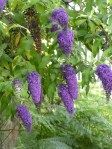
July 20th – People seem to think I’m negative about buddleia, but I’m not really. It’s a beautiful purple shrub that lights up late summer wonderfully, and it’s not known as the butterfly bush for nothing – the Lepidoptera love the huge flowerhead composed of tiny, individual blooms. 

My problem with this plant – if it’s a problem at all – is that for me, it’s a harbinger of urban decay. It’s so successful in urban environments that it’ll grow well in a patch of soot in vertical brickwork. At this time of year, throughout the urban expanses of the UK you can see buddleia sprouting and flowering from derelict buildings, bridges and rail lines. Seemingly one of the first signs that nobody cares for a place anymore is that it starts flowering in purple at high summer.

You can’t blame the plant for that… 

July 19th – Oh, hi pals. Where have you been? Not seen you for a while.

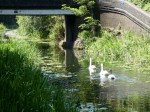
Near Bentley Bridge, just near the nest where they hatched their single cygnet, the swan family were moving purposefully towards Darlastoin.

Their single offspring – very attentively looked after – is growing large, and doing well by the looks of things. 

They stopped briefly to see if I had food, then scooted on, little one in the classic ‘resting foot’ position, leathery limb tucked high on the back for rest.

A lovely sight.

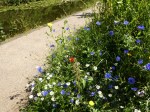
July 19th – I’ve been largely ambivalent about the odd project to resurface the canal towpath between Walsall Town Wharf and the Bentley Mill Way aqueduct. It’s a decent enough job, I guess, but I don’t feel the surface is that much of an improvement, and the loose gravel and untreated under bridges are problematic. But there is something that’s beautiful.

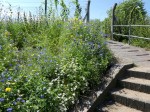
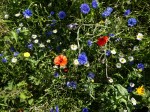
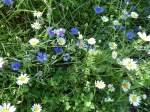
When the contractors remade the retaining walls to the steps at the Scarborough Road Bridge in Pleck, they planted wildflower seeds down the embankment, and at other spaces on the towpath.

This has resulted in stunning little urban patches of sunshine like this, so wonderful on what was the hottest commute of the year so far.

Thank you to whoever, for the act of beauty and foresight.

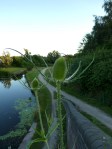
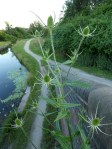
July 18th – I like this a lot. On Catshill Junction Bridge, just on the Walsall Wood side, there is a very healthy teasle plant growing from the brickwork.

It’s now tall, and in bloom. It looks fantastic, and slightly alien, as these plants always do.

A migrant from the wild sowing of nearby Clayhanger Common, we never would have seen these kind of plants here in my childhood. A wonderful, life-affirming thing.

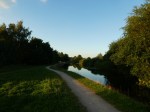
July 18th – A pootle up the canal to Walsall Wood on an errand in a glorious golden hour. The hottest day of the year so far, the water bubbled as unseen creatures walled in the cool water, and grasshoppers, bees and birdsong filled the air.

An absolutely wonderful evening that shows that while people seem to think this area is ugly, it’s actually beautiful.

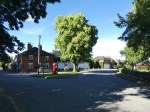
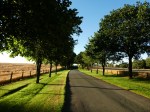
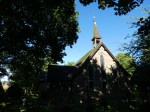
July 17th – In spite of some grim mechanical problems and slow initial progress, I made it to Rosliston for tea and cake, and then pootled back through Coton in the Elms, Lullington, Clifton Campville, Haunton and Syerscote, calling at Hints and Weeford in the golden hour.

The villages glowed in the summer evening warmth, and even though I was battling a keen westerly, my England was right here – in a view familiar to Peter Cutler, in the flower-adorned villages, and in the sad but tranquil churchyard at Haunton, with it’s ranks of gravestones to nuns from the nearby convent.

It doesn’t get much better than this.