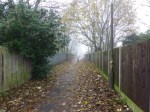
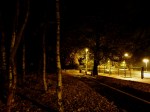
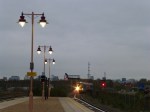
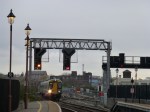
November 15th – Autumn – season of mists and mellow fruitfulness. Well, we got the mists. Cycling on foggy days like this is unpleasant. in a short, 20 minute journey to Blake Street, 6 cars and 1 cyclist without lights at all. The usual selfish, aggressive driving. The discomfort of water condensing over your clothes and face. 

It does, however, add a pleasantly enjoyable air of mystery to otherwise unremarkable scenes. A challenging day for riding, and photography too.

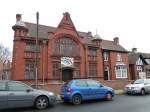
November 13th – Later, in Acocks Green, I was surprised to note some old and rather wonderful architecture I hadn’t noticed previously. I was so busy looking for old cottages last week, that I never spotted some rather wonderful examples of civic buildings in Alexander Road. The Baptist Church Hall is a classic Birmingham terracotta brick building, and puts me very much in mind of the Magistrates Court in Corporation Street in the city centre. It seems to have an attached caretakers house, and next door appears to be an attractive former schoolhouse. I must look into the history of these buildings – they’re very grand for a small suburb. There must have been a fair bit of money here once…

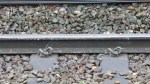
November 13th – As I waited for yet another late train at Blake Street this morning, I gazed at the rails. The train service has been lousy of late – continual staff shortages and equipment failures have made the system terribly unreliable. This particular service hasn’t been on time for a fortnight at least. Normally at this time of year, London Midland, the local train operator, would institute a ‘Leaf fall timetable’. This is a much derided, but little understood thing. Falling leaves lie on the rails and get pulped by the train wheels, creating a slippery, sappy lubricant the causes wheels to slip and brakes to become ineffective. The pulp also forms an insulator which prevents signal detection functioning.

A leaf-fall timetable allows drivers to go more slowly and allows rail cleaning trains to operate in-between passenger services. The cleaning trains spray gelatinous substance on the rails called Sandite, which as it’s name suggests, contains sand to counter the grease. The rails I was looking at had clearly just been treated, and the residue could be seen. This is a huge problem for trains worldwide and not unique to the UK.

I’m unclear why there’s no leaf fall timetable this year, and the services on the Cross City line are woeful. Combined with cancellations due to staff shortages, bad signals and train breakdowns, I bet they’re losing punters hand over fist.
November 12th – It was on my return that afternoon that I spotted a relic of times past, fitted high up on the gable wall of a house on the Walsall Road in Darlaston. It’s an Ionica antenna. You don’t see many of those about now.

Ionica were a pre-internet age telephone company that promised much, yet failed in the dot com boom. Launched in the early nineties, they offered cheap telephone line packages. What was unique was that the technology they offered was based on microwave transmission, rather than the copper wires BT used. If you signed up, engineers came out and installed one of these octagonal 3.5GHz microwave antennas, which pointed at a base station in the locality. The idea was fine, but never covered it’s costs, and as they were narrowband, would have been useless for the internet connections that were to come later. The company value was inflated to over a billion pounds in 1997, but collapsed in 1998. The network was wound down by BT, and only a few remnants like this antenna survive.

Like the Rabbit zone phone, a curious idea in a time of great change.

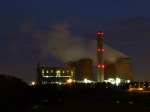
November 11th – Returning via a rather dark and cold Rugeley bypass, at least I had the wind behind me. I stopped at the Bridge in Rugeley and checked out the view before me. I love Rugeley Power Station by night. This is one of the most advanced coal burning generation facilities in Europe, and the fume scrubbing plant, covered in lights, is futuristic and fascinating at night. Built as one of the postwar River Trent behemoths, most of it’s companion facilities have long since gone, like Drakelow and Willington. A stunning, and dare I say it, beautiful thing.

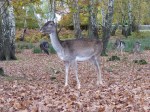
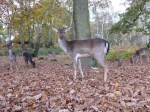
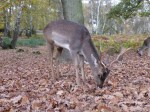
November 11th – An afternoon on Cannock Chase, with mixed results. It was chilly, but clear, and I was looking for badgers. I found the sett I was after, but approached with the wind the wrong side of me and they stayed resolutely hidden. No such shyness, however, from the Penkridge Bank fallow deer who were loafing in their usual spot. The handsome young stag – too young for the recent rutting, I suspect – was drawn by my offerings of carrot and flapjack. These animals are usually here, but usually very skittish. I think the recent chillier weather has drawn them a shade closer to humans. beautiful creatures. Shame the light was so bad.

November 10th – I didn’t get out until nightfall. It was cold, and clear, and I was all set. Then I discovered my camera had not charged from the night before. I carried on with my ride, then returned home, got a fresh cell, and nipped out to Brownhills. It was around 7pm, and the High Street was quiet. I looked in Ravens Court, the battered, all but derelict shopping precinct. A typical design of the period, it was further bastardised by a hideous facelift in the 1990s. It’s now down to a couple of tenants, and stands, unloved, steadily decaying. Tesco were to demolish this and build a new superstore, but they got cold feet and have left the community in limbo. this desolation is our gift from the retail behemoth that destroyed our town. At night it’s grim, desolate and forbidding.

In daytime, it’s worse.

Further towards home, I traversed the Black Path, the cycleway and footpath that heads up through Holland Park to the A5 and Newtown. That too was dark and hostile. I don’t know what it is about Brownhills at night these days, but the quality of darkness seems to be getting more malevolent. Perhaps it’s just the mood I’m in…

November 9th – The day was very grey indeed, and the train service lousy. Bad weather had been predicted for the evening commute, and with cancellations and slow running all round, I left work half an hour early. We’re in the days now of the nascent winter; grey, smoggy air, partial drizzle and heavy cloud makes for a greasy, unreal, not-quite-daylight feel. This is the worst bit of winter for me; not cold enough to be dramatic, or photogenic, or even challenging to ride in, but just headache-grey mundanity, rumbling from day to day. Stuff this, bring on some real winter, please. Snow, or crisp frosty mornings with bright air that hurts your forehead and clutches your chest when you breathe in. 

The only thing that looks good in the is murk is the light of the railway. Steady, bright, control.

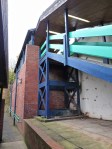
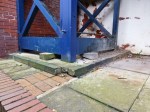
November 9th – I’m fascinated by this bit of structural joinery at Blake Street Station. It’s nothing more than the wooden frame supporting the access steps to the Birmingham bound platform, but the way they’re erected is a work of art. At the base, they’re chocked level with two pairs  of perfectly cut reverse acting wedges. You don’t see that very often these days. I’d be interested to know how old this assembly is – had it been crated today, it would be a steel framework with jacking bolts, so it must be at least 2 or 3 decades old. The precision of the wedges makes me smile every time I see them. That was a joiner who understood his art.

November 7th – I’m really getting into Acocks Green in Birmingham. I love the suburban, Metroland architecture, broad tree-lined streets and air of urban dignity. What’s really interesting me, particularly now I’ve spotted Hay Hall, is that there are clearly buildings of an earlier period dotted throughout the district. Some are quite well hidden, but this suggests a long history. This is fascinating and I must read up.