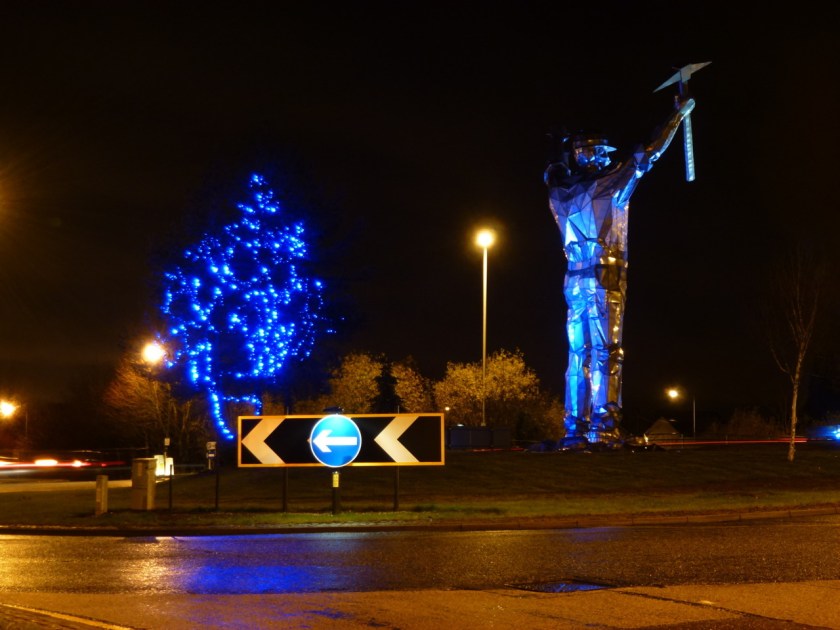
December 17th – A day infused with pre-Christmas rush. I finally got out on my bike at teatime, and took a spin around a very wet Brownhills. The roads glistened and it felt quite Christmassy. Morris Miner, when viewed from the Lichfield Road, always looks to me as if he’s expressing contempt towards the town. Still not absolutely sure they erected him the right way around… the blue lighting cheapens him, too. Shame they couldn’t have lit his lamp, like the residents requested. 

December 16th – I’d been looking forward to a snowy, wintry commute. The weather forecasts had been for a cold morning with maybe a settling of snow, but it was not to be. Sadly for me, I was sold short and have never quite been so disappointed to find myself cycling on a bright, sunny and temperate morning. Here at Darlaston Green, the sun caught the wet town and made it beautiful. Yet another example of why I love Darlaston so much. Ah well, the snow can wait…

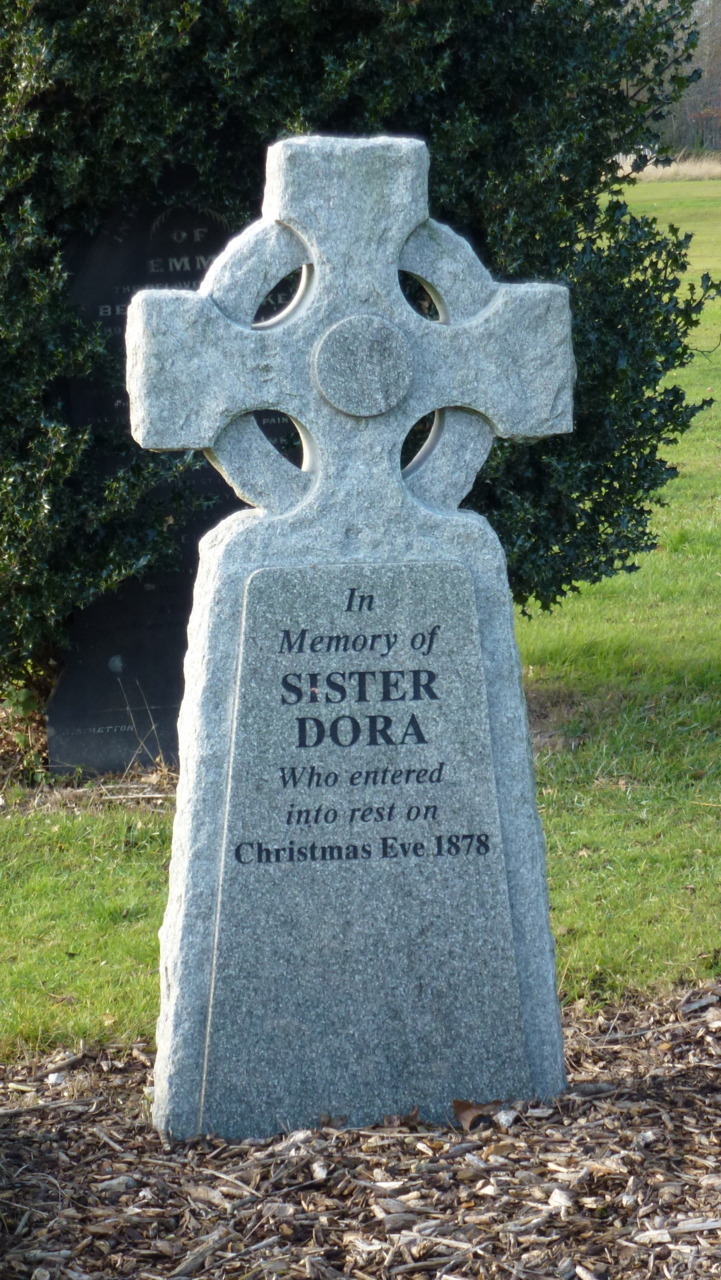
December 15th – Of all Walsall’s notable folk, I think perhaps the most loved is Sister Dora. Dorothy Pattison was one of the first nurses in the town, and she worked tirelessly to heal the sick and injured from industrial accidents and smallpox. She was well respected in her lifetime, and her reputation remains to this day. She’s buried at the sadly dilapidated Queen Street Cemetery in Walsall, in a very low key grave. Her statue stands proudly on The Bridge in Walsall, and as well as giving her name to streets and buildings locally, Dora also gave her name to the town’s mental hospital. 

Wikipedia has this to say about the great nurse:

She was the second-youngest child of the Rev. Mark James Pattison, and sister of the scholar Mark Pattison Jnr. From 1861–1864, she ran the village school at Little Woolstone,Buckinghamshire.

In the autumn of 1864, she joined the Sisterhood of the Good Samaritans at CoathamMiddlesbrough and devoted her life to nursing. She was sent to work at Walsall’s hospital in Bridge Street and arrived in Walsall on 8 January 1865. The rest of her life was spent in Walsall and it was there that in local eyes she became to be compared with Florence Nightingale.

Later she worked at the Cottage Hospital at The Mount.

In 1875, when Walsall was hit by smallpox, Sister Dora worked for six months at an epidemic hospital being set up in Deadman’s Lane (now Hospital Street). During 1876, Sister Dora attended more than 12,000 patients.

The last two years of her life, Sister Dora worked at the hospital in Bridgeman Street, overlooking the South Staffordshire Railway (later the London and North Western Railway). It was there that she developed a special bond of friendship with railway workers who often sufferen in industrial accidents. The railwaymen gave her a pony and a carriage and even raised the sum of £50 from their own wages to enable Sister Dora to visit housebound patients more easily.

In 1877 Sister Dora contracted breast cancer, and died on Christmas Eve in 1878. At her funeral on 28 December the town of Walsall turned out to see her off to Queen Street Cemetery, borne by eighteen railwaymen, engine drivers, porters and guards, all in working uniform. On her death Florence Nightingale paid the following tribute, ‘May every nurse, though not gifted with Sister Dora’s genius, grow in training and care of her patients, that none but may be better for her care, whether for life or death’. Her epitaph read, ‘Quietly I came among you and quietly let me go’.
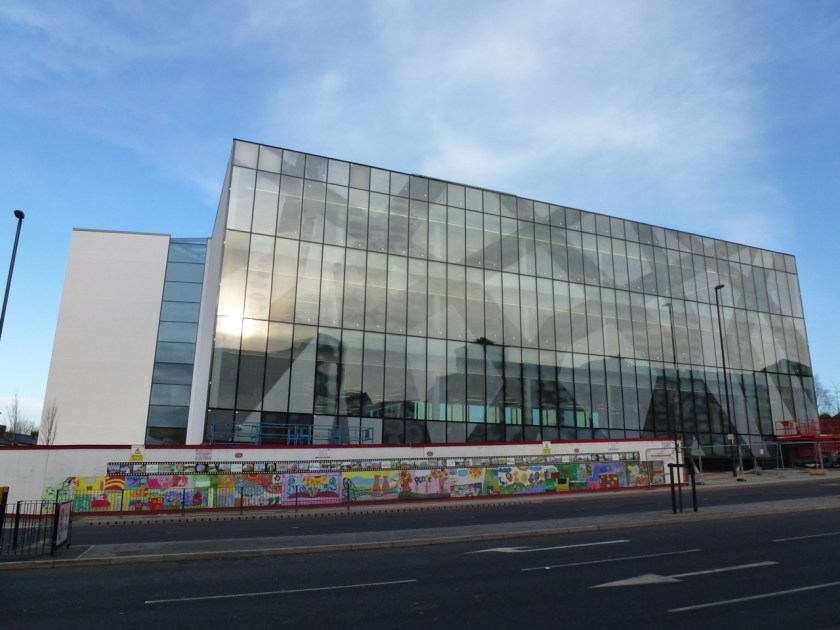
December 14th – Walsall Housing Group have spent a huge amount – said to be about 6½ million pounds – on a new headquarters at Hatherton Street on the new ring road in Walsall. The development seems to have undergone some difficulty, with the glazing suffering a manufacturing fault causing condensation ingress and having to be replaced. The entire project was hoped to kickstart Walsall Council’s ill-fated Gigaport project, a development area intended for high tech businesses. There have been few takers, however, and the council sold the land this block stands on for a pound. Sometimes, I think councils should leave development stuff to the developers. These things never seem to go right… 

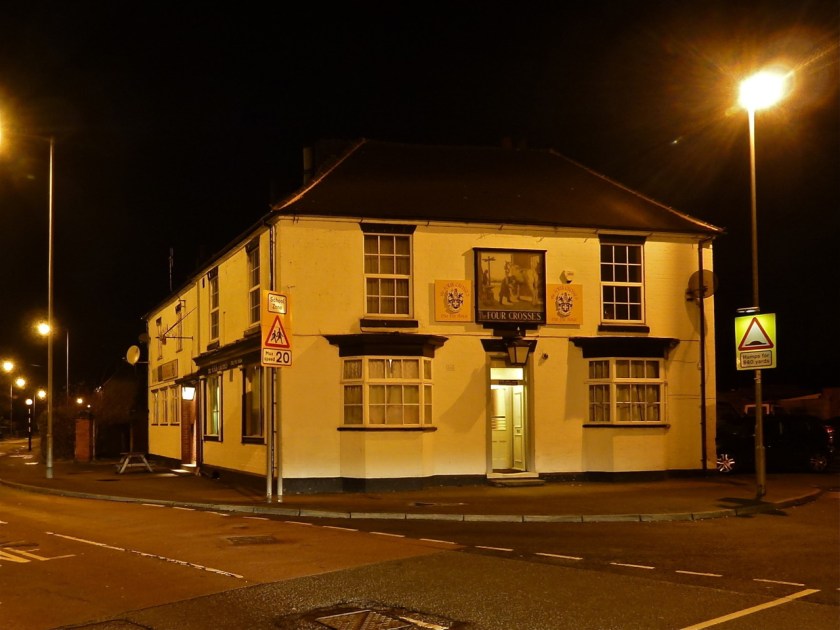
December 13th – Over in Shelfield, the traditional boozer wins. Whilst the Spring Cottage had loads of brewery money spent on renovations and refits over the years, the Four Crosses behind it ploughed on in it’s own traditional way. The larger, more modern pub failed; a succession of poor managers, problems with the clientele and falling returns now see it being converted to a Co-op store. The street corner local behind it, however, has always been peaceful and welcoming. Closed for a few months a couple of years back, it was thought to be lost, but a new owner and good real ale ensured its revival. A pub in the true sense of the word.

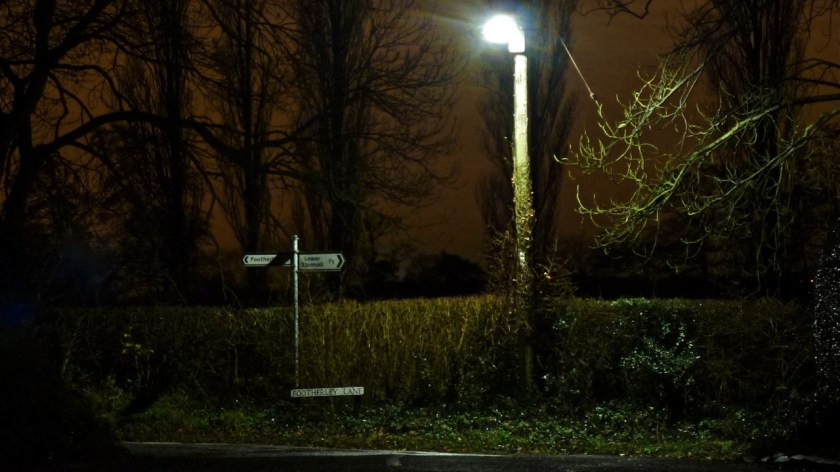
December 11th – A warm, damp evening following a blustery, wet afternoon. The wind had died down, the rain ceased and the temperature had risen by the time I ventured out for a lazy loop of Stonnall and Shentsone. I’ve always been fascinated by the single, rather aged mercury streetlamp that stands sentry on the junction of Footherley and Hollyhill Lanes; it illuminates the fingerpost and is like a beacon to the weary cyclist. Many times I’ve been glad of it’s welcome sight on a cold, dark winter evening.  

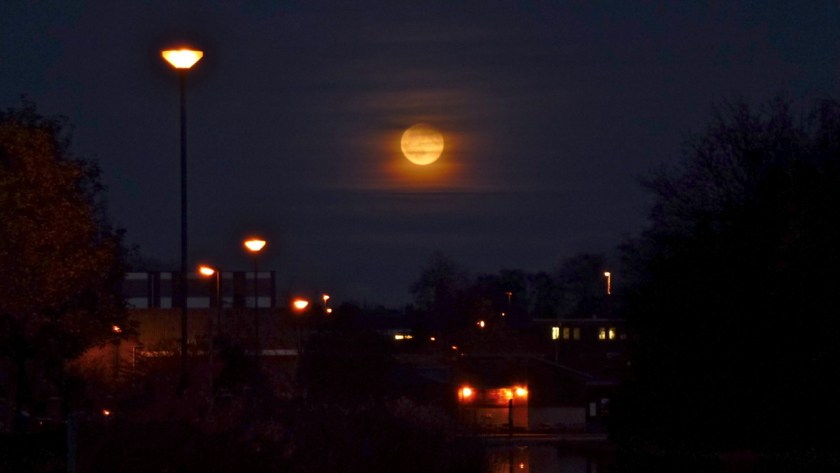
December 10th – The moon was remarkable. Heading along the canal by the Watermead Estate, I noticed it behind me; orange and masked by banded cloud. I missed the eclipse, but there was something about that big, orange lunar glow that I found reassuring. It doesn’t seem long since that moon was new, and time is passing. Soon, it will be the shortest day, and life will begin to open out again; the moon will continue its inexorable transitions, and soon there will be lightness and spring again. A lunar chronicle. Winter draws on…

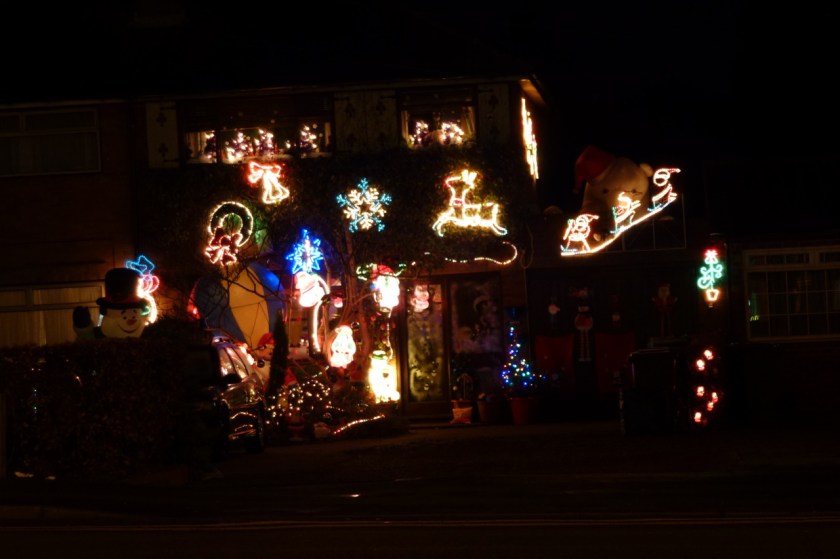
December 9th – I like Christmas as much as the next man – that is, I generally keep my head down and enjoy the break. However, I don’t think I’ll ever match the enthusiasm of some of those who have adopted the odd suburban American tradition of decorating the outside of one’s house with lights. This example is in Rushall, and I quite like it. There are plenty of examples locally. I find the whole phenomena utterly baffling.

December 9th – Newcomers to Walsall often wonder where Karma is. Lots of folk talk about it, but it’s not marked on any map. There’s a reason for this – it’s actually spelt Caldmore. This local linguistic quirk helped nail child killer Raymore Morris, and continues to baffle delivery drivers and visitors alike. The area itself is busy and possesses the air of the inner city. A huge immigrant population – initially afro Caribbean, then asian, now eastern European have settled in areas like this around south Walsall. This has led to a huge variety of shops, busy into the night, selling everything from furniture to felafel to fenugreek. The focus, of course, is on the asian; samosa, shashlik and shami mingle with brightly coloured burfi, gulab jamun and jalebi. On a Friday Night at 6:30pm I stop for indian snacks, smell the aromas of cooking for tomorrows wedding parties and mooch through the Polish delicatessen. I love this place.

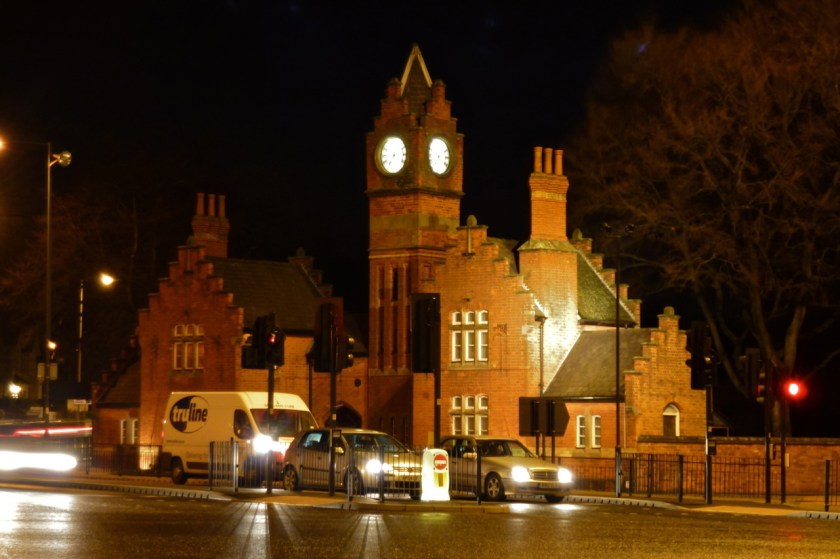
December 8th – Walsall Arboretum is the jewel in Walsall’s Victorian crown. The extensive park was created out of former limestone mining land over a century ago, and remains, to this day, a classic example of a municipal park. Neglected somewhat for two decades, it is currently undergoing a lottery-funded restoration which has proven controversial. The gatehouse – classically Victorian in design and execution – is sadly diminished now by being overseer to the hideous traffic junction bearing the park’s name. Still, the handsome tower and clock give the weary cyclist something to admire whilst waiting for the lights to change…