#365daysofbiking Radio activity and G force

June 20th – Another dusk departure from work gave me chance to take some pictures of networking equipment causing some bizarre consternation locally at the moment.

A handful of local residents have spent some time in the dafter enclaves of social media and decided these white boxes and antenna on lamp columns, traffic signals and street furniture in Walsall are the rollout equipment for the fifth-generation telecoms network.

For some reason conspiracy theorists are given to believe the fifth generation network will be harmful to health, is a plot to test radiation on the population and an effort to spy on us all. Oh, and it’s somehow all connected with low energy LED street lighting.

Well, these boxes and aerials are far more mundane: They are actually pretty much high speed WiFi like we have in our homes, but designed as a specific, peer to peer network for traffic signals and other on-street infrastructure that benefits from central control.

It’s called Mesh4G and you can see it here.

As signals, junctions, crossings, air monitoring and traffic cameras are updated across Walsall, more of these relay units will appear, allowing traffic folk to monitor, modify and control their equipment without having to leave the office.

Which is interesting to me as a geek, but far more mundane than conspiracies would have us believe.

And I’ll still be waiting ages at the Bull Stake junction in Darlaston…

This journal is moving home. Find out more by clicking here.

from Tumblr http://bit.ly/2WVgf31
via IFTTT

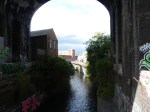
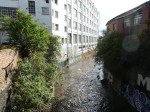
May 19th – Much of the journey was an errand in Digbeth. I visited the Custard Factory, the hipster area that once promised so much, but these days seems to be a sort of holding area for a failed urban arts dream; but beyond it I found the River Rea, skulking through Digbeth like a dirty secret. 

Also in the backstreets, the bizarre, never finished abandoned Duddeston Railway Viaduct, partially built by the Great Western Railway to gain access to Birmingham New Street, but abandoned half-built when they built their own station at Snow Hill instead, now standing as a sort of infrastructure curiosity, barely noticed by most people who visit.

Returning through Aston and Gravelly Hill, I passed from Salford Park to Aston itself, along the cycleway by the Tame, snaking under the motorway and Cross City Line viaducts. The 1960s motorway revolution heard you liked viaducts, so they put another viaduct over the one you already had.

Birmingham is about it’s arteries: river, canal, rail and road. They both bisect the city, and give it character and history, and I love them all.

February 14th – Also caught in the sunset was the M6 Toll, Britain’s toll motorway, recently put up for sale by it’s banker owners, presumably because this botched, badly conceived project isn’t making enough money.

Frequently next to empty, people never flocked to use it as the tolls were considered too high, and the whole misadventure – which was at one time to be the future of such roads in the UK – does little except illustrate the folly of a country where we can no longer invest in anything for the common good. 

When everything – even the most basic infrastructure schemes – have to turn a profit – then this is what we end up with. We need to stop thinking about price and get back to value.

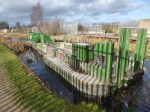
February 2nd – I had to leave work and pop to Walsall mid morning, so I hopped on the canal. Passing through James Bridge, I noticed a works compound had been set up, and butties and a utility boat were blocking the canal under the old IMI bridge. From the contents of the compound, it seems a particularly daft folly is about to commence: the tearing up and resurfacing of one of the best canal towpaths in Walsall.

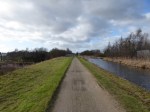
The stretch from here to Walsall is being relaid by the Canal & River Trust, apparently as a cycle route, for reasons I’ve been unable to discern; but one thing I’ll guarantee is the person who decided it was needed was not a cyclist.

The towpaths here are wide, smooth and well made, in contrast to those from Aldridge to Rushall Junction, which are unusable in winter, or those through Pelsall to Goscote. The money spend here will be an unneeded waste.

Breathtaking folly.

October 28th – Last commute by train for a while hopefully, and the morning wasn’t the wet one predicted – in fact, it was warm, and although damp from the previous night’s rain, it was a pleasant ride.

I stood and looked for my train, and noted a northbound one in the opposite direction. The trains haven’t been too bad of late and I remain fascinated by the exaggerated perspective and complexity of the lines, overhead wires and general machinery of the rail system.

Today wasn’t the worst weather, but it made me think about just how resilient these systems are – the engineering shouldn’t be underestimated.

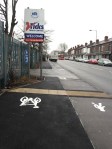
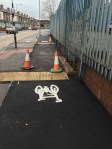
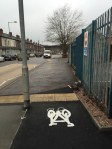
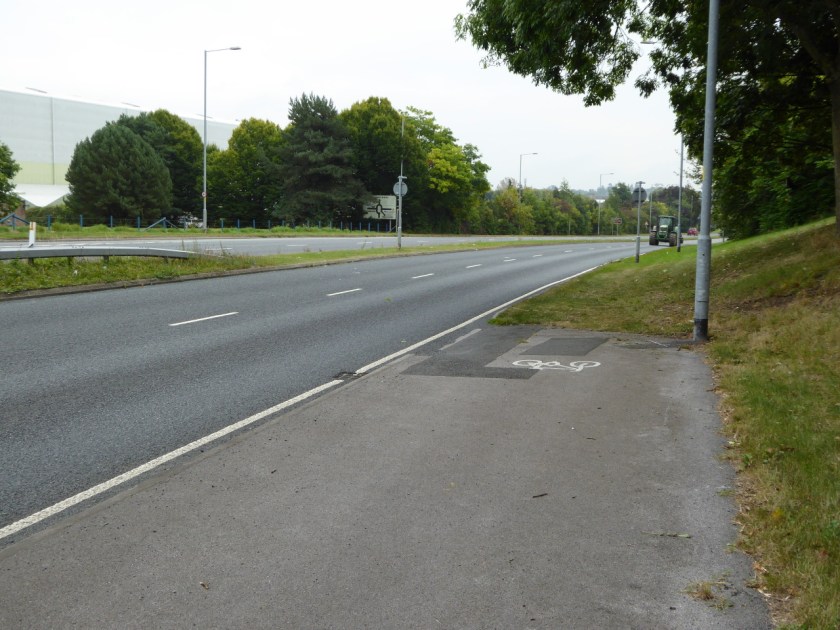
January 21st – On a grey, depressing day, I stopped to check out the new magic bicycle symbols added to the footpath in Pleck just by the motorway Bridge on the Darlaston Road. I guess this is part of the commitment to safer cycling routes with the road improvement scheme here. It’s dismal.

A bit of tactile paving, blacktop some verges and a splurge of magic paint. A grim, shared use path hazardous for pedestrians and cyclists, along the front of a factory gates with little visibility.

The people who design and implement this rubbish aren’t cyclists. They aren’t thinking about cyclists. They’re ticking boxes on a form to satisfy a requirement.

This is why we can’t have nice things, people…

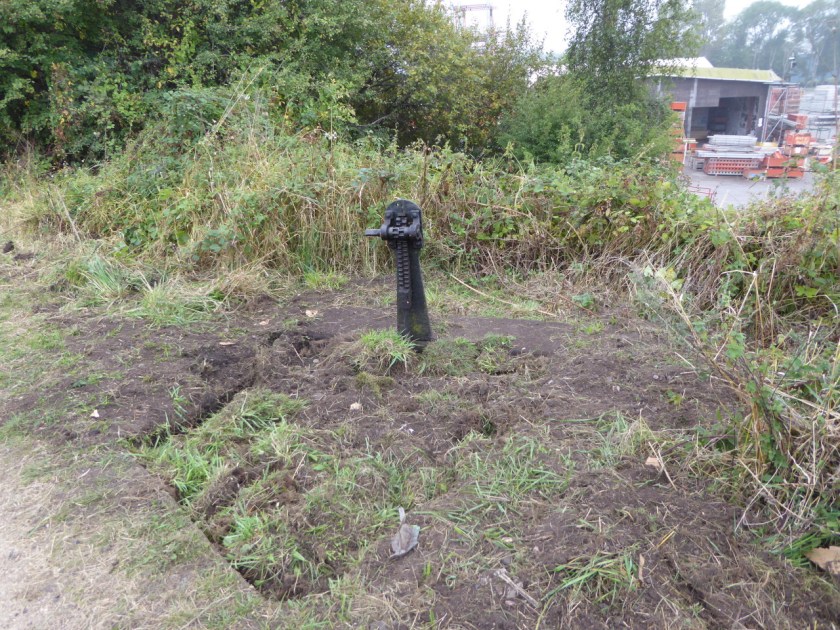
September 19th – There seems to be a lot of work going on with the local canals at the moment. At Walsall Wood, the embankment has be reinforced near the Black Cock Bridge, and near the Big House in Clayhanger, a month ago a pump appeared for a few days, and disturbance in the scrub showed work had been carried out surrounding the canal sluice drains there. Coming home down the canal from Aldridge, I noted that the sluice hear had been oiled, painted and digging had been going  on.

Wonder why the sudden rash of maintenance?

September 15th – I spent the afternoon in Droitwich. This piece of woeful, inexplicable cycling ‘infrastructure’ is precisely why we’ll never have nice things.

Do you think the designer gave any thought to cyclists going in the other direction?

(No, there isn’t a lane on the other side of the road; there isn’t even a pavement.)

June 22nd – Riding (unusually for me, it’s a long story) up the A460 through Rugeley, I spotted this bit of arsehattery masquerading as cycling infrastructure. This is a ‘mandatory’ cycle lane, as indicated by the solid white line. Mandatory in this context means it doesn’t have to be used by the cyclist, but that traffic shouldn’t occupy it or park in it. 

So far so good.

So they run it close to an oblique parking bay, on the left. What could possibly go wrong? 

What’s wrong with this picture, kids? 

June 17th – At Spring Road station in Birmingham, I overheard to travellers discussing the white plates visible on the the edge of the opposite platform, down beside the track. They often baffle station users, and their usage is a bit obscure, really.

These are merely a datum survey marker for when the rails are replaced and the track relayed, which happens more often than one would imagine. Before the old track is moved, a surveyor uses a laser level or theodolite to measure the exact position of the rails, and their tilt angle if they have one. The rail height – plus any required offset – is set on the sliding knob, and is used as a datum for relaying new lines.

The legend proclaims this plate no 3; it’s 1105mm to the nearest rail, on the Up Main (UM) line. The cant (or tilt between the two rails to enable safer dynamic cornering of rolling stock) is 2mm.

The (just visible) +474 above the slider indicates that the level set is 474mm above the desired rail height (vertical offset) and a green knob says this is the level the rail should be at as it was designed, and may not currently be at that level. A red knob indicates the actual track position when the plate was installed.

Geometry like this is essential to rail engineers, who obsess over it. Maintaining correct geometry is of prime concern, prevents accidents and ensures trains fit under bridges, alongside platforms and don’t foul each other on bends.

You can often see these marker plates fixed to line side structures or electricity and signal masts.