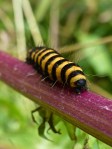
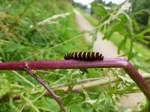
July 19th – Spotted by the canal near Clayhanger, on a ragwort plant – their favourite food – a yellow and black striped cinnabar moth caterpillar, which seem to be having a good year this year.

These stripes fellows turn into beautiful black and red moths later in the season and are fascinating.

A nice find on a hot day.

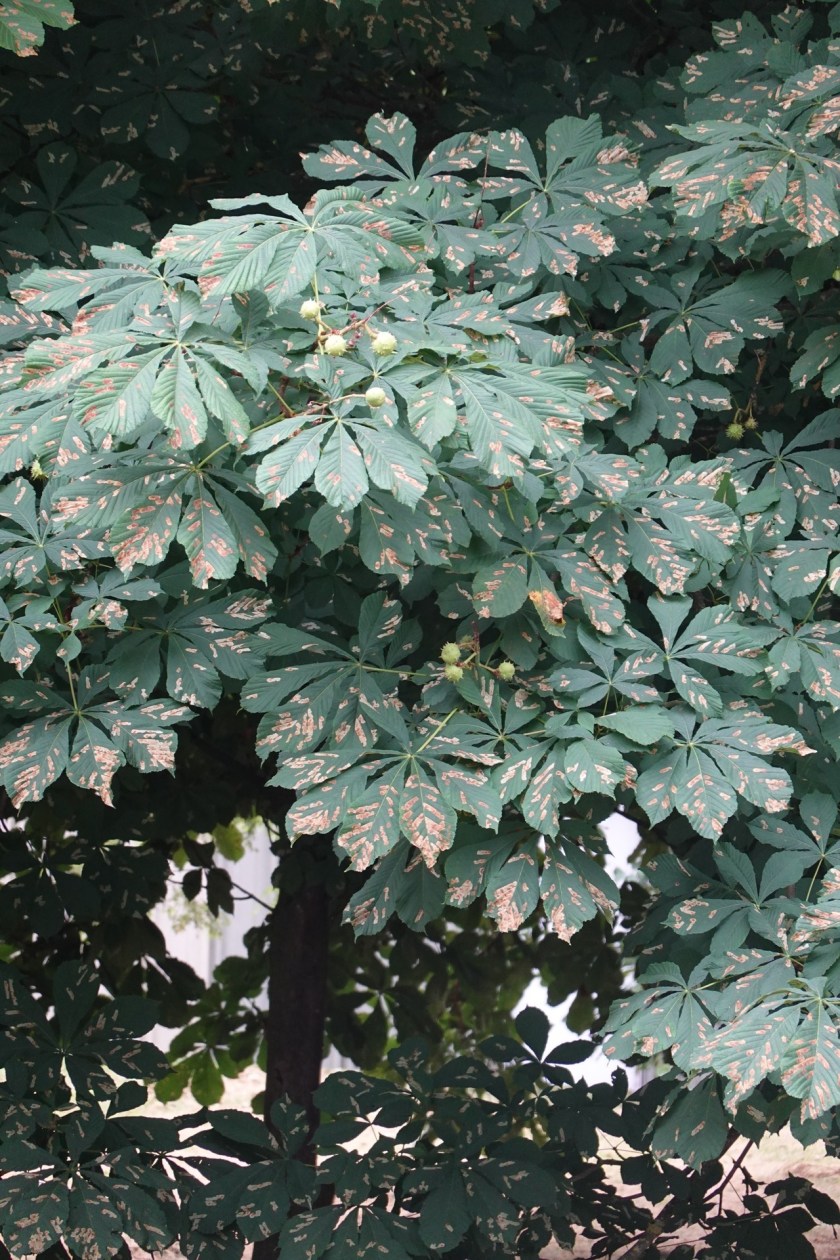
July 13th – I’m sad to see the huge horse chestnut trees on Stafford Park in Telford are suffering for the first time I think with leaf miner parasites. 

These tiny larva destroy the leaves of the host tree from within, and although leaving the host pretty much unharmed, they bring on an ‘early autumn’ but causing the leaves to become blotchy and brown.

It looks worse than it is, but it’s a sad end to the season for many a beautiful tree.

Hopefully the current wave of these insects will pass soon.

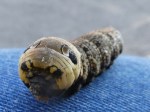
August 15th – A real treat for the seventh day of seven days of wildlife, the challenge set me by reader Susan Forster. I was riding through Pleck, and I spotted something wriggling, right in the middle of the road; stopping to investigate, I found this elephant hawkmoth caterpillar.

About two inches in length and ½ inch diameter, this is a big creepy crawly, not for the faint heated, but harmless and rather fascinating. Camouflaged to look like a plant stalk or twig, it has fake eyes and a bulbous head to make it look far more threatening than it really is, should it be threatened. Living mainly on willowherb or fuchsias, I suspect this one had been dropped by a bird, and thus escaped being lunch, and after posing for photos, was popped back on the scrub I think it came from, thus avoiding being squished.

This is a truly huge, fascinating caterpillar, and although common, a great chance find. Read more about it here.

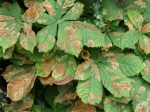
July 30th – I see the horse chestnut leaf miners are back with a vengeance now. A moth lays eggs, whose larvae burrow through the large leaves, eating them and leaving huge brown scars, which suddenly appear around this time of year. A relatively new problem, it doesn’t seem to hurt the trees, but it causes premature leaf fall, and they look bad. 

Experts are assessing links between this and the canker also affecting many of these stately, arboreal giants.

It’s a great shame, I love these trees and hope this ugly affliction soon passes. I cycled a loop around Shenstone and Stonnall and I don’t think there’s an unaffected tree anywhere in the area.

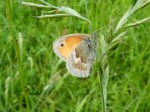
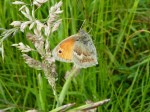
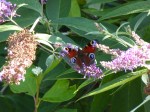
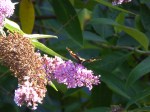
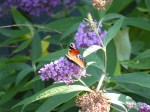
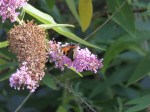
June 9th – I have no idea about Lepidoptera, but spotted this lovely moth (I think) in the flowers near the new pond in Clayhanger. It was beautiful and very active – and along with the bees and a whole host of other bugs, shows why margins and scrubs left to run wild are so very important for biodiversity.

July 22nd – The Mad Old Baggage noted the other day that buddleia was known as the ‘butterfly bush’ – and she’s right. By a busy roadside in Walsall, the purple, masonry-destroying shrub is quietly reclaiming the built, and using it to nurture the lepidoptera.

It may be a plant of the margins, scrubs and wastes, but buddleia is a bright, beautiful shrub that clearly supports a whole host of bugs – which can’t be bad.

A fantastic sight.

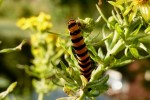
August 31st – I know bugger all about Lepidoptera. That’s not to say that caterpillars, butterflies and moths don’t fascinate me, because they do, but I never found time to read much about them. They’re very curious things. Take this fellow, for instance. 30mm long, clearly a Wolves fan, I spotted him whilst travelling at some speed down a canal towpath in Aldridge. I pulled the bike to a halt, and went back to examinee what I thought I saw crawling along a himalayan balsam stalk. How does that even work? I spotted him really easily, presumably so can his predators. How does that work on an evolutionary level? He’s certainly striking, hairy and caprivating. Anyone recognise what it is?

Edit: he appears to be a future cinnabar moth. Wonderful, black and red moths… and also rather late, it seems.

August 7th – I noted today with some sadness that the horse chestnut trees in St. Johns Hill in Shenstone, and the ones forming the avenue and hedges along Hollyhill Lane towards Footherley were badly affected this year by the leaf miner moth. The tree survives this new pest, but starts to look sick around late summer, and drops it’s leaves early. It’s thought to affect the conker yeild, although there’s no conclusive proof of this yet. First observed in Wimbledon, London, in 2002, this pest has spread like wildfire, and as yet, there’s no sign of a solution. Very sad. 

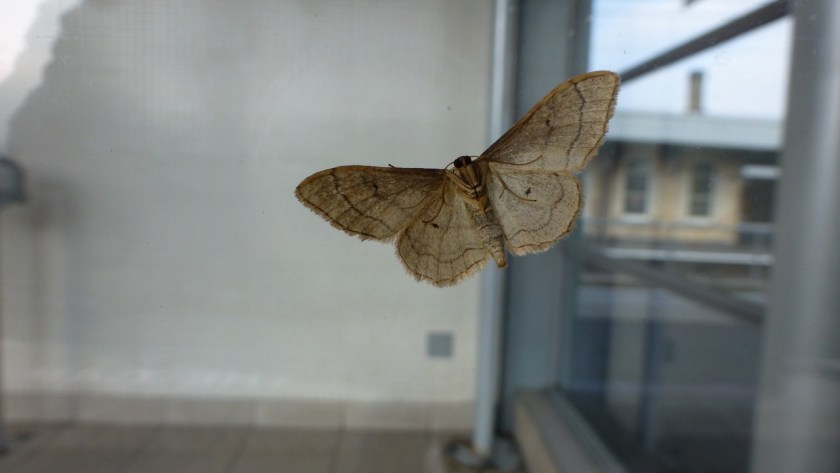
July 26th – I’m really liking this summer malarkey. I think it might catch on. Commuting in just a teeshirt and jeans is so liberating. This morning it was dull, but warm. Whilst changing trains at Nuneaton, I leant my bike up against the glass of the waiting room. As I did so, I noticed this little indicator of the advancing seasons: a moth. I’ve no idea what species it is, but the way it was resting caught my eye. With the warm sun and still conditions, there will be a lot of Lepidoptera emerge over the next few days. There’s been a marked shortage this year. 

Hello, little fella. Welcome to summer!