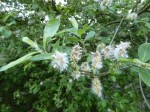
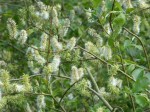
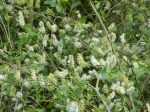
May 18th – I like it when things here resolve themselves and intertwine. Way back on April 28th, I spotted an unusual, willow-like tree growing by the canal I’d not noticed before. What snagged my attention were the curious, spiky, flower-like growths, and I asked at the time what the tree might be, and were the ‘blooms’ flower or seed?

The wonderful fellow cyclist Wilymouse kindly pointed out on the original post that the tree was Grey Sallow (or Grey Willow). I learned from a link supplied that what I had seen was the female flower of this tree; the male being the familiar pussy willows.

Check out Grey Sallow here, and the images down the right hand side of the page.

Moving on, Rose Maria Burnell sent me some photos this weekend of seed fluff blowing around Chasewater. Rose assumed it was from dandelions, and I think a lot of it is… but also, it’s coming in huge amounts from grey sallow trees – the spiny flowers I photographed have seeded and are shedding wind-born material into the air, and coating everything with fluff. 

The trees seem particularly dense around Fly Creek and the dam, although they’re all over Chasewater, and the atmosphere is thick with little seeds. At the creek by the boardwalk crossing, the water is white with seed fluff. It’s really quite eerie.

So, mystery solved – thanks to Wilymouse and Rose for the input!
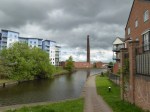
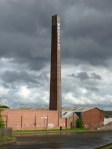
May 7th – I rode back from Darlaston under the threat of rain, but took to the canal for a change. Coming through central Walsall, I stopped to look back at the sky, and remembered the Majorfax chimney, one of the last Victorian skyline landmarks walsall has outside it’s churches. There’s something curious about it that’s barely visible until you look closely.

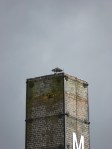
Someone, at some point, has erected a modern, tubular flue inside the chimney – It’s rain-cowl can just be seen poking over the top. Why would you do that? 25 metres of pipe, in a confined space designed as a flue in the first place. Why not just fit a roof vent next to the stack?

Is it a real flue, or a steeplejack’s joke? Whatever it is, it’s a curiosity.

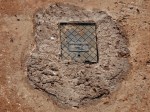
April 17th – The minutiae of drainage engineering are wonderful. I’ve been passing this array of manholes for a couple of weeks now, and noticed that new bars had been installed across the covers. It’s taken me ages to work out what they’re for. It’s not what one may imagine.

Opposite a small, automatic sewer pumping station on Green Lane at Bullings Heath, Walsall Wood, there is the concrete cap to what must be a storm buffer. A storm buffer is a large underground tank that, in time of heavy rainfall, collects drainage water and fills up, storing it and allowing slower discharge into the main network to prevent overload. There are lots around and they work well; you can tell this is one due to the large circular ‘cap’ evident with the access covers.

Recently, bars were mounted over the covers. Initially, I assumed they were to prevent access by drainers – a type of Urban Explorer that goes into sewers and storm drains to explore – but they aren’t actually secure. They’re secured with normal nuts and bolts, not locks. A couple of covers in front (not shown), which I think house pumps of valves – are not so protected.

They have actually been fitted to prevent internal pressure from blowing the access covers out. If the buffer filled to capacity due to a storm event, water pressure would increase against the hatches, and lift them out. That would then expose anyone walking through the subsequent flood liable to fall into a very deep, open manhole.

The bars are therefore a safety feature.

I wonder what has occurred, and where, to make this risk suddenly appreciated?

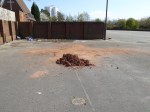
April 13th – Hmm. Something is happening. Put on to this by local history wonk [Howmuch?], he told me in the week that he’d noticed that there was a crew drilling a borehole on the former marketplace in Brownhills.

Today, I swung past to take a look. He was right – a pile of fresh earth, and an access cover. Marked further towards the pedestrian bridge, a surveyor’s mark ‘BH2’ – presumably borehole 2, yet to be sunk. If that’s all the spoil to be removed, they’re not very deep.

Coupled with reports of surveying in the area of late, someone’s either taking measurements in preparation of building something, or there’s a problem underground, like a leaking drain. 

Whatever it is, it’s very much worth keeping an eye on.

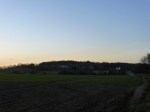
February 27th – I’d had a tough day at work, and just wanted to get home fast. I wasn’t in the mood to faff about, and got the first train I could in the right general direction. That turned out to be the service that terminated at Four Oaks. It was a cracking ride home – dry, clear, crisp – a great spring evening. The sunset wasn’t outstanding, but it was pleasant in it’s starkness, and Castlehill looked as beautiful as ever in the half light.

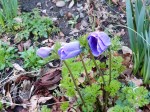
What intrigued me most, however, was growing on a small patch of neglected flowerbed alongside the access ramp at Four Oaks. Violet flowers, looking a bit like poppies. Just the one small group in an otherwise weed-srewn border. Anyone any idea what this delightful flower is, please?

February 24th – Headed home mid afternoon after an early start, I did what I usually do at such times and came though Aldridge to avoid the mania of the school run traffic. Zipping along the canal, just by the overflow in Aldridge, a tiny clump of four beautiful purple crocuses. They were the only ones I could see, and stood quite alone. I wondered how these harbingers of spring came to be here; but it doesn’t matter how, just that they were. And I saw them, and their existance made me happy indeed.

February 3rd – I was out unexpectedly early, so I left work while it was still light. The sharp wind was drying out the towpaths, so I hopped onto the canal at Aldridge to get a break from the traffic of the school run. 

Passing the drain sluice near the Big House at Clayhanger, I noticed something I hadn’t previously. I always thought that if the sluice were opened, it would drain the canal onto the gardens below, as early pictures show this sluice feeding an open channel.

Now the leaves are off the trees, I see there’s actually a drain shaft on the embankment through the trees a few yards away that it must flow into; one assumes this is connected to the common drain for the area.

I’d always wondered why that sluice wasn’t better locked than it is.

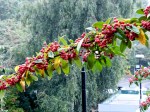
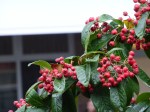
October 11th – I was in Telford for the day, and a commute that started in bright sunshine ended in steady rain at my destination. I noticed as I stood on the covered walkway waiting for the rain to pass that the northbound platform was lined with a tree with bright, orangey red berries, yet leaves a bit like those on a cherry tree. I have no idea what this is, and the birds don’t seem to be very interested, either.

It put me in mind of cotoneaster, but the leaves and berries are way too big.

Anyone help me out here, please?

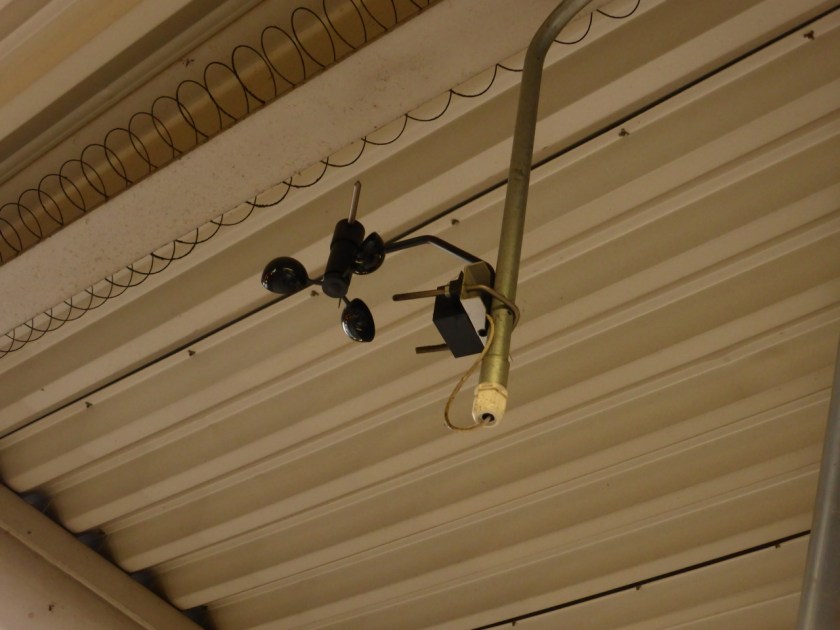
September 9th – Answers on a postcard, please. Looking up on the platform at New Street Station today, I noticed this little anemometer, wind vane and what looks like a humidity sensor. Normal climatic monitoring kit, you’d imagine. Except this is undercover, and at least 25 meters from the open air. 

No idea why anyone would do this. Maybe they’re measuring turbulence caused by the train movements?