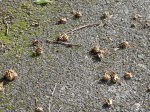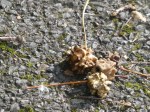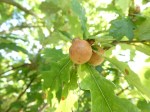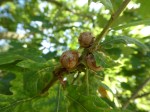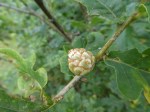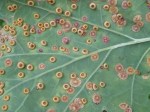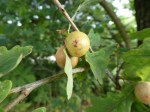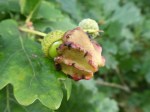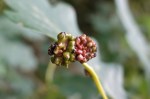
July 25th – These oak knopper galls actually took me by surprise a couple of days ago, but the photos I took weren’t great, so I revisited the saplings they’re growing on today.

I spotted them on a tree near Victoria Park in Darlaston and I don’t think there’s a single normally formed acorn on that tree at all, and yet several adjacent ones have no knoppers at all.

These mutations of normal acorns are of course caused by a tiny wasp that lays eggs in the acorn buds earlier in the year. A secretion the eggs are coated in causes the acorn bud to mutate and grow in a distorted form, forming a gall, with the wasp egg at the centre. 

The larva hatches, and eats it’s way out of the gall, which provides it enough nourishment to grow to maturity.

Insect galls like this don’t hurt the tree, but of course, do affect it’s fecundity.

Isn’t nature amazing?

September 13th – Also falling from trees now and altogether less of a hazard are the knopper galls, the genetically mutated acorn-cum-insect-cocoons that are bastardised from the normal oak fruit by the knopper wasp.

These seemingly dead, spent galls will most likely have larva inside them and they will overwinter in the fallen galls before boring their way out in spring – although those dropping in vulnerable positions like these on the footpath will be lost under feet, cycle tyres and to the wind and elements.

It’s not until you think about it you realise what a high rate of attrition there is with such things – just how many larva are lost and how this must affect the fecundity of the knopper wasp as a species.

Remarkable how they survive at all. 

September 11th – I had promised no more wasp galls. Sorry, just one more I missed. 

I’ve been looking at this type of gall for ages and not realised what they are – a small, coffee-bean sized growth, caused by genetic mutation provoked by an injected tiny wasp’s egg. These small, rough galls are tiny compared to the more familiar marble oak galls which are smoother  and rounder.

They function in the same way though, as a growth pod and foot source for the wasp larva that hatches within, and when ready, the wasp will eat it’s way out to freedom.

This poor tree at Darlaston had knapper galls, marble galls, common galls and cola nut galls. And plenty of acorns!

August 14th – Sorry, after this I promise no morale oak wasp galls!

This is an artichoke oak wasp gall, created the same way as all the others, this wasp selects acorn buds, which are corrupted into these neat little artichoke shaped growths to house it’s larvae.

These examples spotted on Clayhanger Common.

That’s it now, I think we’ve collected the set…

August 13th – More oak wasp galls, which I’ve gone all out to find this year for no other reason than they fascinate me.

On a small sapling by the canalside track at Hopwas, hundreds of thousands of almost annular, ring-like growths on the leaves, looking maybe like fungus or some odd egg. These are the delightfully named common spangle gall for the flat ones, and silk button galls for the rounder, more sharply defined ones.

These are all created by the same mechanism – a small wasp injects an egg into the leaf, and a chemical coating the egg disrupts the plant DNA to grow the gall, which leaves a light patch on the upper surface of the leaf where nutrients have been leeched away by the larva growing underneath.

I’m not sure why galls like this captivate me so much but they are absolutely fascinating.

August 10th – Oak galls continue to fascinate, and on this tree in Victoria Park, Darlaston, there’s quite a display of knopper galls, the first I’ve seen this year.

Like other oak parasites, the knopper wasp lays eggs in it’s host, secreted in a chemical that corrupts the cellular DNA of the host plant matter causing the gall too grow. In this case, the target is the acorn itself, and on this tree, one can see some acorns blighted by two such galls.

As with others, the egg hatches and ithe wasp larva eats the gall and grows safe in it’s corrupted acorn, before boring it’s way out when mature.

Also on this tree, the more conventional wasp gall – the common ‘oak apple’ of folklore, a spherical gall grown the same way.

These galls don’t harm the host, but do reduce the functional acorn crop. I’d love to know just why the oak is targeted so particularly with the and not so much other trees…

July 16th – I seem to have it with a cold. I’ve been feeling a bit peaky all weekend with a headache and sinus trouble, and today I couldn’t raise any energy to move until evening – but a short ride in a terrific warm, sunny golden hour was well worth what seemed like a superhuman effort.

In the backlanes of Stonnall, a shed, fallen spent marble oak gall. Spongy, expanded and very different to the marble-hardness of the fresh variety, this had maybe a couple of hundred holes drilled in it where the emerging wasp larva had bored their way out to freedom.

Galls are fascinating and gruesome at the same time. They do captivate me so: I wonder what the tine wasps look like?

March 12th – I felt awful. Really bad, as if I had the mother and father of hangovers. I’d not had alcohol, and it could have been an MSG thing, but I was dehydrated and groggy. But I had to go out.

I called in at Shire Oak Park to check the frog pools to see if they’d mated there yet – if caught at the right time, that place is like toad soup but today, it was devoid of amphibia – but a heathy patch of spawn in each attested to the frog’s presence at some point.

I was interested in the difference in the frogspawn. I know that frogs produce globular ‘clumps’, and toads ribbons, but the frogspawn seemed to vary from the huge ones in my hand to tiny eggs the size of a small blackcurrant. I wonder why that is? Age and health of the female? Different types of frog?

Never noticed the variety in this stuff before.

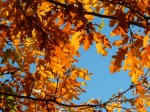
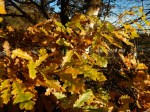
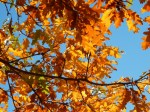
November 18th – Another gorgeous, but bitterly cold late autumn morning, and the oaks near Clayhanger were showing their autumn explosion of colour beautifully against an azure sky.

It’s been a very tough week, with very long hours again. I’m tired, and aching and mentally spent. But sights like this feel me with positivity and joy counteracting the hours I’ve spend riding in the darkness.

Winter is long, and still to come. But I think I can get through this.