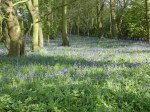
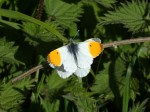
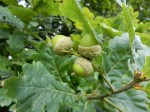
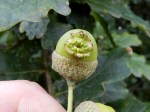
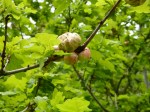
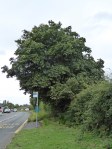
April 23rd – In the sun, it was warm, but otherwise another cold, quite windy day with very bright sunshine. I headed out on a beautiful St George’s day and found the English countryside at it’s springtime peak. Trees verdant, coconut-smelling gorse lined lanes; bluebell woods were a carpet of strident violet and orange tip butterflies mated in the hedgerows.

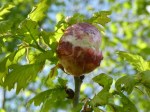
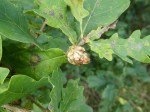
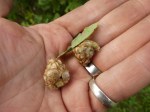
Even the oak plum galls growing in profusion near Hilton were sort of beautiful, in the slightly unnerving way only  these parasite generated growths can be.

Again, I’d appreciate a bit more warmth, but not a bad day at all, and a lovely ride.

September 4th – This is an interesting find. I’m fascinated by insect galls – the aberrations caused mainly to oak trees by parasitic insects who lay their eggs in leaf and acorn buds and cause them to mutate into safe enclosures for their larvae to hatch and grow.

We mostly know oak apples, the round globes top right – often, like these, with a little hole bored in their surface where the wasp that grew within emerged. Also, I’ve featured a few pictures in the past of the gnarly, fascinating knapper and marble galls. But these are new to me.

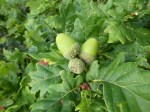
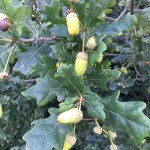
This tree at the new pond in Clayhanger was covered in fruits that looked like hops, or alder fruit, as well as healthy, plump acorns. I’ve never seen anything like it, and so asked twitter. My old mate Posh Dave, @tringonometry came to my aid.

These are artichoke galls, yet another variety of insect parasitisation on oaks. You can read about them here.

Both nature, and the usefulness of social media are astounding. Thanks, Dave.

August 22nd – I note a fair crop of acorns this year, and like last, I was caught by false memory with the knopper galls.

I tend to think these parasite-created growths happen earlier in the year than they actually do, and always assume we’re not going to see any when they’ve not appeared by late July. Since they’re caused by a wasp larva hatching in the acorn bud, they can’t occur earlier than the fruit, can they?

The tiny wasp that drills it’s egg in to the fruit bud earlier in the year – coated in a secretion that will corrupt the bud’s growth plan into these curious galls – is pretty unremarkable. But the distorted, knobbly knopper galls are glossy, leathery and fascinating.

Nature can be very weird sometimes.

September 4th – And then, there are the oaks I was concerned were lost. All the galls and nasties seem to have appeared long before the acorn crop I thought would not appear – there is now a stunning crop of tiny acorns growing well all along the canal at Clayhanger.

It’s good to see, and when they start to fall, I’ll gather them and spread the acorn love.

Never lose faith.

September 4th – Apologies for the poor phone photos, I forgot the camera…

I’m still musing on the oaks, and their various blights and parasites. I asserted a few weeks ago that the oak seemed to suffer disproportionally with these afflictions, but I was forgetting the various leaf-miners, bugs and aphids that affect other species.

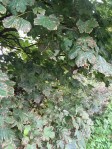
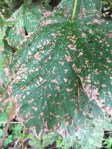
This sycamore in Pleck, Walsall for instance is suffering form various things, including leaf miners. I have no idea why, but only this tree out of several neighbours is affected.

I really ought to read up on this stuff.

August 18th – The poor acorns are really hampered this year – the gall wasps really seem to have affected them. These seem very like knopper galls, which are caused by the wasp injecting a chemical encased egg into the acorn bud when it’s forming. The chemical causes the acorn to mutate, and inside, the wasp larvae hates and feeds.

There are now a good few healthy acorns, though, so perhaps it’s not as bad as I feared, but I do wonder why it just seems to be oaks that are tortured so.

August 7th – This oak tree was spotted by the cycle way in Pelsall, and seems to be afflicted by the same ills befalling similar trees everywhere I go. The poor oaks this year seem to have few acorns, leaves dying off early and tiny, deformed acorns.
I hope this is an aberrant year and in seasons to come are better.

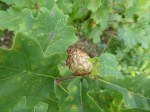
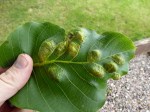
May 29th – I don’t know why, but I find these oak galls a bit horrible. They are distorted leaf buds, into which a wasp injects it’s egg and a chemical which causes the tree to grown the gall instead of a leaf stalk. The larva lives within the growth, feasting on it. When mature, the wasp eats it’s way out and the life cycle continues.

This tree on Clayhanger Common is peppered with these tumour-like galls – they look like fruit. The gall doesn’t harm the tree particularly, but it’s a very visible parasite.

there are many different types of gall wasp, all with different methods and growths. I’ve not seen this one before, and am unsure what it is specifically.

Nature can be very odd sometimes.

August 26th – The day was better, I guess, by virtue of being dry, but when I set out for a tentative ride mid-afternoon it was cold, and a harsh wind blew. It wasn’t a bad October day, I thought.

I’m taking it easy. My foot isn’t completely better, and I thought I’d see how far I could push it before embarking on longer rides again. I looped up to Chasewater, then down to Wall, through Chesterfield and Hilton, back to Lower Stonnall, then home. Apart from a bit of toe-burn, not too bad.

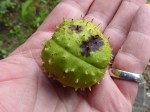
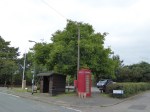
What did impress was the fruits I saw. A terrific year for large, plump conkers; the tree at Edial between Burntwood and Pipe Hill is laden, and although suffering leaf miner damage, has a huge crop this year. In a few weeks standing at that bus stop could be hazardous.

At Wall, the walnut tree has a crop too. After finding it last year, I didn’t expect it to fruit this year too, but it has, with the lime-like ripening walnuts hanging from the boughs. I picked up a few windfalls, which were firm and large. When ripe, the green husks will split to reveal the more familiar brown nut inside. That’s if any survive the squirrels.

The Walnut tree also seems to have some kind of leaf miner activity. There are ‘blisters’ on some of the otherwise healthy, waxy leaves. I wonder what the bug is?

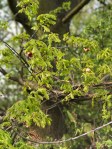
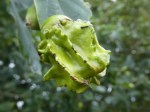
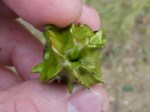
August 12th – This is strange. I spotted it growing in the thicket by the cycleway in Telford. The plant itself looks like maybe a rose or some kind of bramble, the the growth ar the top is totally alien to me. 

It’s about the size of a golf ball, maybe a bit bigger. Is it some kind of parasite, like an oak gall? Genetic mutation? Or even some kind of uncommon species?
Help invited… it is kind of beautiful.