January 30th – A bright, clear but chilly day. Still not well, I went out in the afternoon, and had errands to run in Aldridge and Lichfield. Although the day was lovely, the wind was really not to be trifled with.

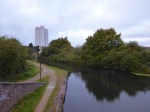
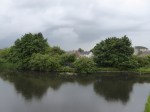
Passing through Catshill Junction, I noted something I’ve been meaning to record here for a while: the sculpture erected some years ago on the opposite side to the towpath has had the undergrowth and scrub cut from around it, I’m not sure who by, but my thanks to them.

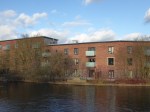
With the leaves off the trees, the new building here looks really good, and I hope the growth here can be cut back for the summer – otherwise those brand new apartments will be awfully dark and have hardly any view of the canal at all.
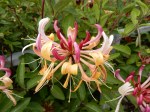
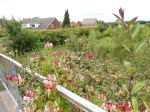
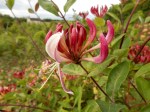
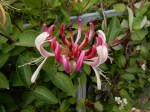
June 22nd – Another impressive showing this year is the honeysuckle, or woodbine on the south side of the Black Cock Bridge in Walsall Wood. A veritable carpet of pink-yellow blooms, it’s alive with bugs and bees and smells gorgeous.

I love the slightly prehistoric, otherworldly appearance of the flowers, too.

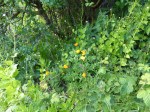
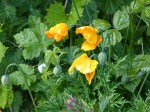
May 20th – I’m intrigued by these deep yellow poppies, which seem very, very early and somewhat unusual. They’re growing in dense undergrowth near the Black Cock Bridge in Walsall Wood, and were so bright they caught my eye as I rode past.

Are they indigenous, or garden escapees? Whatever they are, they’re beautiful.

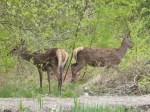
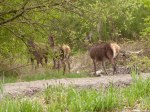
April 30th – This was a shock – I cycled to work for a change up the canal through Walsall Wood. Just past Clayhanger bridge, at the back of Maybrook Industrial Estate, a small group of female red deer (still very much in moult, the poor scruffy things) were browsing the scrub. This is an isolated patch only really accessible from nearby roads, but in itself, although small, is not bad for them as it’s barely touched by humans.

This means the deer are now crossing Clayhanger Bridge. 

Watch out on the roads, folks.

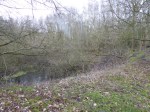
February 1st – Just on the rough side of Brownhills Common, a handful of yards from Coppice Lane, there’s a deep void in the land through the trees It may be the remnant of early surface mining, or the later evidence of hamfisted mineral exploration (the coal here was evident on the surface, so it was said; the grey clay also highly prized by potters), but it’s been here for decades; the spoil is piled up around it in mounds with fairly mature trees growing from them, which must date from around 1977, as the year previously, the whole of this side of the common had been flatted by a grassfire.

Every landscape tells a story This one tells of an industrial, blighted past, which we now sort of revere.

Brownhills holds some of it’s oldest secrets closest, but in plain sight.

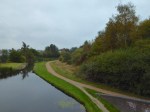
October 1st – Autumn is certainly coming to Catshill Junction and Clayhanger Coomon, as the deciduous scrub here turns golden. On this drizzly October evening, despite the murk, it looked beautiful. 

I note the building taking place on the former Bayley House site is coming on well, but the sculpture on the far side of the water is being rapidly claimed by the scrub.

I do hope it doesn’t get forgotten there.

September 9th – This is bothering me. On the border between Darlaston and Walsall at Bentley Bridge, there’s a field of meadow-scrub next to the nascent River Tame. There has been planning permission granted here for a warehouse and new driveways and drainage which have never been built – instead, the land is being used ostensibly as storage, but is more akin to a flytip.

Building materials, old pallets and scrap, including a couple of portable site toilets are strewn around, and the water that must run off this site into the Tame is more than likely contaminated by the waste here.

I have mentioned this to Walsall Council, who assured me something was being done, although I’m not sure they understood the location or where I was referring to.

This can’t be allowable, surely?

June 3rd – I headed back to Brownhills along the canal, avoiding the rain-maddened traffic. Rounding Catshill Junction, I noticed that the sculpture here ‘Cycle of Life’ by Ron Thompson & Julie Edwards, is again being consumed by the scrub. This sculpture – of which I’m not a fan, to be honest – was unveiled in 2005 as part of the canal refurbishment; the position of the artwork is so far from the towpaths that the detail of it can barely be appreciated, and it’s always felt a bit of an afterthought to me. 

Now, there’s a new development of flats and houses being constructed on the other side of the fence and the sculpture is more isolated than ever. I do hope the plans for the newbuild have taken this into account. 

Ideally, it would be nice it the piece could be moved to somewhere nearby where the public can actually see the detail in the metalwork. A bit of a missed opportunity, really.

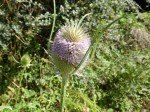
August 12th – The teasel, or dipsacus – is a great plant. Alien-looking, spiky, provider of food for finches and small birds, it grows in meadows, scrubs and hedgerows. Once used for teasing out cloth (hence the name), it’s now spread as a wildflower. These examples have matured beautifully on the wild embankment at South Wigston station, and were, unusually, the only colour there today to speak of, yet by the look of the rosebushes, we’re due an excellent crop of hips in all their red-orange glory.

March 4th – A day beset by travel difficulties. Actually, a bloody awful day all around, if I’m honest. I set off on an 8am train to go to Leicester. I didn’t get there, due to signalling issues, until gone 12pm. Hopping off the train in South Wigston, in bright sunshine,resisting the urge to kiss the platform papal-style, the deathly dark mood was suddenly lifted.

Readers who’ve been following this journal a while will recall from last year that I’m fascinated by the flowers that grow, untended, on a patch of embankment at South Wigston Station. All year, this once tended strip of border is a riot of colour. Today, I noticed it had already got it’s spring jacket on.

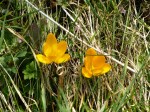
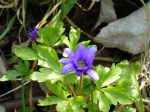
Yellows and blues were the order of the day. Crocus, forsythia and a small blue flower I think may be hepatica or anemone, but I welcome a positive ID.

I went on my way, my mood lifted. Heaven, in a wild flower.