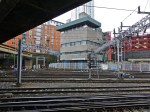
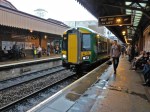
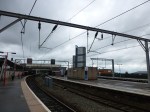
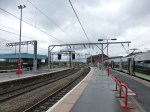
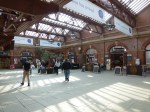
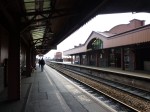
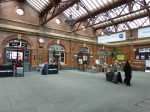
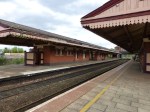
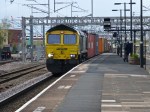
July 5th – I found myself in Birmingham City Centre at 9am. I had to be elsewhere, but my trusty old bike lock had finally failed and it was time to get a new one, so I went to the nearest bike shop to New Street Station: Evans Cycles in Temple Row. I was sad to discover that oddly, the shop didn’t open until 10. This cost Evans a 60 quid sale, as I went to On Your Bike in Digbeth, instead. On the way between the two, I noted that once again, Birmingham is undergoing change. The revamp of New Street Station – which will do little for travellers, but provide a great retail opportunity for big business – is gathering steam. I have no idea what’s going on here in Stephenson place, but the end result will be a new branch of John Lewis. Something tells me that this is going for the Selfridges effect. I’m not sure that will work twice…

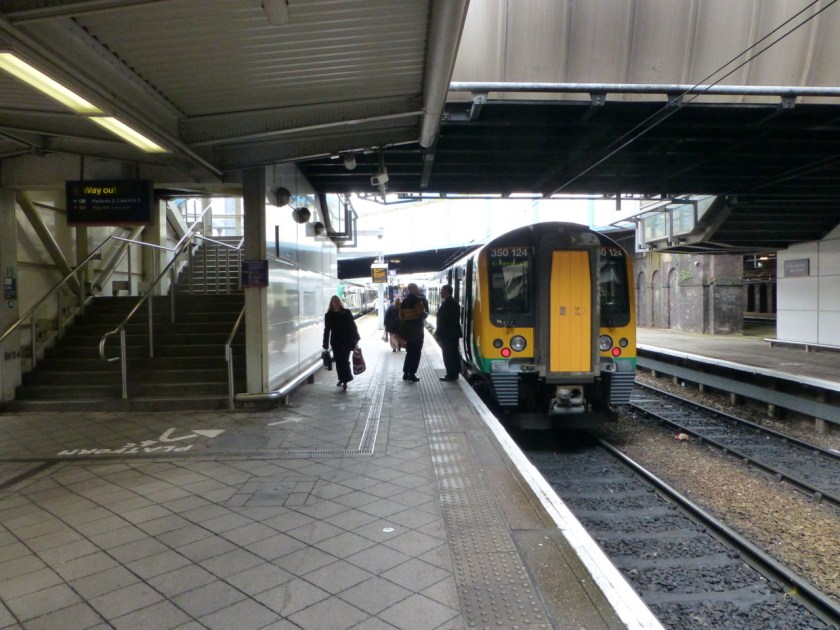
June 7th – Birmingham New Street. This is Birmingham New Street. All regular travellers through Birmingham’s derided main station will recognise that tannoy jingle. I have a love-hate relationship with the place; dark, grubby, overcrowded, a nightmare on a bike or for the elderly or disabled. Yet, unlike so many stations, the layout is logical, compact and easy to grasp. It just carries way too much traffic and we need a new station – possibly on Eastside – to relieve it, then maybe the platforms could be reduced in number and widened, some natural light could be let in. 

There’s history, here, too, but not many realise. The arches at the end of platform 2 and 3 are a remnant of the original Victorian Station, as are many of the retaining cutting walls. The signal box – a remarkable Brutalist style structure designed by Bicknell & Hamilton to resemble an electrical component, is listed and a wonderful thing. As developers tear away at the upper levels, the ‘regeneration’ (how I hate that word) of this much misunderstood transport hub will not solve any of it’s functional problems, but I’m still rather fond of the old dump, if I’m honest.
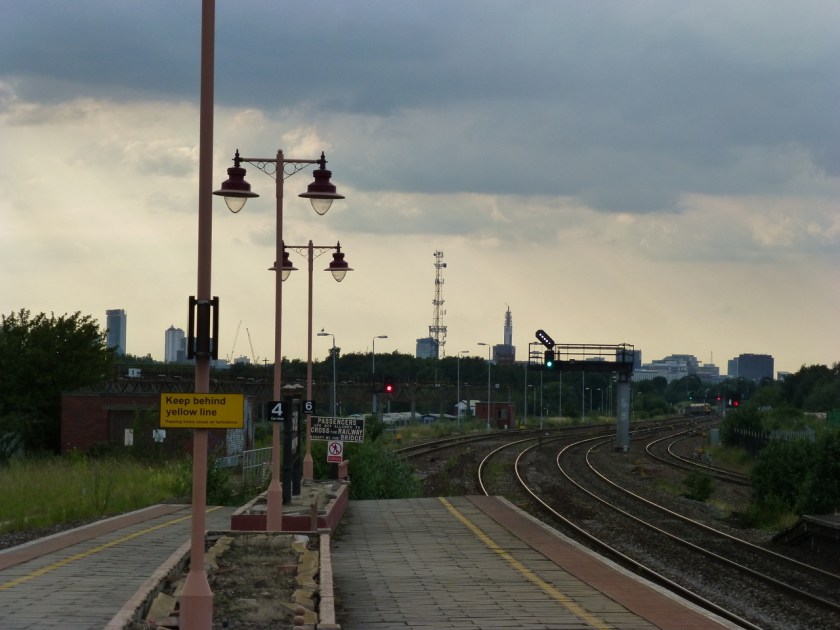
June 6th – I left Darlaston late in the afternoon to head to Tyseley for an important meeting at short notice. This happened to coincide with heavy downpours, which I managed to avoid with an air of smugness that must surely come before a drowning. At 5:45pm, Moor Street in Birmingham was busy, and wringing wet in the midst of a rainstorm. At the other end of my short hop, I waited ten minutes for the rain to ease off. With all the gutter-less canopies, Tyseley is surprisingly hypnotic in the rain.

May 31st – A really bad commute home this evening. The train I was due to catch – the 16:08 from Telford to Brum – was running 30 minutes late. Then cancelled, which meant there wasn’t another train until 16:51. Then it reappeared on the system, and rolled up at about 16:40… to terminate short in Wolverhampton. Resigned to my fate, I changed onto the stopper train from Wolves to Walsall that stops at every anthill and lamp-post. I arrived in Walsall – this train itself late – at about 18:25. I should have been at home with my feet up by then, and I still had to cycle home.

Wolverhampton station is a barren, soulless place. Like the city itself, I’ve tried to love it, but can’t, sadly. Always seems way too harsh and way too neglected to me. It matched my mood perfectly.  

May 21st – Today, I was mostly in Tyseley again, which meant a short hop on the Snow Hill line. I jumped on the train at Moor Street Station – a beautifully restored building, more of a film set than commuter hub. Like it’s sister Chiltern Railways station, Marylebone, it’s a bright, airy, wonderful place to catch a train from. 

A rare delight in the UK rail system.

May 16th – Today found me in Tyseley, which made a change. I don’t come down this way much, but when I do, I always love the air of bustle in these industrial, urban streets. There’s always something going on around every corner; stuff to be shifted, things being unloaded. The backtreets are alive with the buzz of small industry – sewing machines, lathes, injection moulders all add to the background susurration, along with the clank of metal, clatter of doors and hiss of compressed air. Intermingled with it all is the faded air of a once possibly genteel Victorian place, whose station still bears the hallmarks of that period, from when the nearby terraces must also date. Most people pass this place in disgust, but actually, if you spend a while and traverse its streets, it has a kind of faded charm all of its own.

May 8th – Bloody typical. A miserable bank holiday Monday, followed by a crestfallen return to work on a gorgeous, bright sunny spring day. I was heading to Telford, which means catching a train from New Street’s platform 4c, which I always think of as being Birmingham’s equivalent of platform nine and three quarters. There was something about the light today, the sun, the music I listened to on the way… it did feel very good to be out, even if I was going to work. Most peole seem to hate this station, and aspects of it are truly horrendous; but I also have a genuine affection for the old place. It feels like home, I guess.

April 19th – I’m fascinated by the machinery of the railways. I’m no train spotter, and wouldn’t cross the road to watch a train go by. However, as a train traveller of a certain geeky nature, things like signalling, communications and the weird and wonderful machines that one sees whilst negotiating the morass that is the British railway system hold a certain fascination. At a wind-blown and damp Nuneaton, there sat an incredibly complex ballast regulating machine. This Austrian made train levels, adjusts and cleans the ballast, the bed of shale under the track, and keeps the track in perfect condition. Usually run with a tamper (the yellow machine parked behind), a train that measures and corrects the sleeper and track positions, this is a very complex machine indeed. While I was admiring it, a General Motors class 66 locomotive trundled through the station; at a little over walking pace, it clanked its couplings, pulling upwards of thirty containers behind. The raw, yet controlled power of that – the noise, vibration and sheer presence – is awe inspiring.

You’d have to be dead not to be impressed by that…

April 6th – I came out of Birmingham on cycle route 5, up the canal to Smethwick’s Galton Bridge, then up through the Sandwell Valley to Rushall Junction on the canal. Galton bridge is a historic, very high bridge over the mainline canal. Built in 1829 by Thomas Telford, it’s a classic of its kind and the views from it are fantastic. The canal here is lovely to cycle, and steeped in industrial history. Well worth a wander if you get chance. Travel writer and culvert crawler Nick Crane came this way in his book ‘Two Degrees West’ and pointed out that the arrangement of canals (2, side by side at different levels), Railways (2 different lines at different levels) and road bridges made the physical geography here so complex that he had to draw it out on paper. He’s right.