February 3rd – Out in Brum after completing a rush job, this made me smile – near St Philips cathedral, a hybrid electric car, a Mitsubishi Outlander – being charged at a public charging point. 

First time I’ve ever seen that and it filled me with optimism for the future. 

Nice car, too.

October 25th – Passing New Barns Farm at Footherley, I stopped to greet some cows waiting at the gate to go off for milking.

I love these huge,, but gently nosey animals. I noticed they were all wearing radio tags so the milking equipment could trace their statistic and wellbeing. Farming’s come a long way technologically in the last decade or so.

Always nice to say hello to the coos.

September 20th – Spotted in a customer’s cycle shed, two bikes side by side that illustrate something that annoys me.

Shimano, the Japanese industrial giant that revolutionised cycling are not what many people imagine them to be. They are essentially production engineering experts, probably more than they are bicycle technology or fishing equipment manufacturers.

Shimano make loads and loads of great, well thought out products that I love. their work to refine the derailleur gear system in the 80s and 90s, their clipless pedal systems and electronic gear technology have changed cycling for the better immensely. But something more than these innovations has had a massive influence.

Shimano sell innovative kit to bike manufacturers. That means they also sell and produce the tooling to manufacture bikes en masse. Shimano often market products to manufacturers because they’re cheaper or easier to assemble on a production line, but sometimes of little discernible end-user benefit.

Shimano pioneered the external bottom bracket, a frankly piss-poor idea that is hated by lots of cyclists for it’s increased wear and susceptibility to corrosion. Shimano invented it to make assembly of bikes from one side far easier. It shifted to producers in large numbers and is now, sadly, ubiquitous.

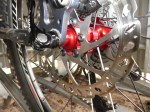
Similarly, for years, bicycle disk brakes – which I love as a technology – had their rotors attached to the wheel hubs by six M5 screws, like the bike in the top picture. This ‘6 bolt’ design has been a standard for more than a decade, and works well. You can feel if there’s a securing issue without the loose disc being dangerous, and the rotors are light and easy to replace with standard workshop tools – usually an Allen or Torx driver.

Shimano recognised that a big cost in disc brake adoption to mainstream bikes was assembly of the disc onto the wheel – six screws require either a complex, mutispindle head or an operator repeating the same action 12 times per product. So they invented Centerlock(sic).

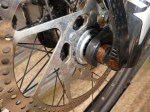
The lower picture shows a bike with a Centerlock rotor.

Centerlock uses a splined male dog on the hub, and a special brake disc with a mating female recess. The rotor slides onto the splines, and is held in place by the same type, thread and tooled ring that holds the gear cassette on a rear wheel, thus requiring one tool to fit the cassette and two brake rotors, a huge cost saving in production.

Centerlock rotors are heavier, and you need a special tool to fit or remove them. If the ring comes loose, there’s nothing else to hold it.They limit consumer choice of aftermarket replacements.

There’s a whole industry sprung up around centre lock to 6 bolt adaptors.

This change in technology was introduced purely for the benefit of bike manufactures, arguably to the detriment of consumers and to me, is inferior.

Rant over.

August 1st – A mechanical mystery. Three month old Shimano hydraulic brake pads, which suddenly lost grip and appeared to be glazed or contaminated. The pads are the sintered metal type and are genuine manufacturer parts.

Sometimes, long periods of braking can ‘glaze’ pads. causing them to become highly polished and shiny, meaning they don’t work well. The common treatment for this is to file the surface of the pad and pop them back in. 

These I have degreased, cleaned, filed and even surface ground, but whatever I do they quickly glaze again. New pads of the same type were just fine.

Anyone got any idea what’s going on here? I’m wondering if overheating has caused the pad material to harden…

June 13th – At my destination, a very unusual steed was parked in their shed: an Elegance electric bike. It has a 3 speed Shimano Inter-M rear hub, driven by a shaft drive (yes, shaft drive, so no chain), rear roller brake, front disc brake, a large battery on the back and a motor in the front hub. 

It was a heavy beast, and seemed to have both electric pedal assist, full motor drive and pedal only options. It’s a nice looking thing, but it was very heavy, and I wouldn’t want to pedal that far without electric drive…

The shaft drive is clever, but it’s a lot of faith to put into small gears with high efficiency losses and worrying wear rate.

Having said that, it’s a lot of innovative design for a shade off £700.

I don’t like e-bikes, but I can see the utility of this. Find out more about it here.

October 23rd – Here’s a security tip for cyclists with disc brakes. The other day I noted that you can’t make your bike theft proof, but you can make it fiddly and a pain to steal, hopefully putting off all but the most determined thieves. 

Some of the best deterrents lie in novelty; professionals will come with tools usually to smash D locks or cut cables, not both. You can make your D lock more effective by ‘filling’ it with as much bike as possible (thieves often use bottle jacks to break them open – they can’t if there isn’t room for one).

This yellow item probably isn’t that secure, but it’s effectiveness lies in the way it works: they’re sold online as disc brake locks for motorbikes and they have a plunger that latches through your brake disc, rendering the wheel unable to turn. In addition, there’s a piercing, vibration-activated alarm inside – so if the bike is handled roughly, it screams the place down.

It’s small, compact, thieves probably wont want to bother with it coupled with other locks, and it costs less than a tenner. What’s not to love?

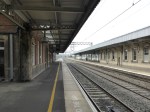
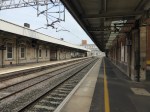
July 23rd -By the time of my return, the sun was shining hazily, and things seemed to be drying out a bit. It was still threatening, but the ride home was dry and uneventful. At Nuneaton, the light was interesting, and highlighted the exaggerated perspective of the railway and it’s architecture. I love the accentuated vanishing point, the repetition and recursion. The forest of overhead metalwork – every member in that mess of stanchion, gantry and wire does something. 

For a quite simple idea, the railway is incredibly complex and deeply fascinating.

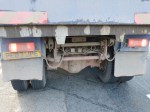
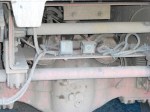
October 15th – One of the things about riding a bike is that you get to study vehicles in a way that most folk don’t. I’ve spent large amounts of time behind cars, wondering how the  bodywork was fitted together, of behind weird and wonderful lorries, working out just what everything on them does. It was while I was waiting in the queue at the Shire Oak junction today that I noticed this interesting feature on a tipper lorry. Tucked in the back, below the main body, is a camera and light, clearly for reversing purposes. It must be a fairly common feature, but I’d not noticed one before – presumably, it’s monitored by the driver. Only snag is, there’s no automatic lens cleaning, and it must get pretty mucky under there. Wonder if the driver was munching on a Yorkie and watching me whilst he waited?

April 8th – Heres a cycling one for the tech heads. Sorry, but it may save some folk hassle.

Disc brake pads. Don’t skimp on them, it’s just not worth it.Two of my bikes have Avid BB7  units fitted. One bike has original factory-fitted Avid brand pads, and the other, which is older, after the originals wore out had some Kool Stop ones, which were good at first but glazed over, reducing the stopping performance. I replaced those with some cheap ones from Decathlon as I was passing at the time and it was easy. They were awful. I was noticing that the Avid pads on the newer bike were far better than the others. Eventually, after cleaning and roughening discs, adjustments and degreasing, I gave up, and ordered some original Avid sintered metal pads. Performance restored.
The moral of all this is that your brakes are your life. Don’t waste time with cheap shit.