365daysofbiking Ladies, please:

October 8th – This is a post that will hopefully confine us to a mild winter.

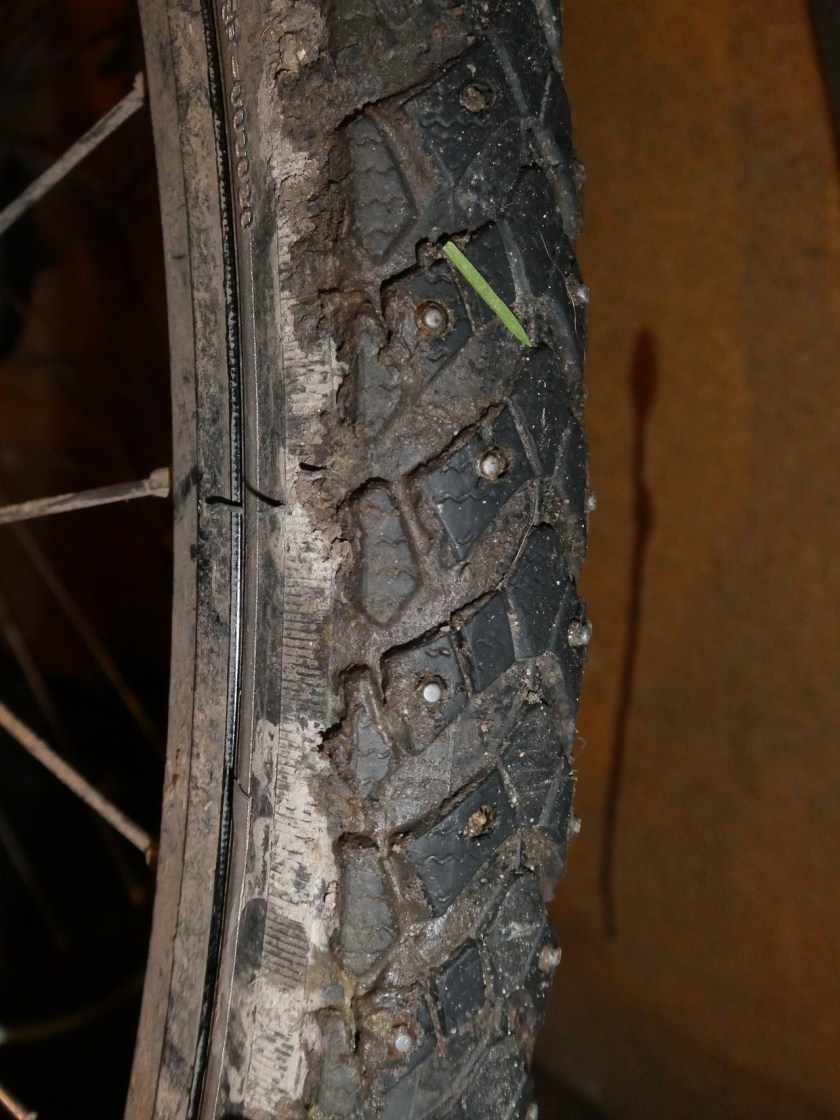
After suffering a spill in November last year on ice while riding summer tyres, I’m taking no chances this year and have the ice studs on now as we’ve already had a couple of heavy frosts, and I’m, getting too old for the falling off lark.

My rubber of choice for the cold months is Schwalbe Active Winter 30mm which has a good tread and several hundred tungsten carbide studs that bite into black ice and keep me upright.

They are a little noisy, and although not slow, not the nippiest tyres in the world.

Now I’ve fitted them, expect it to be warm throughout the winter…

August 16th – A dreadful morning commute in heavy rain to the railway station was a shock to the system, on slippery roads with a worrying amount of spray. Getting to the station, when the train arrived I found I was sharing the bike space with a hardy cyclist in shorts.

Looking at his bike, a respectable singe speed, I saw what can only be regarded as the worst bit of rear light positioning I’ve ever seen.

Almost lower than the rear wheel, on the seat post behind the seat stays.

I hope this guy doesn’t do anything engineering-based for a living.

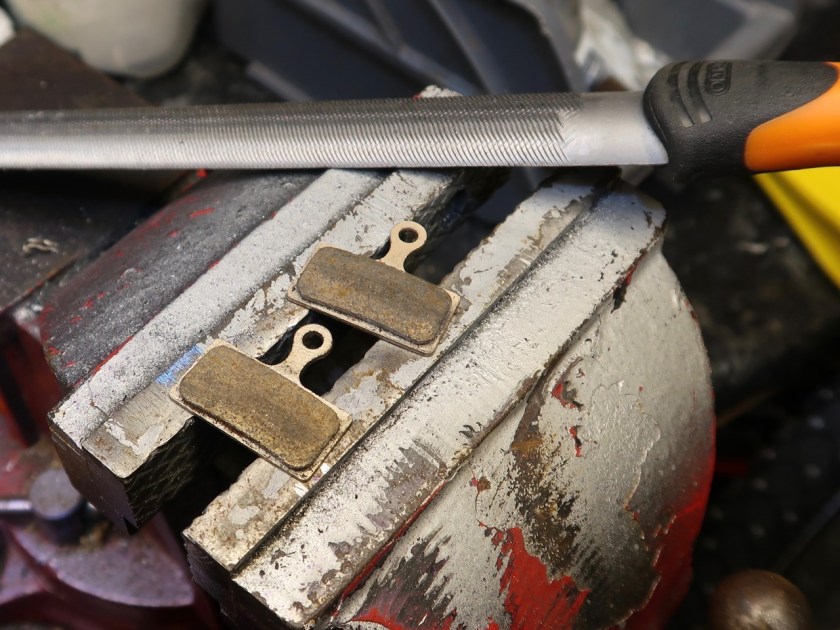
February 13th – I wore out a set of front brake pads, and still have a fair few part worn ones glazed out from the problems with the rear brake, which I wouldn’t throw away in case I found a way to reclaim them.

I’ve been thinking about it idly, and I’ve managed to recover a set. I filed off the surface a little with a clean flat file surface. Filing alone doesn’t work, so working on the basis whatever has destroyed them must be oil based, I took the pads, placed them on an aluminium sheet, and gently heated them with a very hot plumber’s blowtorch for ten minutes, until they stopped smoking when I removed the flame.

I then cleaned off the oxidisation with a scotchbrite pad and finally degreased them with a zero residue spray cleaner.

They are as good as new. Without the heat, none of these steps have worked before. 

I guess you could stove the pads in a normal kitchen oven if you don’t have a blowtorch.

It’s saved a few bob, I guess. Be interesting to see if they wear any quicker or glaze again.

January 14th – I experimented in an area where Panasonic have always been streets ahead – very long exposure. The interface for this on those cameras is so much nicer than the Canon, but there is one caveat: if you have the device set to silent – meaning it uses electronic shiutter – the mode is castrated. That confused me last week and I couldn’t work it out until I read the manual.

The toll road was quite busy as I shivered and stomped in the cold.

I’m really not well.

December 13th – The snow, ice and road grit is destroying the brakes on two bikes at the moment. This rear disc is now wearing considerably, and is about 0.3mm thinner than it was new, and the front, 0.7mm. That doesn’t sound much, but once you get to about 1mm worn off, the discs get so thin they buckle and become useless. 

One thing about cycling through the winter: It isn’t cheap!

December 4th – Although it suddenly got warmer over the weekend, I’ve taken the plunge (late this year) and fitted ice tyres to a couple of my bikes as I do every winter.

Slightly fatter than my normal road tyre of choice at 35mm, these have a pronounced tread more akin to a cross tyre, with 4 radial bands of carbide-tipped spikes that bite into ice and packed snow.

Last week was cold, but mercifully, due to the dry spell, not too icy, but a close shave with a frozen puddle concentrated my mind. Although noisy and draggy, these tyres won’t slip easily on ice and wash down slime and will make me feel more secure on those dark, icy commutes.

If you’re out on the roads in a cold spell, here are my tips for safe cycling, even if you don’t have winter tyres…

  • Stick to main routes where possible. Avoid backlanes and canal towpaths.
  • Ride on the road, out of the gutter where standing water freezes.
  • Take it steady, and ease off on the speed – particularly downhill.
  • Use your momentum and judge it – avoid braking where possible.
  • Turn gently without braking.
  • Use your back brake rather than your front, and pulse it don’t clamp it on. Just light touches.
  • Move with the bike. Go with it if it slides, don’t fight it.
  • If you lose the back, you can pull out of it with care. Lose the front and you’re gone. Bear that in mind in a slide.
  • Give other roadusers more space, and consider the consequences if they slide.
  • Let a little air out of your tyres to increase contact area.

Take it easy, folks.

November 27th – Been a while since I discussed brakes here, but the glazing issue of the rear pads I had – I think I’ve cracked it. And built Frankenbrake as a result.

I, like many utility and commuter cyclists, like to ride a bike that’s essentially a tourer. I like the bars, the variety of positions, and I like that Shimano finally made hydraulic brakes for road and cyclocross bikes with the same bars.

The trouble with tourers for years has been that they’re mongrels. No one groupset (ie. drivetrain with brakes and controls) is wholly suitable. Tourers carry load, don’t mind a heavier bike as it’s sturdy and stable. They like a wide gear range – preferably a triple front ring. And solid wheels with damn good brakes. 

So a good tourer may have utlegra, SLX, XT and 105 series parts all working together.

Brake options have traditionally been anything you want as long as it’s canti, but since road discs and suitable frames appeared – first cable, then hydraulic – our braking options have improved. 

My rear brake – A Shimano R785 lever with a BR785 calliper – has been eating pads. They appear to glaze, loose all friction, and no matter how well cleaned, filed or surface ground, never regain bite. Pads are not cheap. I thought I’d cracked it using Uberbike pads – but the last two sets have gone really quickly.

The last set went a week after fitting, and without the same happening on the front, I decided to solve the issue. I’ve been using a primitive parking brake on trains – I use a rubber loop to keep the back brake on to stop the bike rolling about. It turns out that the brakes aren’t designed for continual operation like that, and the vibration from rocking was weeping fluid out of the piston seals, on to the back of the pad plate, and dropping the odd drip of fluid onto the rotors.

I’ll stop using the band. But that left me with a possibly faulty rear calliper, which has never been quite as snappy as I’d like. And Shimano are transferring to flat mount – a format incompatible with my frame – for their 785 replacements.

I knew the 785 was a variant of the XT mountain bike, 2 piston brake with slight design changes in shape. Reading about, I found people who’d put Shimano 4 piston callipers on XT levers for mountain bike use, so I figured a 4 piston Saint calliper should therefore work with a 785 road lever, as the same oil volume was being moved as the XT model, if you see what I mean. They all use the same hoses and fluid, a light mineral oil.

So I ordered a saint calliper, got the bleed kit out, and got oily. The result is that the Saint calliper works really well, has a much bigger pad friction area, and is nice and firm, yet progressive. It’s a bit more fiddly to set up as the piston stroke isn’t as large, but it’s working well with patience.

To any home mechanic who’s thinking about this, it’s an excellent upgrade – but as with any brake fluid operation, remove pads and keep well away from the disc as you will spill oil everywhere.

Meanwhile, a slow handclap for Halfords. When on the off chance I called in for a bottle of Shimano mineral oil brake fluid, the twit behind the counter said ‘Use Dot 4 – it’s all the same stuff.’ – it so isn’t. Dot 4 is Glycol, not oil, and will swell and perish Shimano seals and cause premature failure. Urrrghh.

Now, let’s see how well these pads last…

October 7th – Time for a seasonal warning, I guess. Along the canal from Anchor Bridge to around Wharf Lane Bridge, the hedge flail has been out and the towpath is covered in cut foliage debris and thorns from the hawthorn that constitutes the hedge here. This thorns are just lying, waiting to be picked up in soft tyres where they’ll quickly cause a period of deflation.

If your rubber is a bit thin, best avoid this route for a couple of weeks until the thorny problem has passed.

September 3rd – It’s been a while since I bored you with disc brake pads, so it’s your lucky day – or maybe not.

I favour a hydraulic disc brake on all my bikes, road or off-road. On road bikes, I think the Shimano 785 based callipers are the bees knees; combined with a decent disc and pads, they control my resplendent girth down the steepest of inclines and without snatching.

The only issue I have – and I’ve covered this before – is the mystery of what exactly happens to rear pads in particular when they overheat. Sometimes, despite the best care, pads will develop a sheen, lose the nice grip and squeal horridly. I’ve been trialling aftermarket alternatives all summer to see if other manufacturer’s inserts are better.

I tried Kool Stop, an expensive brand. They were nothing special, and glazed out. Clarks performance was tepid, but lasted well. My best results have been with Uberbike sintered and semi-metallic. These are an interesting design – 785 road pads normally have a backplate with cooling heatsink fins. Uberbike have separated the two, so you can re-use the cooling fins on a slightly thinner pad, which are only £6 a set instead of the £20 for a set from Shimano. And they work a dream.I had one set glaze out near the end of life, but other than that, great.

I thought the front set had taken the same dive while winding down from the Roaches the day before, becoming squeaky and losing friction, so swapped them in the workshop the next day, to find the pads had worn to the spring, and that was the wail.

I really do recommend Uberbike pads.

March 14th – My experiment with Specialized Armadillo tyres is now over.

I will not be buying another set.

On my favourite steed, I have tyre clearance issues with the mudguards, so wanting to return to the softer, more forgiving ride of a 28mm tyre over the usual 25s, last September when tyre replacement was needed, I got a pair of Specialised Armadillo tyres I’d heard were very good – apparently nearly as resilient as Martathon Plus which I normally use, at a lower profile. 

People ho liked them recommended them with an almost religious zeal.

My initial feeling was that the tyre were not as tough, but they bedded in and proved very puncture resistant, which surprised me. My issue was that for a tyre described as ‘all condition’ their grip was sketchy at best in even moderate rain and useless on even slight ice, as two offs and various skids in the winter had proven.

The compound seemed very hard and they tyres were noisy when rolling.

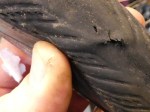
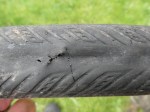
Leaving work this evening, I flatted on the rear. examination of the tyre revealed the surface had totally delaminated from the inner lining, and was shredding. Within five months.

I’ve popped Schwalbe Marathon Plus 28mm back on. The quiet and feel is heavenly. Stick with what you know, folks…