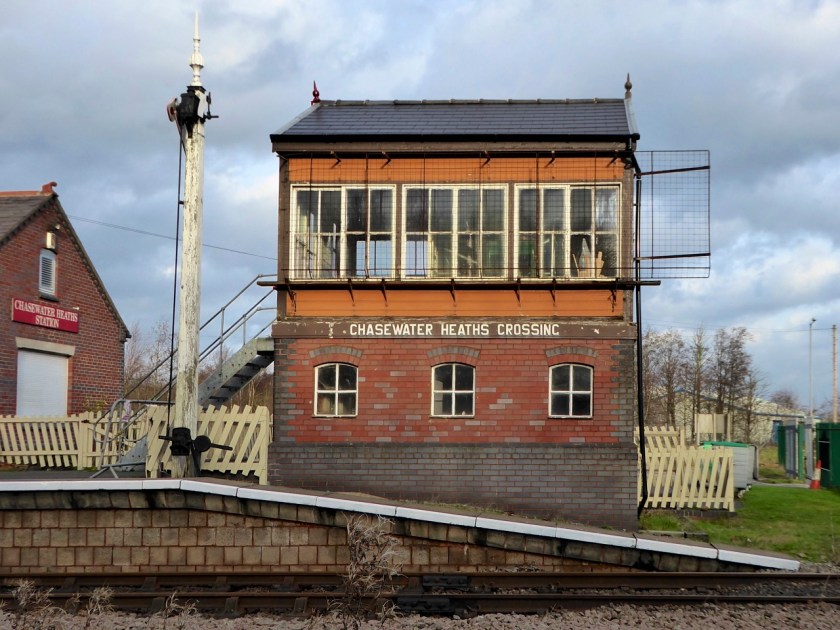
December 26th – The signal box on the preserved railway ay Chasewater Heaths is wonderfully authentic – because up until a few years ago, this signal box stood monitoring the level crossing that existed at Hademore, near Whittington in Staffordshire. 

When that line was expanded to four tracks and the signals upgraded, the level crossing was replaced with a bridge, and the box transferred to Chasewater Railway. I’ve actually spoken to the signalman at Hademore whilst waiting for the barrier out on a ride many times. It’s odd to see it here.

Never went a bundle on the colour they painted it, either; it was always white, not orange.
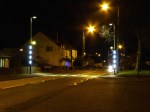
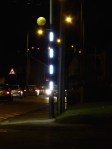
Deember 21st – I’m interested in road safety technology and lighting as many readers will have gathered, and I’m intrigued by the recent upgrade to the zebra crossing on the Lindon Road by the Clayhanger Road junction.

The conventional Belisha Beacons have been replace for two LED streetlights, shining down on the crossing and adjacent footpaths, bathing the whole area in white light. This gives a stunning effect in an area of orange sodium lights; further, the beacons themselves are bracketed off the lighting columns, which have LED lights in them and shine out the white bands on the post that would normally just be paint or reflectives.

The overall effect is remarkable, but very hard to photograph. I’m impressed.

January 16th – As much as I’m growing to loathe the results of the renovation of New Street Station in Birmingham, the process is still fascinating me. One of the things I like about it is how normal conventions of public buildings are broken. There is serious civil engineering going on at the same time as huge numbers of people and trains pass through this humming interchange..

Odd things happen.

Personnel appear from hidden doorways and gaps. There are odd noises and bangs. Occasionally, you get sprayed with water, or dust. Lifts and stairs appear, and then are boarded up again. cables dangle and tangle above the headspaces, and snake and race through the girders and scaffold.

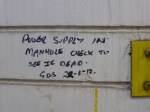
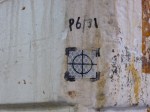
One of the things you see here you don’t elsewhere is engineering graffiti. Surveyors measure. Sparkies test. Cladders clad. All of them leave their marks and datums scribbled on walls, floors and hoardings. Sometimes, they make sense. Often, they’re just mysterious glyphs, whose purpose is only known to those with the skill. I love how they ebb and flow with the focus of the work.

Spotting them is something to do while you wait…

September 11th – A very peculiar day. I had something important to do in the morning, and was expecting to be out of action for the rest of the day. As it happened, the morning didn’t take quite the toll I expected it to and I went to work. Staying late, I came back home as darkness fell. I can’t really put my finger on it, but I’m really taking a serious dislike to the ‘new’ New Street Station. The platform access is now at the one end, and the space down there is restricted and made claustrophobic by the ever-changing hoardings. Passenger information screens are not positioned in useful points anymore, and the cramped lifts, already scuffed and grubby decor in the upper concourse all stink of compromise and bodge.

This is not a transport hub undergoing a Lepidoptera style emergence from the cocoon of renovation, but a desperate attempt to polish a turd that should have been flushed years ago. 

August 13th – Returning from Darlaston, I took to the canal. From pretty much Great Bridge to Gostote, the footpath alongside the Walsall and Wyrley and Esiington Canals is a good as any in Walsall. Well surfaced with a self-healing, stone-blown aggregate, the path is fast, smooth and fine on any tires. If only the towpaths through Pelsall or Aldridge were this good.

Which makes the plan to upgrade the ones here all the more bizarre. Can the council not do the worst ones, rather than fudge about with the best we’ve got? Has anyone who made this daft decision ever ridden a bike anywhere, let alone here?