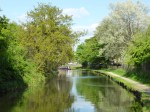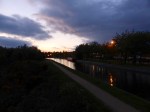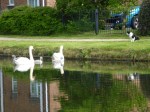
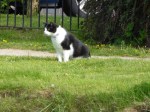
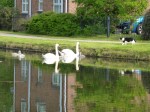
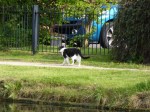
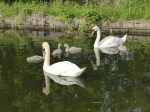
May 25th – First cygnets I’ve seen this year, I think from the swans from the new pool at Clayhanger. Four bundles of grey fluff, and a proud ma and pa at Catshill Junction. A fine, Jellicle cat with ideas above his ability. Curiosity from the swans, who’d eat puss alive if he tried anything silly. A brief, Mexican standoff, then Jellicle realises he’s been spotted, feigns disinterest, and wanders off.

A very hasty series of poor pictures, but I loved the little fellow and his lofty ambitions. I passed him later, snoozing in the hedge and dreaming the dreams of the great hunter.

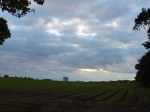
May 24th – After a spin around Stonnall and Shenstone in a rather grim wind, the sunset was nice. Sweeping past hedgerows glowing with cow parsley, bluebells and fields full of oilseed rape, the sky set it all off beautifully. A lovely end to a day of awful weather.
At Sandhills, the polythene covered field has had the plastic removed, and each sheet was nurturing four rows of seedlings beneath. I don’t know what they are, they look a bit like peas. It’ll be fun to watch and see what grows.

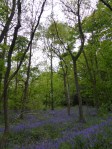
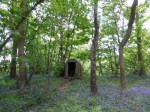
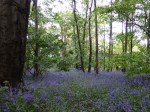
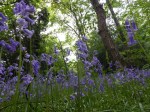
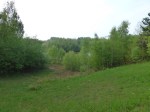
May 24th – Out early evening, and speeding towards Stonnall, I glanced to my left as I enjoyed the downhills. Fishpond Wood is gorgeous right now. After last year’s poor bluebell showing, they’re really excellent this year – and these are true British ones, not the Spanish impostors. The light was awful, but the atmosphere great.

I asked a mate about the tin shack. He said it used to house a pump, and he thought it was something to do with the quarry once. Never noticed it before.

These woods are private property and I was trespassing, so don’t do it, kids.

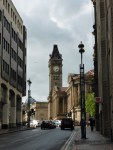
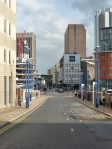
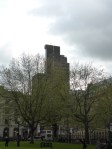
May 23rd – Birmingham continues to fascinate. Finding myself at a loose end for 30 minutes, I took a spin around the city before diving into my favourite cafe to avoid the rain. Birmingham has some brilliant architecture, both old and new, and is sadly under appreciated. Thankfully, Bicktnell, Hamilton & Healey’s New Street Signal Box is listed, and a great example of the Brutalist style, designed as it is to resemble an electrical component. We all know the Council House, but how many ever notice Big Brum, it’s clock tower? The cathedral of St. Philip remains an elegant tour-de-force, complete with cupola and clock, and the remarkable – and derelict – Natwest Tower remains visible, despite the attempts of the trees to hide it. 

This is a great city, and I love it so.

May 22nd – I was heading home today from work, and for some reason I hopped on the canal near Anchor Bridge, and headed up and took a look at Clayhanger Common. The sun was bright after a somewhat dull day, and I guess it was my quest for green. Everything is so vivid at the moment you could almost inhale it. Everywhere you look, there is bright, fresh foliage, in shades of emerald more precious and life-affirming than any jewel.

One thing I did notice on my way over Catshill Bridge, is the clock tower added to the roof of a garage in Chandler’s Keep. Has that always been there, or is it new? I’ve never noticed it before.

May 21st – An odd day, I was at home until lunchtime, then had to nip out for a meeting. I returned late, and took a spin out along the canal to Chasewaer, and back to Brownhills over the common. The sunset and light were lovely tonight, but not golden. Everything had a soft pink tone, which was rather soft and charming. It looked best over water, whether it was the canal or Chasewater. A splendid evening after a hectic, stressful day.

May 20th – On my way home tonight, I hopped onto the canal towpath to enjoy the pleasant evening and see if we had any cygnets yet. Sadly, the swans still seem to be sitting, but I did notice how green and lovely the new pond was looking at Clayhanger. It was wearing it’s summer jacket gloriously well.

This site used to be a spoil heap from Walsall Wood Colliery, consisting mainly of grey clay, coal washings, slack and assorted rock detritus. In the early 1980s, it was excavated and used to cap the former refuse tip on the other side of Clayhanger Lane. The void left behind was landscaped, and lined with red marl and sand. It’s very hard to see any hint of the industrial  history at all.

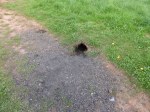
Today, that grubby history was evidenced near the canal bank. At the top of the slope, a digging animal – most likely a fox – has started to burrow, and abandoned the hole after a short dig. Just a few inches below the red clay surface, a whole spread of coal tailings has been brought out. 

Must have been a hard dig, that. History makes itself evident in the oddest of ways, sometimes.

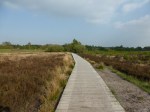
May 19th – Up on the north heath at Chasewater, something rather great has been happening. From the existing path that runs over the hill from Norton Lakeside halt to Chasewater Heaths, there’s a new one been laid towards the lake. Well finished, it bends to the east, crosses a couple of really nice boardwalks and crosses Fly Creek, whereupon it meets the eastern path from behind the Rugby Club. A lot of work must have gone into it, and it opens up the north eastern heath to walkers beautifully. 

For those interested, this is what Brownhills Common should look like: a mixture of heath grassland, deciduous copse and heathers. Not a conifer in sight and the deer absolutely love it, as do the resident maintenance crew, the cows. It varies from being wide open, to dense native woodland, and it’s teeming with life – flora, amphibian, insect, mammal and avian. It’s all here, and a fine work of conservation it is.

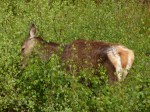
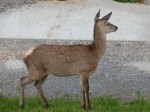
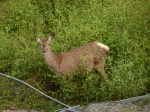
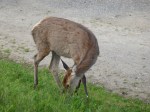
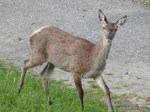
May 19th – A busy day at Chasewater. Linda Mason had posted some pictures of deer on the dam that morning, and I was surprised when I passed by late afternoon that they were still tree. Not at all nervous of their occasional audience, they browsed the scrub, nibbling the shoots off the birch saplings and generally got on with things. 

If anyone had told me 20 years ago there would be red deer here, and they’d be this fearless I’d never have believed them. Beautiful.

May 18th – I’m hoping a linesman or electrical engineer can help me with this one, I’ve never noticed it before.

Approaching Anglesey Basin on the canal at Chasewater, electricity is supplied to the dam cottages by single phase overhead lines. one of the last poles in the run has an anchor cable staked to the ground to stop the change in cable angle pulling it over. The anchor cable, bolted to the top of the pole, isn’t electrically connected to any part of the system, yet has a two to three foot long insulating piece fitted, with a pair of lightning bypass probes to create a safety arc gap. 

Why would they do that? Is is a current limiter to stop lightning melting the anchor or what? Never seen an arrangement like this before.