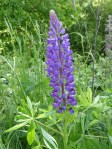
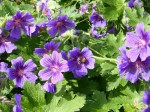
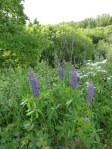
June 17th – I love lupins. These tall flowers grow wild along the canal towpaths and scrubs of Black Country canals, and set the cuts ablaze with purples, lilacs and pinks at this time of year. I don’t suppose they’re a native species, I suspect more of a  formerly cultivated feral fancy from gardens. But they seem to thrive untended on the rough embankments and thickets alongside out waterways.

When I see lupins, I know it’s summer at last.

June 17th – At Spring Road station in Birmingham, I overheard to travellers discussing the white plates visible on the the edge of the opposite platform, down beside the track. They often baffle station users, and their usage is a bit obscure, really.

These are merely a datum survey marker for when the rails are replaced and the track relayed, which happens more often than one would imagine. Before the old track is moved, a surveyor uses a laser level or theodolite to measure the exact position of the rails, and their tilt angle if they have one. The rail height – plus any required offset – is set on the sliding knob, and is used as a datum for relaying new lines.

The legend proclaims this plate no 3; it’s 1105mm to the nearest rail, on the Up Main (UM) line. The cant (or tilt between the two rails to enable safer dynamic cornering of rolling stock) is 2mm.

The (just visible) +474 above the slider indicates that the level set is 474mm above the desired rail height (vertical offset) and a green knob says this is the level the rail should be at as it was designed, and may not currently be at that level. A red knob indicates the actual track position when the plate was installed.

Geometry like this is essential to rail engineers, who obsess over it. Maintaining correct geometry is of prime concern, prevents accidents and ensures trains fit under bridges, alongside platforms and don’t foul each other on bends.

You can often see these marker plates fixed to line side structures or electricity and signal masts.

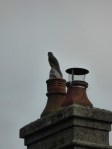
June 16th – Not sure what the deal is here, to be honest. At Peggs Row, just on the corner of Coulter Lane and Farewell Lane in Burntwood, there’s a lovely cottage with a quite ornate chimney. I’ve noticed recently – after being taken in by it – that there’s a decoy bird of prey on the chimney pot, which looks like a peregrine. I’m not sure if it’s ornamental, or serves a purpose; I was fooled by the silhouette enough a couple of weeks ago to actually go for my camera, before realising the model raptor wasn’t real. 

Nice to see it’s fixed down well. Can anyone shed any light on this?

June 16th – A ride out to Cannock Chase in the afternoon. The weather was way better than forecast, with little wind and plenty of sun, although there was very light rain at one point. I tore around the Chase, loving having the forest apparently to myself, then hit the canal at Little Haywood and headed to Rugeley. From canal side gardens to boater cats lazing in the sun, it was truly beautiful. A peaceful, green, gorgeous sanctuary from traffic and speed. Lovely.

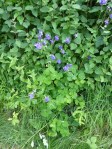
June 15th – Returning from the Canal Festival at Pelsall, I stopped in the sunshine to check out the canal side wild flowers. I’m interested in them all – the only one I recognise being Bullrush. I’m particularly interested in the blueish one bottom left. Think it might be an escaped ornamental. There’s certainly plenty in bloom right now, and it’s all wonderful.

June 15th – Yesterday, a local tweeter spotted something amusing outside our local newsagents in Brownhills. I posted it on my main blog. Passing this afternoon, I took stock myself. The original was still there, as well as these other three. Only one is spelled correctly. It’s been claimed that this is a joke. Is it? Marketing ploy? Not working for me. 

I have no idea what’s going on here at all. It takes all sorts, I suppose…

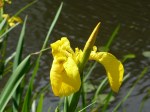
June 14th – The roadside verges and hedgerows are an unusually rich delight at the moment. With the late spring and damp weather, they’re really lush and green right now, with beautiful wildflowers peppered through them. I can’t name the flowers here but both exist in abundance along the A461 Lichfield Road at Sandhills. If you can, take an hour or two out this weekend to go exploring the country lanes around here, which are a delight right now. It’s not until you study them closely, you realise the wild and enchanting beauty they contain.

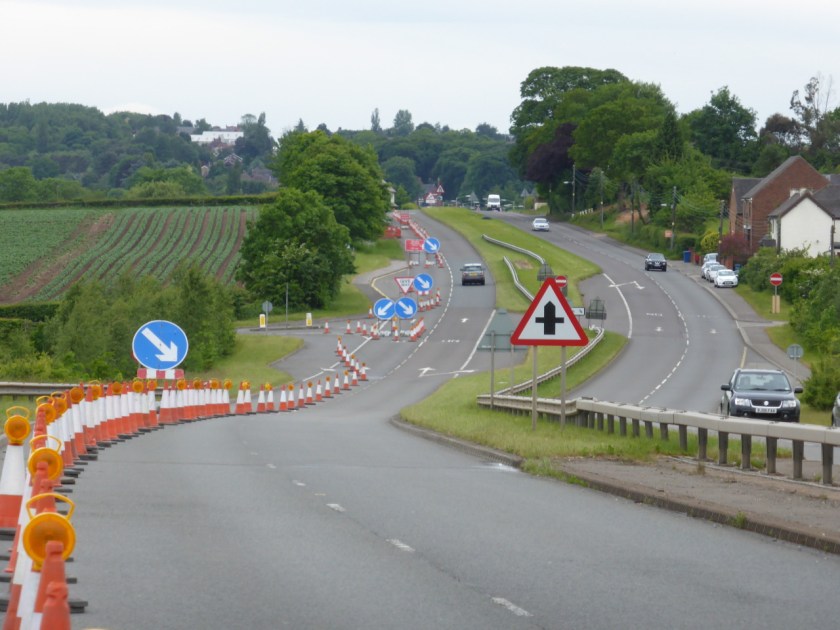
June 14th – Headed out to Lichfield late afternoon, and battled the wind, fully loaded, on the way back. Returning down the Lichfield Road, I noticed the cones were out at Springhill for the construction of a new island junction for Springhill Cemetery, currently under construction to the right of the picture beyond the houses.

This has been delayed quite some time now, and has been locally controversial. it’ll be interesting to see how the development progresses.

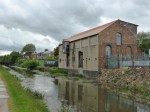
June 13th – I took a diversion from my usual route to Darlaston and hopped on the canal, which was lovely, despite the wet weather. As I passed by the old mill at Pleck, I noticed that an old bike was still taunting me from the open side of the goods hoist. There used to be two in there, but one has disappeared. It still looks like an old steed – note the sprung saddle – but it seems to be fitted with triple derailleur gears. It might be a bit of a mongrel, as although the wheels look chunky, the frame looks quite dainty. Whatever it is, it’s such a shame to see it trapped there in the tower, like some velocipedian Rapunzel.