#365daysofbiking Picture this

September 20th – An old favourite but a new camera, well sort of: The new iPhone is being touted as having the ‘best camera in any smartphone yet’ and having a new one, I’m interested to try it.

Over the years, as the technology improved, more of this journal is phone images – either by convenience, of because the phone was immediately to hand. But they’re no substitute for a decent camera – the physical limitations of a phone camera are just too great.

There’s no doubt that the pictures this device takes are excellent. But the seem a little harsh – since the physical mechanical constraints of a small camera in a thin unit are so great, the real art of this thing is in software. It’s goo, but I think needs softening a little.

It’s still absolutely remarkable though, have to say.

This journal is moving home. Find out more by clicking here.

from Tumblr https://ift.tt/2nOwNO6
via IFTTT

#365daysofbiking Radio activity and G force

June 20th – Another dusk departure from work gave me chance to take some pictures of networking equipment causing some bizarre consternation locally at the moment.

A handful of local residents have spent some time in the dafter enclaves of social media and decided these white boxes and antenna on lamp columns, traffic signals and street furniture in Walsall are the rollout equipment for the fifth-generation telecoms network.

For some reason conspiracy theorists are given to believe the fifth generation network will be harmful to health, is a plot to test radiation on the population and an effort to spy on us all. Oh, and it’s somehow all connected with low energy LED street lighting.

Well, these boxes and aerials are far more mundane: They are actually pretty much high speed WiFi like we have in our homes, but designed as a specific, peer to peer network for traffic signals and other on-street infrastructure that benefits from central control.

It’s called Mesh4G and you can see it here.

As signals, junctions, crossings, air monitoring and traffic cameras are updated across Walsall, more of these relay units will appear, allowing traffic folk to monitor, modify and control their equipment without having to leave the office.

Which is interesting to me as a geek, but far more mundane than conspiracies would have us believe.

And I’ll still be waiting ages at the Bull Stake junction in Darlaston…

This journal is moving home. Find out more by clicking here.

from Tumblr http://bit.ly/2WVgf31
via IFTTT

May 21st – There’s a crucial bit of biking equipment I couldn’t live without – clipless pedals. Pedalling long distances on flat pedals is horrid, and your feet can slip in traffic. The old fashioned alternative was toe clips and straps, which were OK, but nasty if you had to get free quickly. In the 1980s, as a solution, Shimano developed the SPD clipless system.

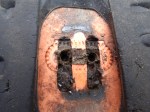
I have sevral pairs of SPD compatible shoes, which have screw mountings on the sole under the ball of the foot. There is a metal plate embedded above which floats for adjustment. On to the plate is screwed a ‘cleat’ – a metal key block that engages smoothly with a spring-latched mechanism in the pedal. This provides a positive, hassle-free engagement which is predictable, adjustable and secure, yet twists free instantly when required. They ensure your feet are always in the best, comfiest position, and the pedals are double-sided, so you never have to think about clipping in. You just do it without looking.

Clipless allow you to ‘pull up’ with one foot while pushing down with the other, and even pedal one-legged while scooting through traffic. This small, drop-forged block of steel – about half the size and thickness of a small box of matches – transmits all your pedalling force in an absolutely tiny contact area, yet fits flush in your shoes in such a way that you can walk all day in a pair of SPD shoes and never feel the cleat.

The intense concentration of force in one small component and two 5mm screws is so great that it wears quite quickly. Tonight, my cleats had developed such a sloppy fit, I couldn’t put up with them anymore. After 5,000 miles, it was time for a change.

It’s easy to do; cleats come with pedals, or can be brought separately. You usually have to drill out one or two of the old screws due to the heads being fouled, but once you get them out, the cleat leaves an impression in the shoe that the new one locates in. A blob of grease on the screw threads, and crank them up. 

The fit is so good, it’s like riding a new bike.

My compliments to the inventors – these really are a great invention.

January 8th – This is a bit of cycle geekery. I have accumulated over the years some new cyclocross tyres. They’re cross country tyres for road-style bikes. They’re ideal for winter conditions, but tend to puncture easily; being designed for competition, they have great tread but are designed for lightness. Since my beloved Schwalbe Marathon Plus are wearing thin, I thought I’d try out the spares. Instead of putting up with the pictures, I’m going to try this Panaracer ‘Flat Away’ tyre liner, and see if it makes them a bit more of an attractive option.

The tape is soft fabric on a kevlar skin, which is lightly self-adhesive. You just stick it around the inside of the tyre before fitting, and it is purported to stop thorns and other nasties cutting through to the tube. 

I’ll admit, I’m sceptical, but it’s hedge flailing season, and I’ll give it a go and see – after all, this stuff is a third of the price of a new tyre and will help me use up some of the perfectly serviceable spares I’ve got hanging around.

Flat Away comes in 26, 700c and 29 versions. Because cross tyres are fatter than 700c, I’ve gone for that for maximum width of coverage. 

I shall report back on the experiment. I may live to regret this…

October 25th – Although it was lightly raining, it was warm, and with the wind behind me I took the back way back to Brownhills, down the Lichfield Road and up over Springhill at Barracks Lane. 

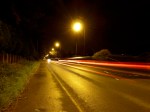
I had a play with long exposure shots at Sandhills, and was quite pleased with the result, but puzzled too, when I looked at the images on the computer. In both, a wavy, oscillating thin trace of light is present above the main vehicle trails, which are very straight. I thought about these thin, curling traces for almost an hour, then I worked them out. 

They’re the light trail created by the reflection of street lights off the car windscreen, hence the curve and double back as the car enters the dominance of another lighting column. It’s quite mathematical, and I think it could be modelled with fairly basic locus mathematics.

I could be wrong, though…

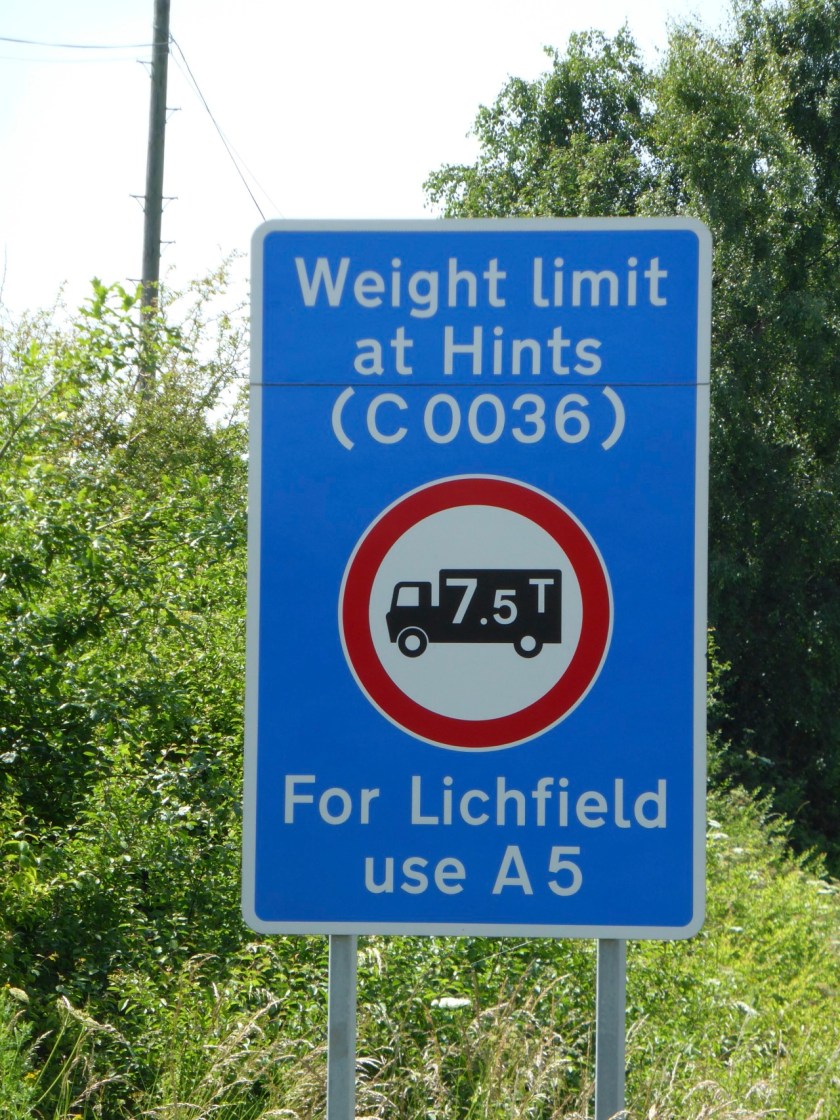
July 7th – Oh my goodness, this is geeky. But it appeals to my sense of the absurd. This road sign on the ‘old’ A5 near Mile Oak isn’t unique, but it’s certainly rather unusual. What makes it so is not the restriction and advice it gives, but the accidental inclusion of the road number C0036. Just about every road in the UK has a number to the Ministry of Transport (or whatever it’s called these days) and to the local authority, but in theory, only the familiar A and B class roads are allowed to be marked on signage.

There are, actually, five classes of road – A through D, in order of major to minor, and U, meaning unclassified, even though they actually are. Maps for public consumption only use A&B, and the remaining numbers are intended for administrative use only, but occasionally, in cases such as this, due to CAD or administrative errors, a C or D number will creep on to a sign.

This one has been in place since the bypass was built, a good few years ago now, and always raises a wry smile.