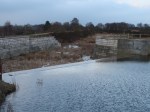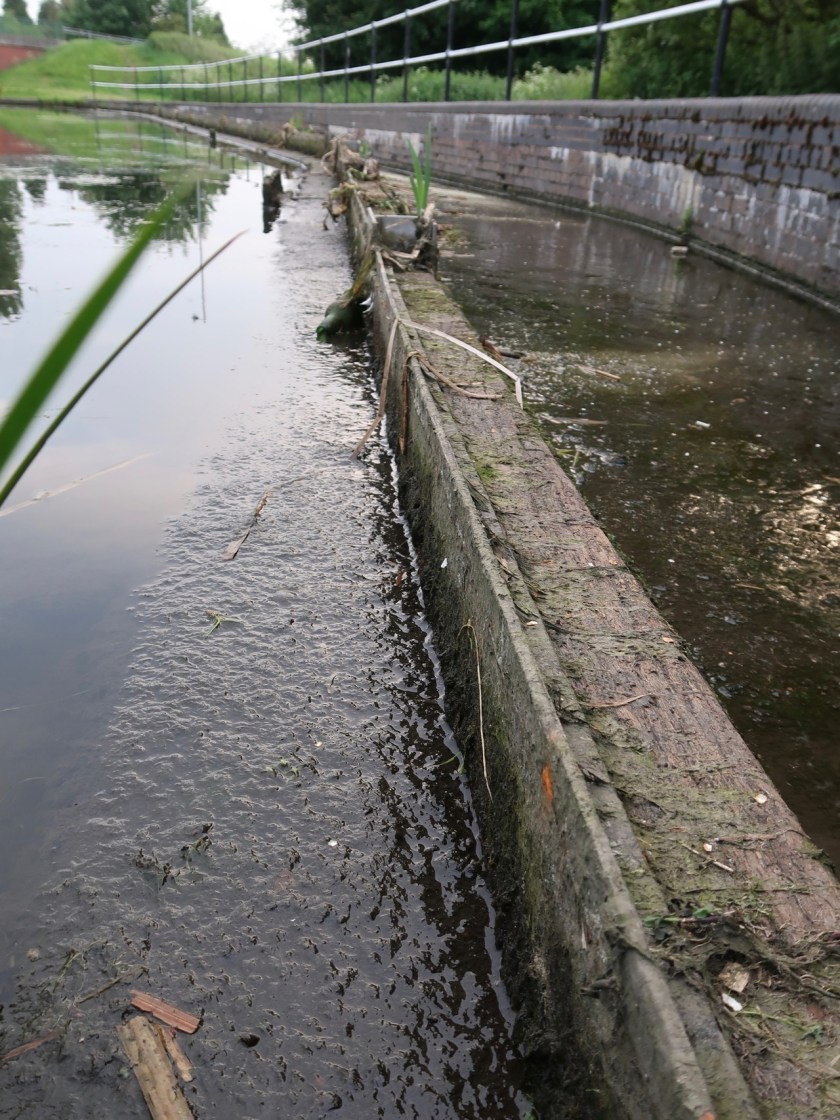
May 31st – My attention had been drawn to comments online that the canal water level had dropped significantly in the last couple of days, so I investigated – measuring from the weir bar to the current level was 123mm. Nearly five inches of water lost since Sunday when the canal was in heavy overflow.

Considering the length of this canal, this is a huge amount of water gone.

Subsequent enquiries with the Canal and River Trust suggest that they were unaware the valves had been turned off at Chasewater by Staffordshire County Council (see here) but I’m unconvinced the water would drop so fast considering the conditions.

I’m wondering if a downstream lock sluice was accidentally left open, perhaps.

It is said the situation is being rectified by pumping water in from Bradley, so it’ll be one to keep an eye on I think. A mystery.
May 19th – A bad stomach day, and a ride out late that was surprisingly good: A 40 miler up over Chasewater, Longdon, the Ridwares and Yoxall, returning through Lichfield and Weeford to home.

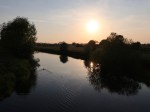
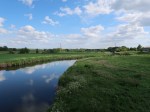
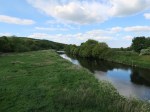
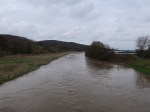
It was a glorious afternoon, the star of which was the languid, limpid River Trent.

I note that at Home Farm, Sandhills, my favourite horse chestnut tree is in bloom – such a lovely sight.

May 13th – I was still feeling groggy but it was a lovely day and the outdoors beckoned, so I headed tentatively for a ride, not expecting to get far.

It was a lovely 52 mile ride, actually, fluid and enjoyable, but sadly dogged with mechanical issues. Time to break out the spanners and do a little maintenance I think.

I headed out to Hints through the backlanes of Stonnall and Shenstone, then on to Hopwas, Wigginton, No Mans Heath, Netherseal, Overseal, Coton in the Elms, Catton and back home through Huddlesford and Lichfield.

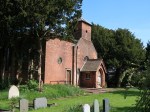
I haven’t visited the church at Wigginton for a very long time – it’s a remarkable place: Foursquare, built of very red, red brick. The main church dates from 1777 but the Spital Chapel dates from 1272. This is a very historic place.

The flowers are out, hedgerows are verdant and the landscape a patchwork of gold, white and green.

Hard to think that just a few weeks ago the Tame in the same spot was filling the flood channel.

David Oakley will be pleased to see Chilcote Pumping Station remains pretty much unchanged as viewed from Honey Hill. I adore that view.

A great ride that was much better than expected.

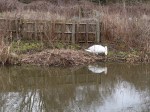
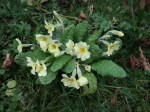
April 1st – A ride out to Hints and Hopwas for cake on a warm, but generally overcast but thankfully dry afternoon, that was much better than expected. Spring inches on in the reluctant winter gloom, with primroses showing well in Hopes Cemetery where the daffodils were also gorgeous, and a swan couple nesting near the social club up in the village. 

The Tame at Hopwas was flowing well, and spreading into the flood margins. People downstream at Elford will be worried. Let’s hope the rain holds off.

An unexpectedly good ride.

March 25th – Lee Marston settling lakes continue to fascinate me. Created from old gravel pits in the early 80s, they are now more or less redundant as heavy industry is no longer polluting the Tame in Birmingham, and Minworth sewage works is a lot cleaner than it was; the dredging of the settled out toxic silt has now stopped and the site is becoming a haven for wildlife. 

It really is quite beautiful.

It’s still a live river, though, and where the weir carries the water downhill a notch, the plastic bottles and detritus still circle in the vortex here, a sign of our huge problem with plastic waste.

March 16th – I had to nip up to Burntwood after an early return from work, and I took a muddy, wet canal towpath up to Chasewater.

My favourite tree at Home Farm, Sandhills seems to be getting into a spring jacket ever so slightly, and the greens were just a bit brighter than a week ago.

Ogley Junction bridge is now finished, and it looks great. The metalwork and bridge deck have been superbly refurbished, but it’s sad the brickwork didn’t get any love. Maybe that’ll be a separate job. 

At Chasewater, I was surprised to see the reservoir overflowing. It’s normally allowed to fill and overflow at this time of year, but the valves are still closed and the spillway is flowing with water. In light of the dispute ongoing between Staffordshire County Council, the owners of Chasewater and the Canal and River Trust who use the water it contains, it’ll be interesting to see how long the lake continues to overflow.

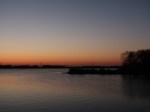
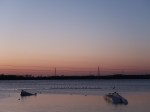
February 25th – I raced back to Chasewater to catch the sunset as I had planned to do they day before, and although inevitably the sunset was not as dramatic, it was very beautiful and calm, but my hands were frozen. It really was very cold indeed.

I noted while there that Chasewater is now about 150mm from full, as it usually is at this time of year. It will be interesting to see what happens this year – if the reservoir is allowed to continually overtop or if the dispute with the Canal and River Trust is resolved and the water is released into the canal.

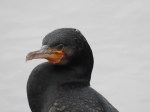
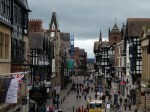
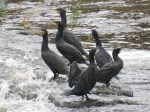
October 13th – Chester is always a delight from the cormorants loafing on the Dee like old men on a park bench to the chimneys and remarkably diverse architectural threads, and in autumn, it’s amplified, particularly on a day with such dramatic skies.

I love the central shopping area with the ‘rows’ – upper tier walkways, bridges and balconies that weave and dodge, reminding you of Pratchet’s Ankh Morpork.

A great afternoon.

October 6th – For reasons too complicated to go into here, my moaning about the daily routine and the greyness of life and the weather were heeded by fate and I found myself visiting Matlock and Matlock Bath in the afternoon on a work related trip. Having to leave a vehicle behind, I’d taken my bike and had a ride down the A6.

Matlock is a nice enough town, with some great architecture, but could do with a little more variety in the shops. But I have to say on the whole it’s a classic Derbyshire river-valley town; beautiful, unpretentious and charming.

Further south, at Matlock Bath, things were a shade more grim. Matlock Bath seems to have been in steady decline since I first visited the place in the 1980s. A tourist stop off and motorcyclist haunt, this odd little town clings to the Derwent gorge with an air of faded, seedy seaside glamour. There must be eight or more chip shops; several sweet shops selling exactly the same stuff, and more than a handful of jaded amusement arcades and pubs. 

The architecture and riverside are beautiful; but there are many closed shops and it’s hard to escape the feeling of something passed from life, if not exactly to death, then to some sort of ghost existence.

But then again, it’s possible that Matlock Bath has been like this ever since it’s heyday in the Victorian years. The place reminded me of one of those lost seaside resorts that were once locally popular but now are only half remembered, like Rhyl or Withernsea. 

Perhaps it was the season and the weather, but the sadness of this place was almost enjoyable. 

Perhaps on a sunny, summer day it acquaints itself better.

May 19th – Much of the journey was an errand in Digbeth. I visited the Custard Factory, the hipster area that once promised so much, but these days seems to be a sort of holding area for a failed urban arts dream; but beyond it I found the River Rea, skulking through Digbeth like a dirty secret. 

Also in the backstreets, the bizarre, never finished abandoned Duddeston Railway Viaduct, partially built by the Great Western Railway to gain access to Birmingham New Street, but abandoned half-built when they built their own station at Snow Hill instead, now standing as a sort of infrastructure curiosity, barely noticed by most people who visit.

Returning through Aston and Gravelly Hill, I passed from Salford Park to Aston itself, along the cycleway by the Tame, snaking under the motorway and Cross City Line viaducts. The 1960s motorway revolution heard you liked viaducts, so they put another viaduct over the one you already had.

Birmingham is about it’s arteries: river, canal, rail and road. They both bisect the city, and give it character and history, and I love them all.