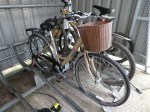
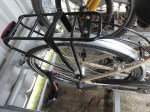
March 15th – With the good weather comes the rash of new bike commuters. Spotted in the shed at Telford, this curious, new looking steed: a Dawes Haarlem commuter bike. Aimed at the female market, huge front basket, step through frame, chain guard, carrier and three speed Sturmey Archer hub gears. It weighs quite a bit, and the frame welds are hideous. Also surprised at the rim brakes rather than disc or hub roller ones.

The outward curve of the carrier stays bothers me: stop sharp with a heavy load on and they’re pre-shaped to bend unpleasantly.

An odd bike, but someone loves it.

January 29th – for the first time in some years, I paid a visit to the railway museum at Chasewater, which was as pleasingly eccentric as ever. This free attraction, run by award-winning volunteers is a little gem, and contains much to enthralling and entertain even if you aren’t a railway buff.

Some of the most interesting stuff though, isn’t in the museum but outside it. That’s certainly nearly a case of the cart before the horse, and that odd little railcar.

That panda looks a bit delinquent to me.

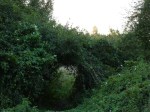
October 7th – I’m fascinated by the way the scrub on Clayhanger Common has formed into a tunnel over the footpath behind the overflow at Clayhanger Bridge. This footpath is used enough to be fairly well worn, and the creepers, brambles and scrub have turned the track into a foliage arch which is quite charming and could, for all the world, be a portal to some kind of wonderful netherworld.

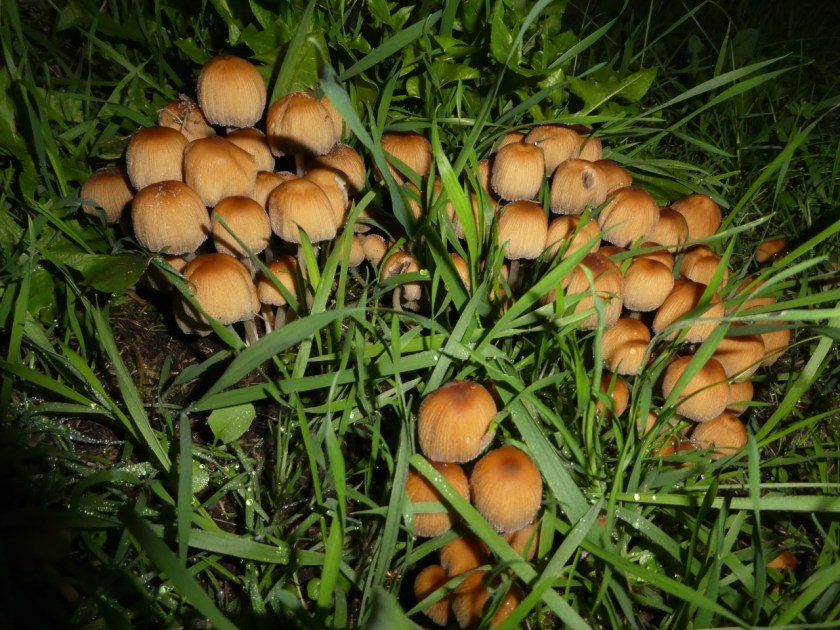
October 3rd – I had somewhere to call on the way back, and returned in darkness, but I couldn’t resist checking up the little forest of glistening ink caps on the edge of Clayhanger Common. 

Grown well, these curious toadstools have peaked now and will soon decay to mush.

I have no idea what triggers these busy, short-lived clumps but they’re fascinating to study.

March 24th – Passing through Wednesbury, I noticed this bank of daffodils by an industrial estate verge. Now that’s a fine thing and I was very happy to see them, then I noticed that amongst the standard yellow variety, there was white too.

I wonder if that was a happy accident or a genetic mutation? Whatever the cause, a delight to the soul for sure.

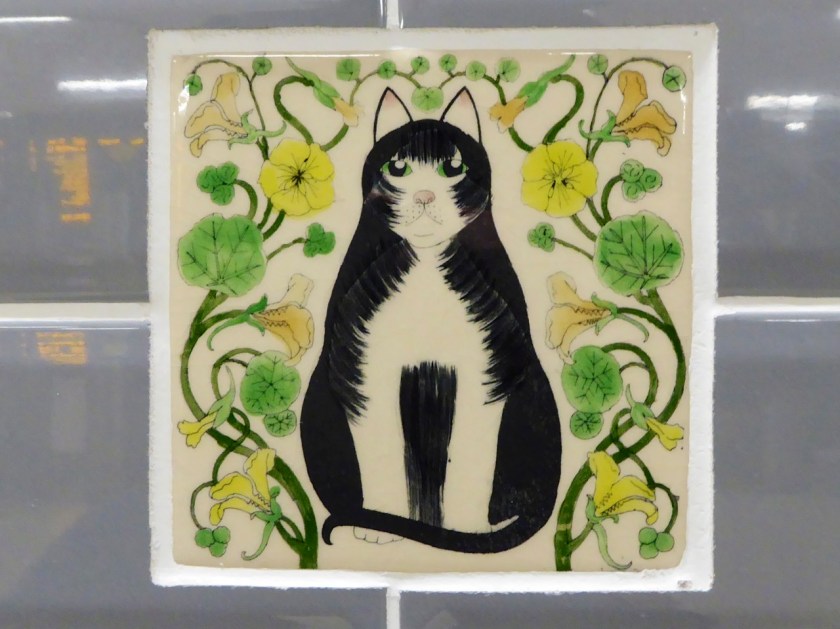
October 14th – I passed through Snow Hill Station early in the day on an errand before work. I hadn’t been there for ages, and scooting my bike across the access bridge, I was shocked to note the concourse had been retiled. I anxiously checked to see if the odd cat tile was still in place: I was relieved to see it was.

I have no idea why this hand-painted puss is here, but it’s clearly old, possibly rescued from the original station. Attempts to find out what it represents or commemorates failed.

I’m fascinated by this ceramic depiction of a cat. There’s a story here, if only I can find it. 

A lovely thing; so glad it endures.

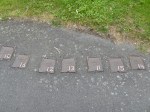
June 18th – A little curio I’ve been passing for years in Leicester. A higeldy-pigeldy row of water stopcocks in a pavement, numbered from 3 to 16. One is unnumbered.

They start in an orderly fashion, then the seuence falls to pieces.

They are labelled in weld – that is, someone drew the numbers using a welder, so the digits stand proud, like metallic icing on a cake. Over years and years, people walking over them have polished the digits to a shine.

But what became of 1 and 2?

March 19th – A hurried, poor snap as I was passing – but what a curious bike. Parked up in Station Street, Walsall, a wee Apollo folder, with a nice rack box, bulb reed horn, lights … and a tea flask. Interesting approach to locking, and what’s the luggage elastic for?

A clearly well used, but unusual workhorse. An odd thing for Walsall.

November 12th – It was on my return that afternoon that I spotted a relic of times past, fitted high up on the gable wall of a house on the Walsall Road in Darlaston. It’s an Ionica antenna. You don’t see many of those about now.

Ionica were a pre-internet age telephone company that promised much, yet failed in the dot com boom. Launched in the early nineties, they offered cheap telephone line packages. What was unique was that the technology they offered was based on microwave transmission, rather than the copper wires BT used. If you signed up, engineers came out and installed one of these octagonal 3.5GHz microwave antennas, which pointed at a base station in the locality. The idea was fine, but never covered it’s costs, and as they were narrowband, would have been useless for the internet connections that were to come later. The company value was inflated to over a billion pounds in 1997, but collapsed in 1998. The network was wound down by BT, and only a few remnants like this antenna survive.

Like the Rabbit zone phone, a curious idea in a time of great change.